
Aug 19, 2026
IGW researchers present Climate Collaboratorium research at the Global Institute of Water Security, Saskatoon (Canada)
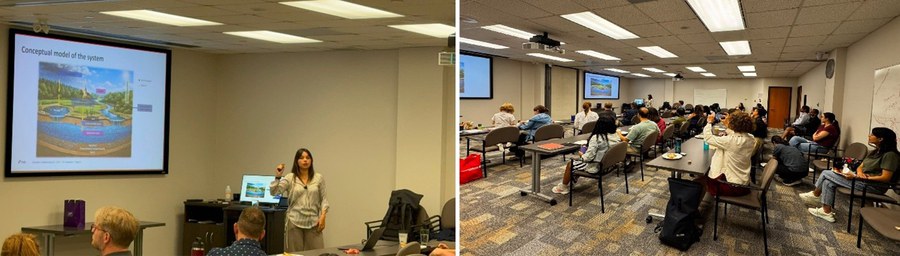
During a visit to the University of Saskatchewan’s partner institution in Canada, researchers from the Institute for Groundwater Management (TU Dresden) presented their work as part of the multilateral Climate Collaboratorium project at the Global Institute for Water Security in Saskatoon. The presentation, titled “Where Narratives, Groundwater, and Drama Intersect,” explained the motivation behind the project and the challenges related to future water availability in the municipality of Rietschen in Saxony, Germany.
The presentation highlighted the project’s interdisciplinary approach, which combines groundwater modeling, climate projections, and social science perspectives to explore desirable futures for groundwater resources in the Sorbian community of Rietschen. The researchers presented the hydrogeological characterization of the study area and the conceptual and numerical groundwater models, and discussed how climate change and water management decisions may affect groundwater availability. A central focus was also placed on stakeholder narratives and storylines, demonstrating how perspectives on engineering, political will, justice, and local heritage can reveal both synergies with and blind spots in the groundwater model. These insights will support future scenario development, including narrative-led dialogue and drama-based formats for co-designing locally meaningful climate adaptation pathways.
The presentation was part of an extended research visit by Ms. Tania Stefania Agudelo Mendieta (TUD), Prof. Dr. Sina Leipold (UFZ), and Prof. Dr. Andreas Hartmann (TUD) as part of the Climate Collaboratorium, a multilateral project led by Professor Lori Bradford and Professor Graham Stickler at the University of Saskatchewan and coordinated by Renata Mont’Alverne. During the visit, the researchers had the opportunity to meet colleagues involved in the Canadian side of the project, exchange experiences on interdisciplinary research approaches, and strengthen the collaboration between the partner institutions. Ms. Agudelo Mendieta’s visit was partially supported by the Zunker Busch Luckner Foundation.
The exchange in Saskatoon demonstrated how the Rietschen case can contribute to the broader Climate Collaboratorium by integrating groundwater modeling, stakeholder narratives, and applied theater approaches. The findings presented will inform the next steps of the project, including the co-development of water management scenarios and Decision Labs that support local communities in exploring realistic, feasible, and socially meaningful options for climate adaptation and water security.