
virTUro
TU Dresden Student Learning and Teaching Project

What is virTUro?
virTUro is a teaching and learning project developed at the Chair of Rail Vehicles, aimed at students of rail vehicle engineering as well as other interested students in technical fields. The goal of the project is to design and model a complete virtual rail vehicle, which can then be explored and experienced in virtual reality (VR).
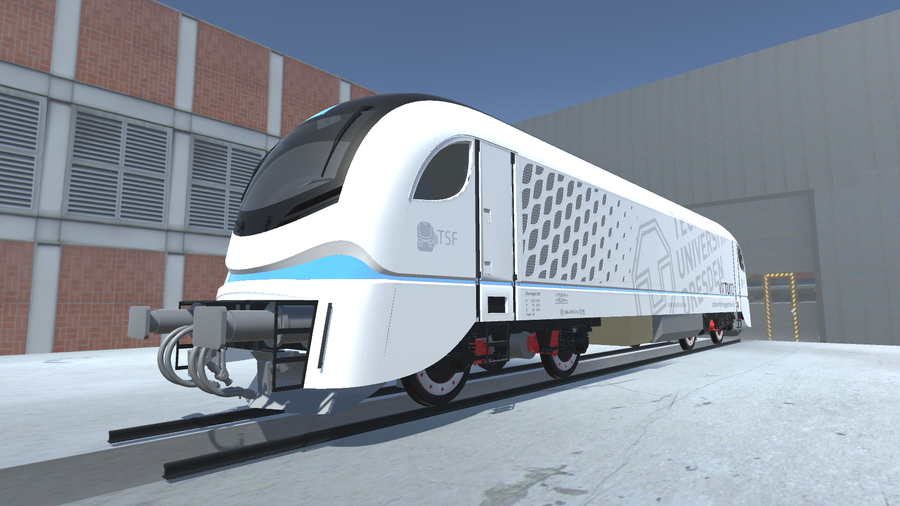
The exterior shell of the vehicle was pre-defined in a student project. It serves as the “framework” for the design, modeling, and construction of the typical assemblies of a rail vehicle. Although the vehicle is conceived as a diesel railcar, the development of variants with electric, hybrid, or dual-mode drives is both conceivable and encouraged.
In virTUro, students have the opportunity to apply and deepen the knowledge and skills acquired in lectures and exercises. They can largely choose the focus areas of their work and receive support from the staff of the chair during their projects.
Participation in virTUro is optional and requires self-initiative and the ability to organize one’s own work. It is not an additional conventional course, but a project that thrives on the active involvement of all participants. The progress of the project so far can be followed on our Project blog.
Since the winter semester 2019/20, the project has been included in the catalog of Interdisciplinary Technical Qualifications by the Faculty of Mechanical Engineering. This means that, in principle, students of the Faculty of Mechanical Engineering have the opportunity to earn credit points through participation in virTUro.

What does virTUro offer and who can participate?
The virTUro project provides an opportunity for students to work on complex, interdisciplinary tasks across semesters in the areas of design, engineering, dimensioning, CAD modeling, calculation, simulation, and virtualization.
For students, this offers the chance to apply, consolidate, and deepen the knowledge and skills acquired during their undergraduate and advanced studies in concrete, practical tasks. A dedicated workspace equipped with computers and a whiteboard is available for the project work. As is common in professional practice, the focus is on teamwork in interdisciplinary groups, allowing students to meet peers from other years and fields of study and benefit from their knowledge and experience.
Participation in the project enables students to gain (initial) experience in project management, group work processes, and, where applicable, working with specialized software. Periodically, workshops and lectures tailored to the needs of the project are offered by experts to deepen or expand the skills acquired in regular courses. In addition, excursions to new-build and maintenance facilities in the rail industry are organized, primarily for virTUro participants.
There is always plenty to do in virTUro, and many interesting topics can be derived for student theses. If you are looking for a thesis topic, it is usually possible to develop a project together that aligns closely with your interests and preferences. Since June 2019, the Chair has maintained a small VR laboratory, allowing students to view their work results—especially CAD models and designs—realistically in a virtual reality scenario.
In principle, virTUro is open to all students interested in rail vehicle technology. In particular, the project is aimed at students from the following fields of study:
-
Mechanical Engineering with a specialization in Rail Vehicle Technology
-
Mechanical Engineering with a specialization in Technical Design
-
Mechatronics with a focus on Vehicle Technology and E-Mobility
-
Transportation Engineering
-
Master’s Program in Railway Systems Engineering
-
Master’s Program in E-Mobility
-
Computer Science (especially Media Informatics)
What topics have been and are being addressed in the project?
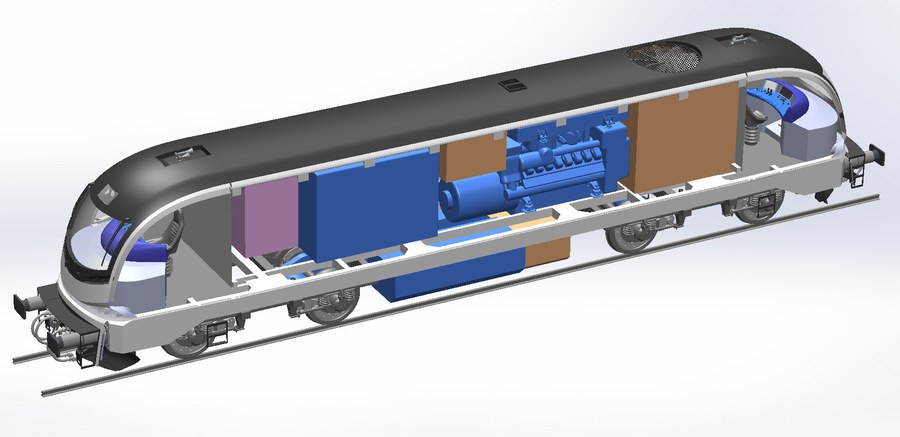
The construction of a virtual locomotive is highly complex and time-consuming. In the current project phase, the aim is to gradually replace placeholders for complex assemblies (see figure above) with realistic CAD models. The assemblies that still need to be modeled or designed include, among others:
-
The cooling system
-
The fuel system, including fuel tanks
-
The compressed air system, including the brake pneumatics
-
The traction power supply (generator and power electronics)
In addition, there is the opportunity to further develop already completed assemblies, linking them to past subprojects (see below):
-
Enhancement of the bogie with sanders, flange lubrication, hydraulic dampers, and a railway plow
-
Design of a wheelset drive (power flow from traction motor shaft to driven wheelset)
-
Further development of the vehicle load-bearing structure (integration of crash elements at the vehicle ends)
-
Computational strength verification of the vehicle load-bearing structure
-
Modeling of control and display elements in the locomotive cab
Another potential area of work is the design of derived vehicle variants:
-
Development of a virTUro variant with six powered axles
-
Design of a dual-mode locomotive based on the existing virTUro version
-
Design of a virTUro double locomotive
-
Development of a control car with virTUro cab
For those interested in exploring the possibilities of VR and gaining experience with Unity, the project offers opportunities such as:
-
Expanding the existing VR scene with animations
-
Developing a new VR scene incorporating track elements and signaling
Below is an exemplary list of completed subprojects, carried out and documented as student theses:
- Schmidt, Tobias: "Integration von Virtueller Realität in das Projekt virTUro"
- Caratiola, Nico: "Festigkeitsauslegung Drehgestellrahmen virTUro"
-
Schulze, Jan: "Konstruktion Tragstruktur der virTUro-Diesellokomotive"
How can I participate?
To participate, you need to do two things. First, register in the OPAL-course under the “Registration” section. Second, attend one of the regularly scheduled project meetings (dates are visible after registration) to meet the other participants and discuss your interests and goals for involvement.
Where can external followers find news about the project?
For those who cannot or do not wish to actively participate but are still interested in updates, the virturo-Blog provides the latest information about the project.
Recent Publications
virTUro – Wie die virtuelle Realität die Lehre bereichern kann, EI 07/2020