
Nov 06, 2026
The RTG on a Journey Through the Night Sky
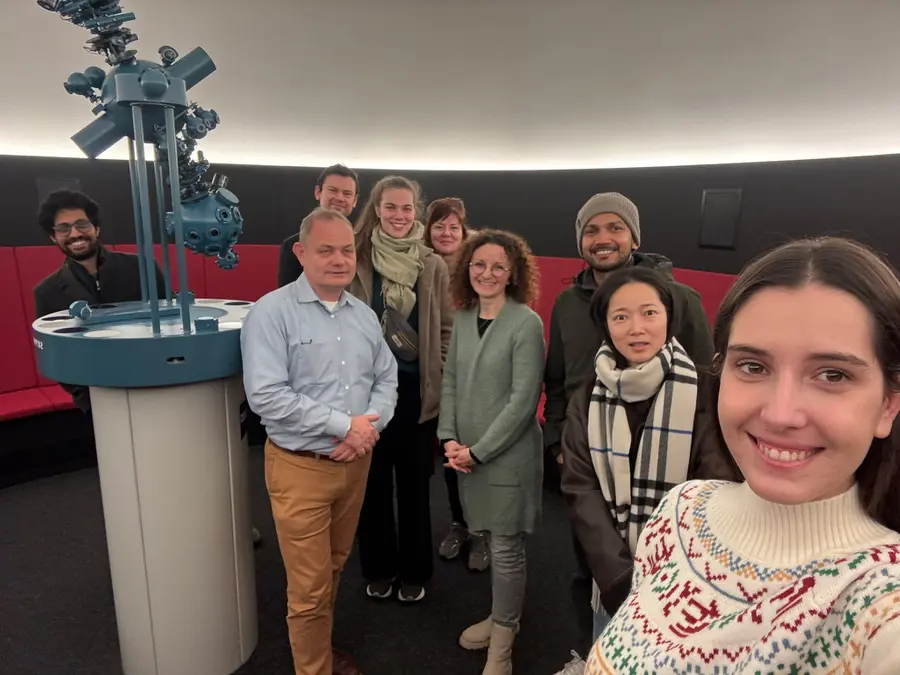
The lights dimmed, the dome arched overhead, and countless stars gradually appeared. This is how the visit by the members of the Boysen-TU Dresden-Research Training Group to the TU Dresden Planetarium began on November 5, 2026. The planetarium is located in the Beyer Building, which was completed in 2025 after a long wait. For just under an hour, the group explored the starry sky as it was set to appear that day and the following night.
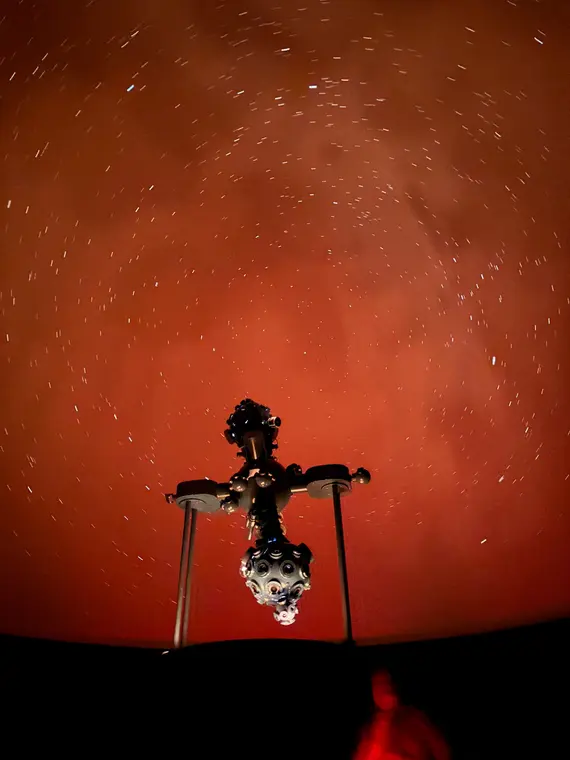
The ‘Skymaster’ planetarium projector in action.
Lutz Graefe (center in the photo above) from the Lohrmann Observatory guided the group through the sky. He began with the sky above our latitudes and then took the group to other locations on Earth, such as the equator or the North Pole. From those vantage points, the familiar sky appears from a completely different perspective: While the stars here seem to trace flat arcs across the firmament, at the equator they rise almost vertically and set in the same manner. At the North Pole, they circle around the zenith without ever setting. The cause of all these apparent movements is, of course, the Earth’s rotation, not any actual movement of the stars.
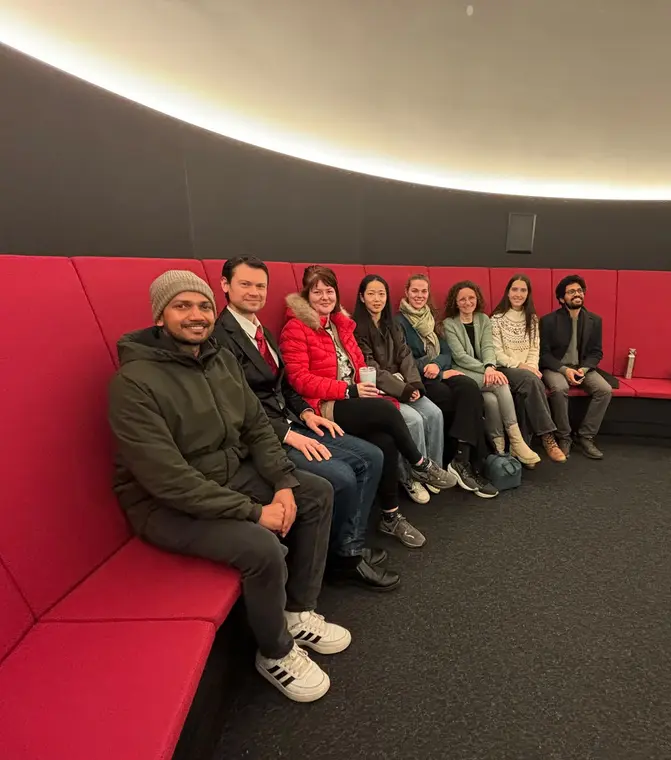
The RTG visits the Planetarium – from left to right: Sampath B. Weerappulli, Siarhei Bartalevich, Linda Ternova, Shiyu Guo, Sophie Jacobs, Tamar Mauritz, Ines Almeida, and Varun B. Gurugubelli.
The students learned about many new or long-forgotten aspects of the night sky. At the beginning of a November night, the summer constellations Lyra, Cygnus, and Aquila are still visible, with their brightest stars forming the Summer Triangle. Later in the night, the winter constellations rise: Surrounding Orion with its distinctive belt, the winter hexagon stretches across the sky, comprising bright stars such as Aldebaran in Taurus, Pollux in Gemini, and Sirius, the brightest star in the night sky. It also became clear that the Sun by no means rises exactly in the east all year round: Here, its point of rise shifts to the northeast in summer and to the southeast in winter. The projections also revealed which parts of the starry sky are permanently visible depending on latitude and how the sky changes over the course of a night and with the seasons.
The doctoral students’ verdict was unanimous: a highly recommended, exciting field trip that broadened their perspective beyond their own daily research routines. A heartfelt thank you goes to Lutz Graefe and the Lohrmann Observatory for the informative and inspiring tour!