
Sep 25, 2026
AI in Research: Sharing Experiences and Exploring New Possibilities
Artificial intelligence applications, including large language models, are increasingly becoming part of everyday research. It can assist with literature reviews, help with programming and data analysis, improve texts, prepare presentations, or serve as a sounding board for developing ideas. At the same time, its use raises important questions: How reliable are AI-generated results? When does it make sense to use AI for a specific task—and when does it not? And which skills remain indispensable when AI becomes part of scientific work?
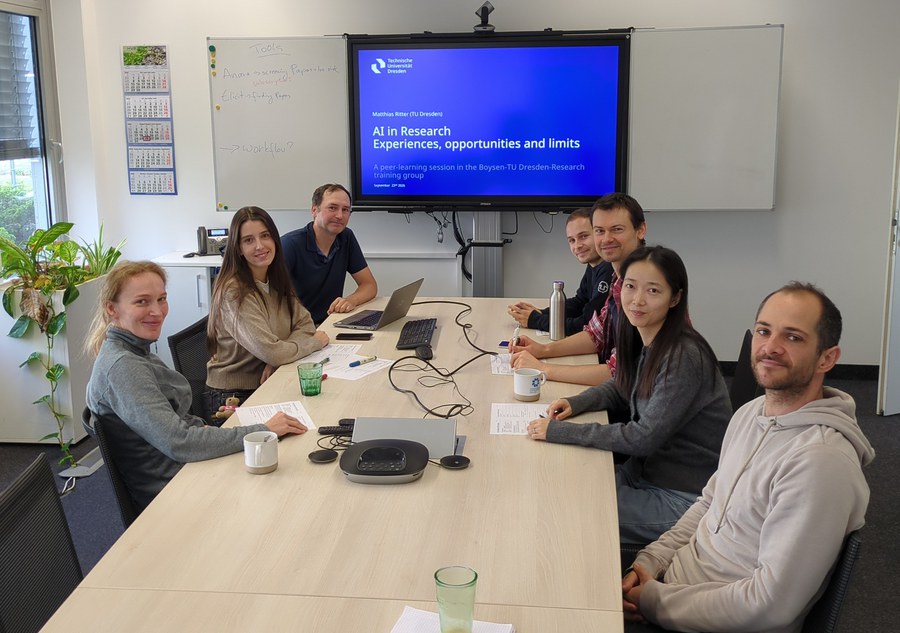
These questions were the focus of a special event on the topic of “AI in Research,” organized for the members of the Boysen-TU Dresden-Research Training Group. Seven participants gathered in the seminar room at Falkenbrunnen to share experiences and discuss how AI is already being integrated into their research and daily academic life.
At the start of the event, various phases of the research process in which AI can provide support were highlighted: from idea development and literature review to analysis, writing, communication, and critical reflection. Rather than focusing on a single application, the discussion brought together diverse experiences and approaches from the participants’ respective research contexts.
Literature review was a particularly relevant area. The participants discussed how AI can support the identification and screening of relevant articles and help researchers systematically manage larger volumes of literature. Various tools were presented and discussed, including Elicit and Arana. Of particular interest was the ability to use tools like Arana to ask specific questions about a defined collection of research articles and trace the answers back to the underlying literature. This was viewed as a valuable feature, as it makes the connection between the generated answer and the underlying scientific literature more transparent and easier to evaluate.
Another important topic was the question of what researchers still need to know and be able to do themselves. One observation was that researchers may increasingly be able to use AI to create or modify code without having to program every solution themselves. However, the ability to understand and critically evaluate the AI’s results remains indispensable: Does the code do what it’s supposed to do? Are the sources and references correct? Are the results plausible? This places researchers more firmly at the center as architects of their own research processes: They decide which tasks can be supported by AI, which tools are suitable, how the prompts are formulated, and how the results are verified and utilized.
Participants also discussed the role of AI as a sparring partner in day-to-day scholarly work. This can include preparing for meetings, developing and structuring presentations, testing ideas, refining wording, or soliciting critical feedback. These more everyday use cases illustrated that the relevance of AI extends beyond specialized research tasks and increasingly affects routine scientific work as well.
For the Boysen Research Training Group at TU Dresden, such an exchange is particularly valuable, as the group brings together researchers with diverse disciplinary and methodological backgrounds. Their experiences with AI are correspondingly varied. Discussing specific approaches can therefore help researchers identify useful applications while also keeping in mind the limitations of AI-generated results and the necessity of human judgment.