
Aug 21, 2026
RESEARCH IN PROGRESS: Where can green hydrogen be produced in the MENA region?
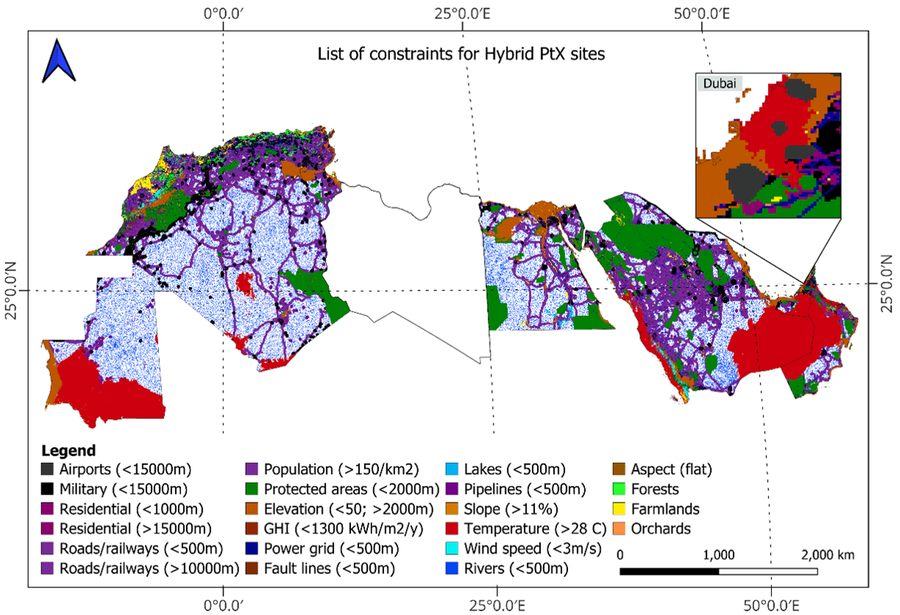
Fig 1: Spatial constraints taken into account when identifying potential sites for hybrid PtX production in the MENA region.
Where can green hydrogen actually be produced on a large scale? Across the entire Middle East and North Africa (MENA) region, the answer to this question is far less obvious than it might initially seem. While abundant solar and wind resources make the region attractive for producing hydrogen from renewable energy and for power-to-X (PtX), many other factors determine whether a location is actually suitable for such projects.
Siarhei Bartalevich, a doctoral student at the Boysen-TU Dresden-Research Training Group (Project E3) is investigating where in the MENA region the production of hydrogen from renewable energy and PtX could be expanded—and how various environmental, technical, and socioeconomic constraints influence site selection.
From Favorable Conditions to Real Constraints
At first glance, the search for suitable sites may seem straightforward: areas with high solar radiation, sufficient wind speeds, and favorable temperatures should be promising candidates. However, topography, existing infrastructure, and environmental factors make the picture much more complex. Siarhei Bartalevich’s current research takes 22 different constraints into account. These include nature reserves, settlements, airports, roads, pipelines, power grids, rivers, slope gradient, temperature, wind speed, and other environmental and infrastructure factors. When these constraints are combined, the area potentially suitable for large-scale PtX development is significantly reduced. In the current analysis, only about 7.6% of the study area remains available for potential development (see also Fig. 1 above).
Combining Maps, Data, and Decision-Making
To analyze this complex problem, Siarhei Bartalevich’s research combines Geographic Information Systems (GIS) with methods of multi-criteria decision-making. In the analysis, the study area is divided into a grid of 1 × 1-kilometer cells. With approximately seven million cells across the entire study area, each location can be evaluated using the same criteria.
In the first step, areas unsuitable for large-scale development are identified. The remaining areas are then evaluated for their suitability for renewable energy generation and hydrogen production. The approach also takes into account the potential benefits of combining solar and wind resources. Hybrid systems could enable the use of complementary renewable resources and thereby support more continuous hydrogen production.
Initial Results from the United Arab Emirates (UAE)
The current analysis is being developed step by step, beginning with the United Arab Emirates. An initial test of the Analytic Hierarchy Process (AHP) was conducted using a selection of exclusion and evaluation criteria with equal weighting. The resulting maps make it possible to identify areas where relatively few constraints overlap (see Fig. 2). The preliminary analysis already highlights several clusters of sites that could potentially be suitable for larger hybrid renewable energy systems.
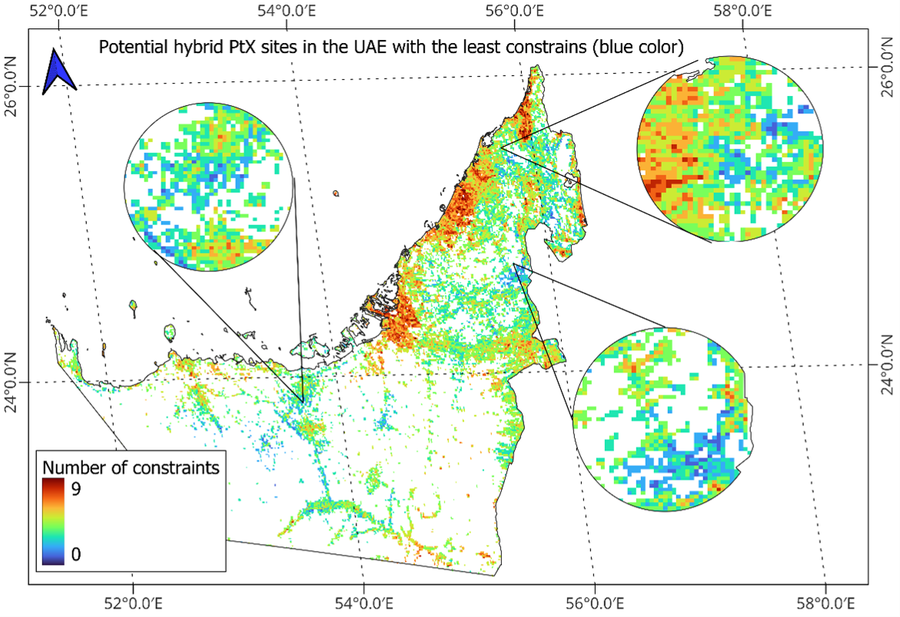
Fig. 2: Preliminary identification of areas in the UAE with fewer spatial restrictions. The map shows the number of restrictions affecting individual 1 × 1 km cells.
The next step is to combine the various criteria into an overall suitability assessment. The preliminary results show several areas where solar and wind resources complement each other and spatial constraints are comparatively low. The final suitability map can help identify sites that offer a particularly promising balance of these various factors (see Fig. 3).
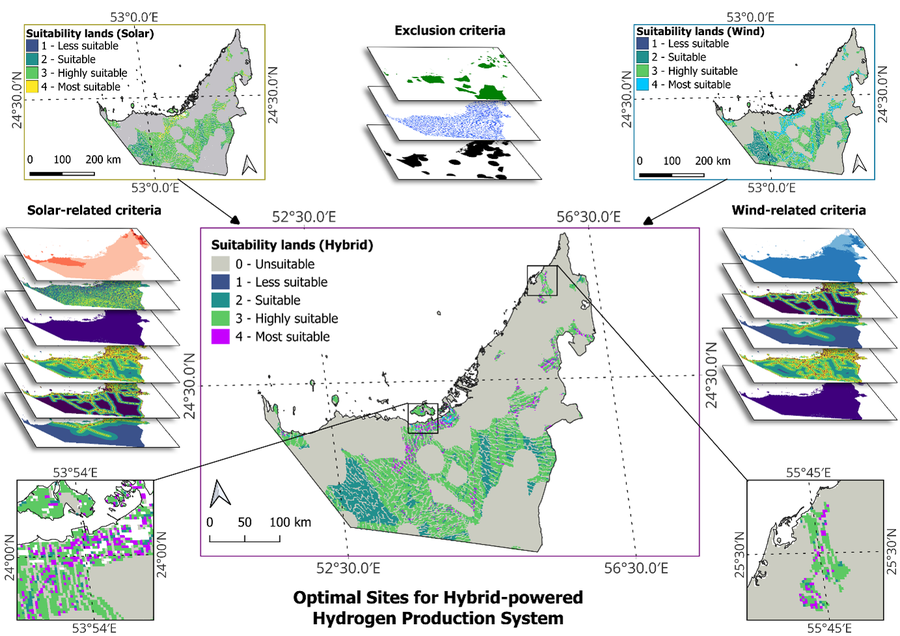
Fig. 3: Preliminary feasibility study for hybrid-powered hydrogen production plants in the UAE.
When Research Doesn’t Go According to Plan
In the course of the research, the original methodological approach also had to be modified. Initially, an econometric approach was considered, but the available data were not detailed enough and could not be compared across regions.
Instead, Mr. Bartalevich relied on spatial and satellite-based datasets and combined remote sensing with other geospatial information. This made it possible to obtain more consistent, location-specific information for the entire MENA region than would have been possible with conventional statistical data. Working with spatial data at a resolution of 1 kilometer presents its own challenges. Even minor discrepancies between raster layers can affect thousands of individual cells. Differences in resolution, projection, spatial extent, and values for missing data must therefore be carefully examined.
Questions such as “Are all raster layers perfectly aligned with one another?”, “How should missing data be handled?”, and “How sensitive are the results to changes in parameters?” become key components of the research process. While the technical details may remain largely invisible in the final maps, they can have a major impact on the reliability and reproducibility of the results. For the doctoral student, this also means developing and maintaining a reproducible PyGIS workflow for the analysis.
What’s next?
The next step in the research is to move beyond equally weighted criteria and examine how different preferences affect the resulting suitability assessment. For example, a decision-maker whose primary interest is in minimizing costs might place greater weight on proximity to power grids and pipelines. A focus on investment risks might give greater weight to infrastructure accessibility and reduced exposure to conflict zones. A stronger emphasis on sustainability might prioritize avoiding impacts on wildlife and natural resources.
The research therefore addresses a question that seems simple at first glance: If we want to produce green hydrogen on a very large scale, where can we actually locate it while balancing environmental impacts, risks, costs, and the differing preferences of stakeholders?
The goal is not simply to create another map. From the perspective of investors and governments, the analysis can help identify locations where renewable hydrogen and PtX projects could be particularly promising. In the long term, such information could support investment decisions, infrastructure planning, and the development of future strategies for renewable hydrogen.