
Jul 07, 2026
IBK at the 2026 Nordic Symposium on Building Physics in Tampere
Logo NSB 2026
IBK at the Nordic Symposium on Building Physics 2026 in Tampere
From June 7 to 10, 2026, the Nordic Symposium on Building Physics (NSB 2026)—one of the most important conferences on building physics in Northern and Central Europe—took place in Tampere, Finland. The Institute of Building Climatology (IBK) at TU Dresden was represented with four scientific presentations.
The presentations covered a broad spectrum of building physics. In the field of energy and building services engineering, the presentation“Co-simulation of renewable energy systems for an industrial building with concrete core activation and ground storage using geothermal collectors” demonstrated how complex energy systems can be jointly modeled by coupling different simulation tools. In a co-simulation, the building simulation (VICUS), the geothermal and ground simulation (DELPHIN), and the building services simulation (OpenModelica/Modelica) were integrated. In this way, building component activation, ground storage, and geothermal collectors can be modeled not in isolation but as an integrated system and optimized together.
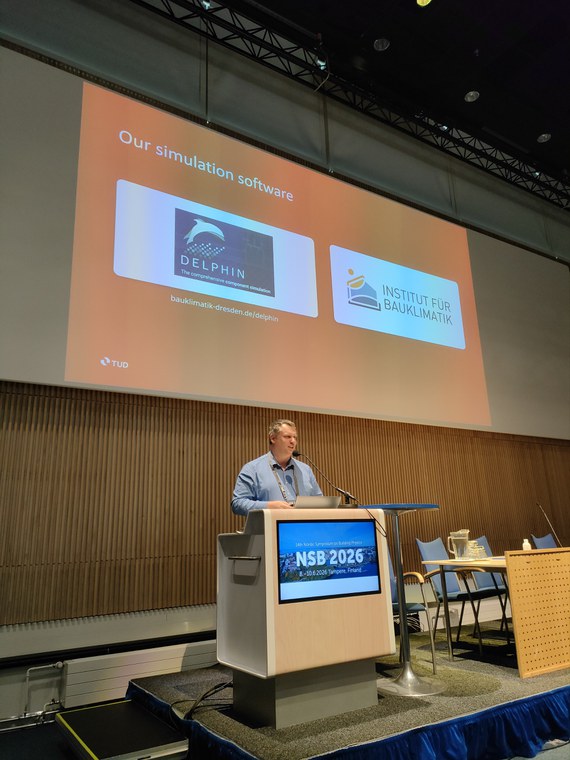
NSB Presentation Dirk Weiß
The paper“AktivDHKS: Capillary Tube Mats for Minimizing Heating Loads and Load Shifting” presented the AktivDHKS facade conditioning system with capillary tube mats, which reduces heating loads and enables load shifting that benefits the grid.
Hygrothermal materials research was represented by two papers: “Hygrothermal investigation of water uptake characteristics of hydrophobic and non-hydrophobic treated bricks” aimed to provide a detailed account of the water absorption test and to isolate the individual factors influencing water absorption, namely the brick’s firing crust as well as the hydrophobic-treated and non-hydrophobic-treated portions of the brick.
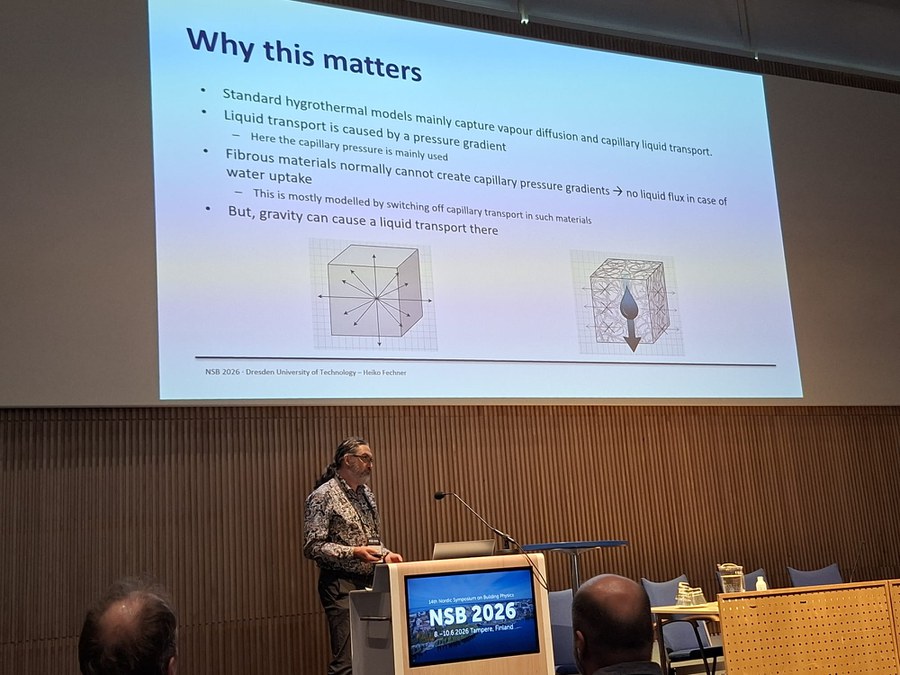
NSB Presentation Heiko Fechner
The paper “Gravity-induced moisture transport processes in fibrous insulation materials” by Heiko Fechner and Uli Ruisinger examined gravity-driven moisture transport in fibrous insulation materials. Several papers utilized the planning and simulation tools of the VICUS family (VICUS Software GmbH) as well as DELPHIN
(Bauklimatik Dresden) were used.