
07.12.2025
Fortschreibung der Smart-City-Strategie Dresden startete mit Status-quo-Workshop
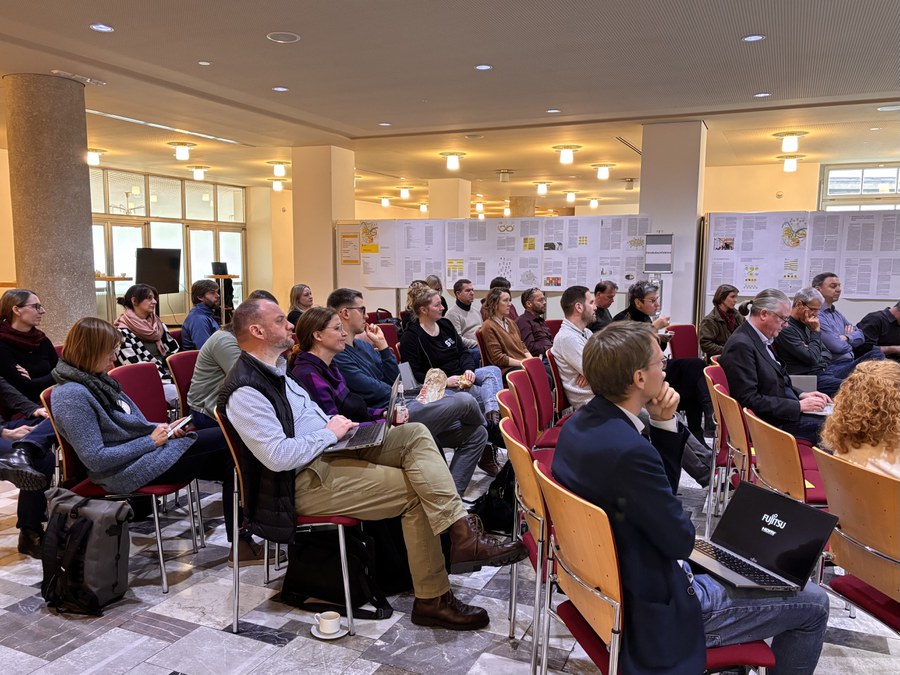
Mit einem gemeinsamen Workshop im Dresdner Rathaus hat die Fortschreibung der Smart-City-Strategie der Landeshauptstadt begonnen. Rund 30 Mitarbeitende aus der Stadtverwaltung diskutierten aktuelle Standpunkte, künftige Leitplanken und Anforderungen an eine nachhaltige digitale Stadtentwicklung. Wissenschaftlich gestaltet wird der Prozess vom WISSENSARCHITEKTUR – Laboratory of Knowledge Architecture der TU Dresden.
Auftakt im Rathaus: Rückblick und Ausblick
Der „Status Quo“-Workshop markierte den offiziellen Startpunkt für die Weiterentwicklung der Smart-City-Strategie Dresden. Ausgerichtet wurde die Veranstaltung vom Team des WISSENSARCHITEKTUR – Laboratory of Knowledge Architecture (TU Dresden), das die wissenschaftliche Leitung des Modellprojekts Smart City Dresden innehat. Das Projekt wird vom Bundesministerium für Wohnen, Stadtentwicklung und Bauwesen gefördert.
Neben direkten Projektpartnern aus der Stadtverwaltung nahmen auch Führungskräfte teil, die mit ihrem Fachwissen wichtige Perspektiven zur Smart City und zur digitalen Stadtentwicklung beitragen.
Zu Beginn blickten die Initiatoren des Förderantrags auf die Entstehung der bisherigen Smart-City-Strategie zurück. Diese war ab 2022 innerhalb von rund 18 Monaten erarbeitet und im Juni 2023 durch Stadtratsbeschluss verabschiedet worden. Das Strategiedokument ist veröffentlicht und liegt in einer Lang- und einer Kurzfassung vor.
Agile Strategieentwicklung und Verstetigung des Modellprojekts
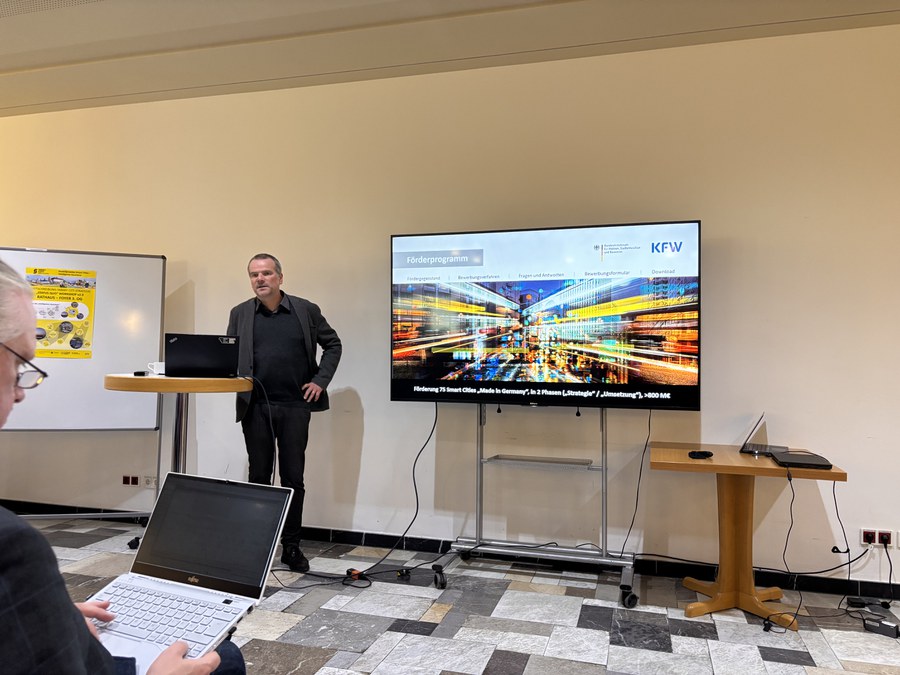
Prof. Dr. Jörg Rainer Noennig, Leiter des WISSENSARCHITEKTUR – Laboratory of Knowledge Architecture, erläuterte die methodische Grundlage der Strategieentwicklung. Zum Einsatz kam ein agiles Prozessmodell, das auf einer breiten Beteiligung von Akteuren aus Verwaltung, Bevölkerung, Wirtschaft und Wissenschaft basiert (Vierfachhelix-Modell).
Dieses Vorgehen sieht vor, zentrale Interview- und Workshopformate zum Abschluss des Förderprojekts im Jahr 2026 erneut durchzuführen. Auf Basis der Ergebnisse soll die Strategie fortgeschrieben werden – mit dem Ziel, sie weiter zu konkretisieren und zugleich die Erfahrungen aus dem Dresdner Modellprojekt systematisch zu integrieren.
Einen Ausblick auf die Zeit nach der Förderung gab Dr. Michael Breidung, Leiter des Eigenbetriebs IT-Dienstleistungen. Er stellte die Frage, wie sich die im Modellprojekt entwickelten Lösungen dauerhaft verankern lassen und wie Dresden vom wachsenden Pool an Smart-City-Lösungen der bundesweit über 70 Modellkommunen profitieren kann.
Externe Leitplanken und strategische Einbettung
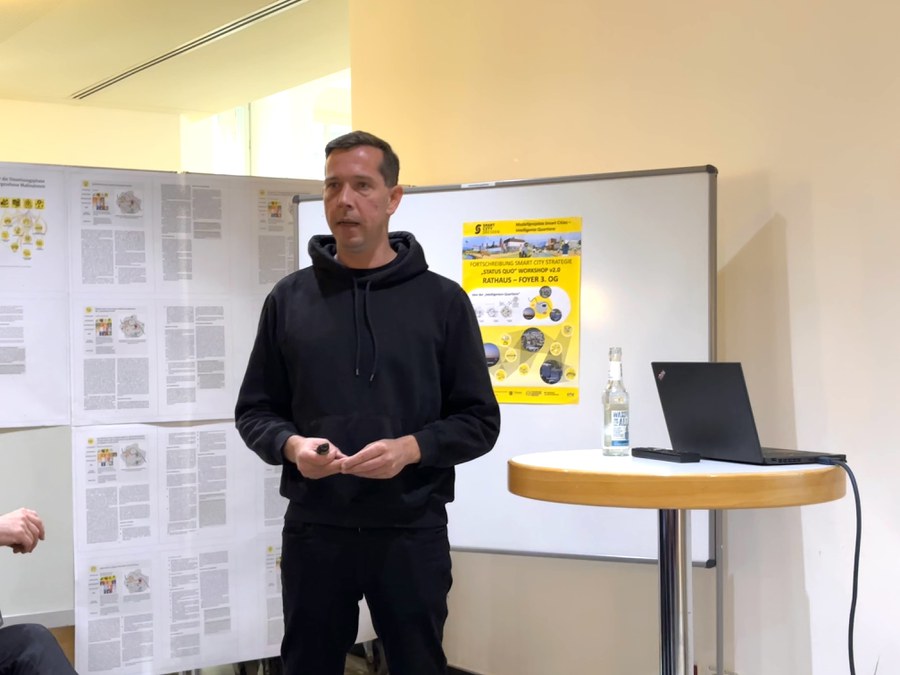
In einem Impulsvortrag skizzierte Dr. Paul Stadelhofer (WISSENSARCHITEKTUR) zentrale externe Rahmenbedingungen für die Fortschreibung der Strategie. Von besonderer Bedeutung sei die enge Verzahnung mit der entstehenden Digitalstrategie der Stadt sowie mit dem Integrierten Stadtentwicklungskonzept „Zukunft Dresden 2035+“, das die Smart City ausdrücklich als Zukunftsthema verankert.
Darüber hinaus müsse ein systematisches Vorgehen zur Auswahl und Übertragung geeigneter Smart-City-Anwendungen entwickelt werden. Angesichts umfangreicher Maßnahmen- und Lösungsdatenbanken – etwa im Kontext der Modellprojekte Smart Cities, auf Plattformen wie „Marktplatz Deutschland digital“ oder Open Code – brauche es für Dresden praktikable und qualitätsgesicherte Auswahlprozesse.
Auch politische Rahmenwerke wie der bundesweite Smart-City-Stufenplan spielten dabei eine Rolle. Sie zielen darauf ab, den Wissensaustausch zwischen Kommunen zu stärken und Strukturen zur langfristigen Vernetzung zu etablieren. Für Dresden sehen Prof. Breidung und Prof. Noennig in einem künftigen „Smart City Hub“ ein leistungsfähiges organisatorisches Element innerhalb der Verwaltung, um entsprechende Lösungen gemeinsam mit den Fachämtern umzusetzen.
Wirkungsforschung und Smart-City-Radar
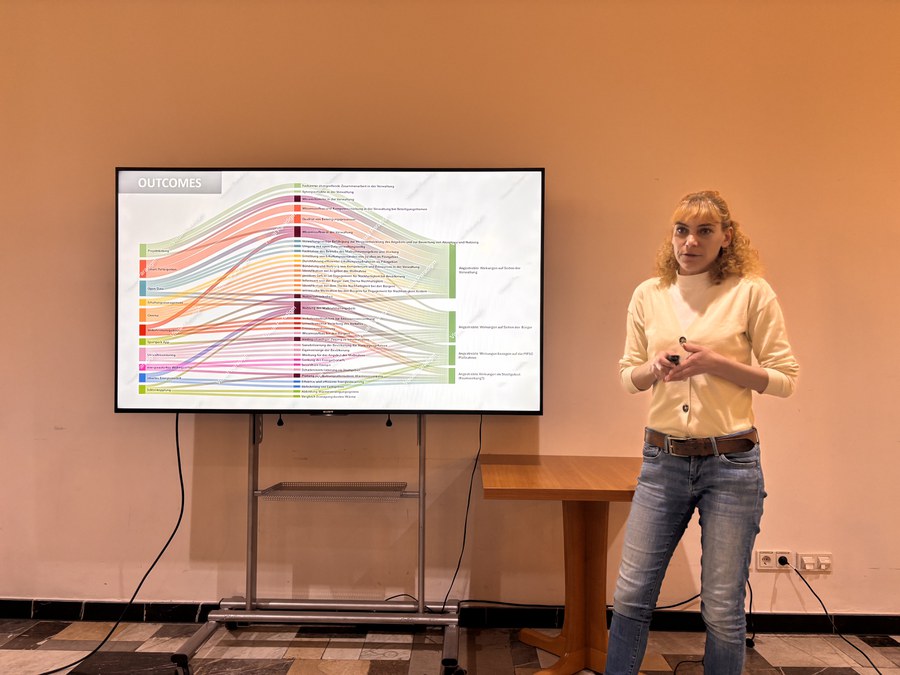
Einen Einblick in die begleitende Wirkungsforschung des Dresdner Modellprojekts gab Nadine Reinhardt (WISSENSARCHITEKTUR). Aufbauend auf dem Input-Output-Outcome-Impact-Modell entwickelte sie ein wirkungsorientiertes Analyseinstrument mit Raum- und Zielgruppenbezug. Dieses wird derzeit anhand konkreter Maßnahmen des Modellprojekts erprobt. Die Ergebnisse erlauben Aussagen darüber, wie einzelne Maßnahmen mit den Zielen zentraler Smart-City-Leitliniendokumente korrespondieren und welche Wirkungen für Stadtgebiet, Verwaltung, Bürgerschaft und weitere Akteure erzielt werden.
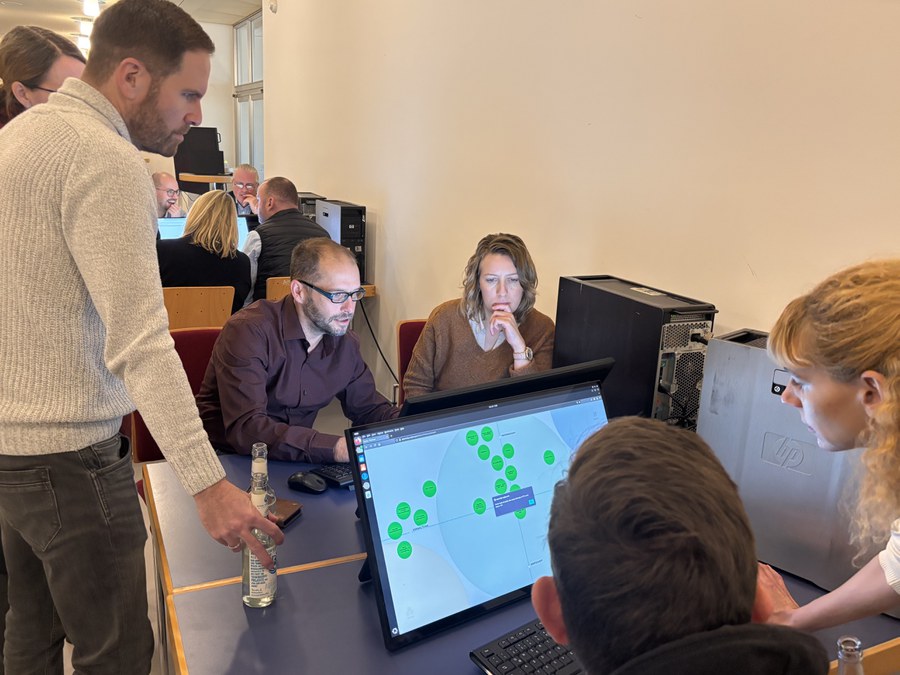
Im anschließenden Praxisteil trugen die Teilnehmenden ihre eigenen Projekte in einen sogenannten Smart-City-Radar ein. Die interaktive Anwendung, betreut von Anja Jannack und Sebastian Wiesenhütter (WISSENSARCHITEKTUR), erfasst Projekte, Themen und Akteure, um die Smart-City-Landschaft Dresdens sichtbar zu machen. Ergänzend stellte Uwe Richter vom Amt für Wirtschaftsförderung, der seit Jahren das Thema Smart City für Dresden erfolgreich gestaltet, eine Kartografie der wirtschaftlichen Smart-City-Aktivitäten vor und entwickelte diese gemeinsam mit den Teilnehmenden weiter.
Diskussion: Lücken, Vernetzung und Kommunikation
In der Diskussion zur Frage „Was fehlt der Strategie?“ bestätigten die Teilnehmenden die Relevanz der bislang gesetzten Schwerpunkte. Zugleich wurden weitere Entwicklungsbedarfe benannt: eine stärkere Zusammenarbeit zwischen den Fachämtern, eine bessere Verzahnung bestehender Einzelstrategien sowie bedarfsorientierte Entscheidungen bei der Nutzung von Daten und Ressourcen.
Ein zentrales Thema war zudem die Kommunikation. Sowohl politische Entscheidungsträger als auch die Dresdner Bevölkerung müssten den Mehrwert und die übergeordnete Vision einer zukunftsfähigen Smart City klar nachvollziehen können. „Only sensors make no sense“, brachte Prof. Noennig diesen Anspruch auf den Punkt. Dr. Breidung ergänzte: „Wir können die Prager Straße mit Sensoren ausstatten. Das ist die technische Seite. Aber erst dann wird es spannend. Wie gestalten wir mit den Daten unsere Smart City? Dafür brauchen wir eine Vision.“