
Jun 29, 2026
Non-destructive opto-acoustic testing method for asphalt layers in road pavements

ERDF R&D Collaborative Project “ZOPAS” Launched
Roads are a cornerstone of modern mobility and the economy. Their sustainable maintenance requires precise knowledge of the condition of the materials used in their construction. As part of the R&D consortium project “Development of a Non-Destructive In-Situ Testing Method for the Bound Layers of Road Superstructures Using Opto-Acoustic Measurement Technology — ZOPAS,” a novel in-situ testing method is being developed that, for the first time, enables a non-destructive, area-wide, and depth-resolved assessment of bound pavement layers.
To mark the official start of the project, the project partners met at the end of June 2026 for a joint kick-off meeting at the Laser Institute of Mittweida University of Applied Sciences. The goal of the meeting was to structure the collaboration and define the upcoming development steps. The project is funded by the European Union and the Free State of Saxony through the European Regional Development Fund (ERDF), with the Sächsische Aufbaubank (SAB) serving as the project sponsor, and will run until the end of 2028.
Currently available testing methods provide only limited information about the structural condition of roads. In particular, there is a lack of non-destructive methods that can provide insights into the mechanical properties and the layer structure beneath the surface. This makes it difficult to plan maintenance measures effectively and often leads to the inefficient use of resources.
The goal of the project is therefore to develop an opto-acoustic measurement technique that can be used to assess the structural condition parameters of roads in a non-destructive, large-area, and cost-effective manner. This should enable a significantly improved assessment of the road structure as well as a more precise prediction of its remaining service life.
The method is based on the excitation of acoustic waves in the pavement structure in a targeted manner using high-energy laser pulses and their subsequent measurement. By combining modern measurement technology, signal processing methods, and physical modeling, conclusions can be drawn about material properties and layer structures. In particular, the research group at the Laser Institute of Mittweida University of Applied Sciences, led by Professor Steffen Weißmantel, the Engineering Acoustics group led by Professor Jörn Hübelt, and the working group on component analysis using FEM led by Professor Uwe Mahn are collaborating on an interdisciplinary basis.
In addition, validation is performed using established testing methods, and the results are integrated into existing road maintenance management systems. The methods developed through this process enable a new level of quality in the condition assessment of road infrastructure.
Public contracting authorities and infrastructure operators could benefit from more informed decisions regarding rehabilitation measures, a more efficient use of resources, and an extended service life of traffic areas. In the long term, the method thus contributes to a more sustainable and cost-effective development of infrastructure.
The project is being carried out as a consortium led by Uhlig & Wehling GmbH as project coordinator, in collaboration with Mittweida University of Applied Sciences, TUD Dresden University of Technology, Gesellschaft für Akustikforschung Dresden mbH, and SINUS Messtechnik GmbH.
ZOPAS represents an important step toward making innovative measurement technology available for the non-destructive condition assessment of asphalt pavements while further strengthening Saxony as a hub for technology.
Text: Prof. Steffen Weißmantel
Link to the project page in the Research section...
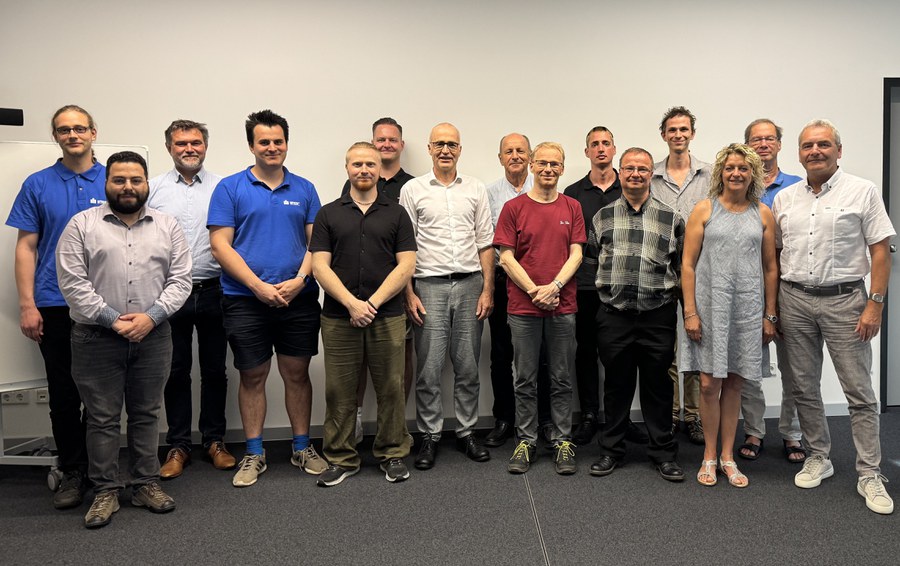
Participants in the ERDF R&D consortium project ZOPAS at the kickoff meeting, from left: Aaron Thriemer (HSMW), Ertac Celik (HSMW), Prof. Alexander Zeißler (TUD), Justus Reuter (HSMW), Manuel Pfeiffer (HSMW), Artur Picht (TUD), Prof. Jörn Hübelt (HSMW), Gunther Papsdorf (SINUS), Frank Seeger (Uhlig & Wehling), Vincent Willenberg (SINUS), Prof. Uwe Mahn (HSMW), Adrian Alexander (SINUS), Bianca Uhlig (Uhlig & Wehling), Prof. Steffen Weißmantel (HSMW), Dr. Wolf Uhlig (Uhlig & Wehling, project coordinator)