
Apr 20, 2026
Technical exchange with the Saxony State Dam Authority (LTV) at the Friedrichswalde-Ottendorf flood retention basin
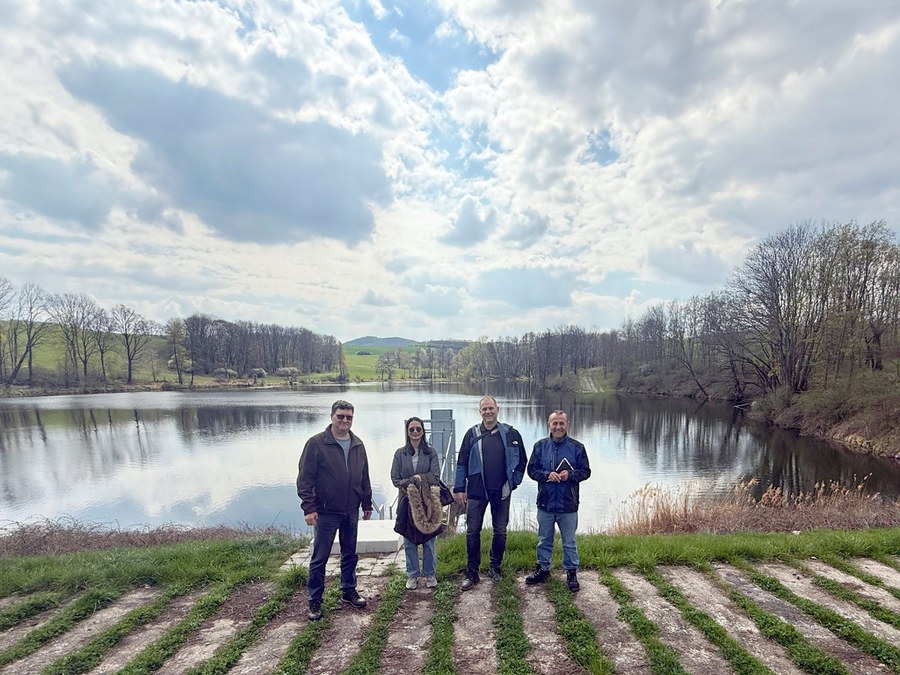
As part of the BIBOB project, an on-site visit took place on 16 April 2026 at the Friedrichswalde-Ottendorf flood retention basin. The aim of the meeting with representatives of the Saxony State Dam Authority (LTV) – Mr Amani (Head of the Dam Facilities Division of LTV in the Upper Elbe region) and Mr Hinz (Dam Supervisor of the Gottleuba Dam) – was to discuss the impact of the local beaver population on hydraulic engineering infrastructure.
Hydraulic challenges posed by floating debris
The Friedrichswalde-Ottendorf flood retention basin has a relatively large catchment area due to the inflow from the Bahre. In its latest monitoring, the Saxon Switzerland-Eastern Ore Mountains Landscape Conservation Association (Landschaftspflegeverband Sächsische Schweiz-Osterzgebirge) counted a total of 13 beaver dams upstream of the reservoir’s head. From the LTV’s perspective, this gives rise to specific operational risks:
- Mobilisation of deadwood: Flood events can cause beaver dams to no longer withstand the hydraulic load and become partially destroyed. Branches and twigs dislodged in the process are then transported as floating debris towards the dam outlet and can potentially cause damage.
- Blockage of screening systems: Smaller or frequently recurring flood scenarios are particularly critical in this context. As the area is not yet completely submerged, no pressure discharge occurs through the pre-relief system. Debris on the water’s surface can thus block the upstream screen in front of the culvert and significantly restrict the normal dam relief.
Stability and operational measures
Another focus of the discussion was the burrowing activity of beavers. Previous activity in the retention basin centred on the creation of cavities in the bank areas. These pose a potential hazard in several respects:
- Workplace safety: Risk of collapse for LTV staff during maintenance and inspection rounds.
- Risk of erosion: Increased risk of bank instability during overflow (particularly during flood events).
Solutions and innovative detection methods
Various strategies for minimising risk were discussed. One technical approach could involve mechanically reinforcing beaver dams (e.g. using wire mesh or wooden stakes) to increase their stability and thereby reduce the volume of debris during flood events.
In addition, the BIBOB project is investigating the detection of macro-cavities using infrared measurement technology. The suitability of this method for the early identification of beaver lodges in the riparian areas of the flood retention basin was already tested on a trial basis at the end of March, and the continuation of the measurements was discussed during the meeting.
Outlook
At the end of the meeting, both sides reaffirmed their interest in ongoing dialogue. Close contact with the LTV and other local authorities in the project area is essential to reconcile the hydrological potential of beaver settlements with the safety requirements of critical hydraulic engineering infrastructure.

© S. Thepphachanh / IWD

© S. Thepphachanh / IWD

© S. Thepphachanh / IWD


