
Jul 02, 2026
Farewell Lecture by Prof. Dr. habil. Peter Deegen
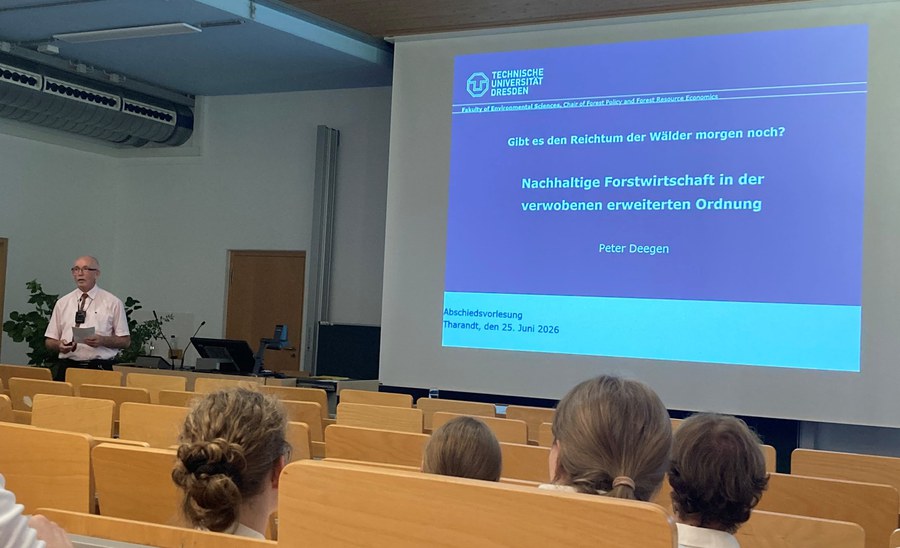
"Will the forests' riches still be here tomorrow?" –
Farewell Lecture by Prof. Peter Deegen
Forestry operates within various regulatory frameworks. In addition to the external framework of personal interactions between people who know and meet one another, foresters are also part of international networks in which countless people collaborate without ever meeting in person. It was this broader regulatory framework that Prof. Dr. Peter Deegen addressed in his farewell lecture on June 25, 2026, at the Department of Forest Sciences at TU Dresden.
Peter Deegen has shaped the field of forest economics in Tharandt for over 40 years. He has delved deeply into the regulatory frameworks that determine the outcomes of human interactions. His extraordinary erudition, intellectual depth, and methodological innovation have inspired generations of forestry students and helped practitioners understand the complex interrelationships in modern societies. Throughout this time, he never lost sight of the subject of study in Tharandt: the forest and the ways in which it is used and managed by humans. By applying economic theories that explain why forests are the way we observe them, and provide guidance on how rules should be designed to improve the condition of forests and forestry, Peter Deegen has left a rich legacy in Tharandt and carried on the tradition of forestry economic theory and teaching that made Tharandt world-famous in the 19th century.
In his farewell lecture, however, Peter Deegen also emphasized the vast field that remains to be explored: While extensive theories exist regarding the outcomes of forestry interactions in a market economy, economic theories that address the forestry implications of exchange transactions via political institutions—and, in particular, the interactions within interwoven regulatory systems consisting of diverse, interlinked market-based and political institutions—are rare. Since forestry is increasingly active in political and interconnected spheres as well, Peter Deegen called on the younger generations to develop explanatory frameworks in this area for the benefit of the forest.
The farewell lecture was attended by numerous guests from various forestry research institutions and different departments. The tribute to his work demonstrated that Peter Deegen lived and shaped the university in the true sense of the word as the “totality of the sciences.”