
Jun 15, 2026
WISSENSARCHITEKTUR presented its current research and the Smart City Research Network at the 2026 IPSC Conference
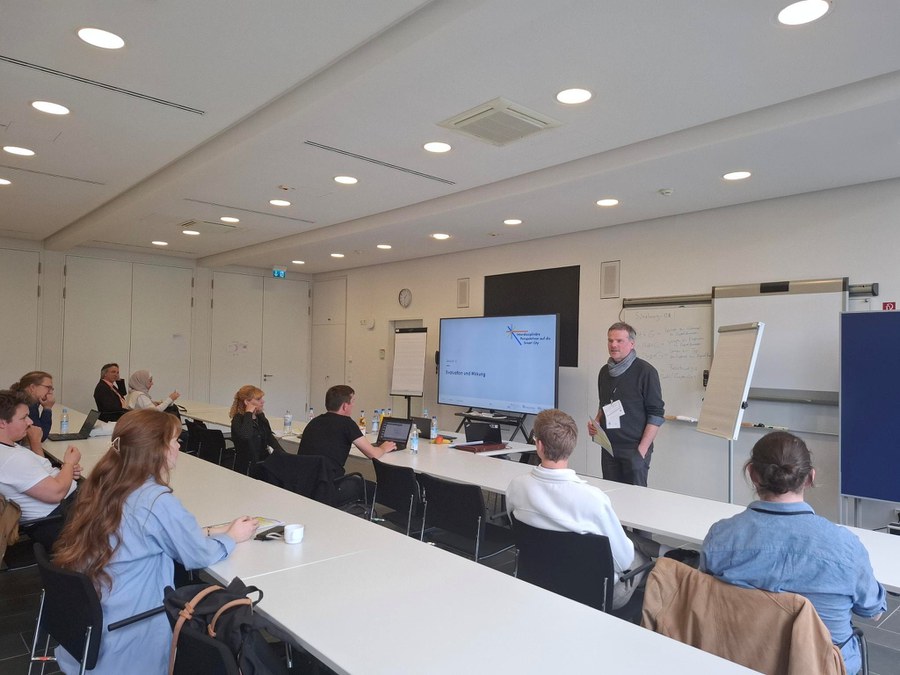
Prof. Jörg Rainer Noennig (WISSENSARCHITEKTUR) at the thematic session on impact analysis and transfer strategies
How can cities and regions be designed not only to respond to demographic, social, and digital upheavals, but also to actively shape the future? This question was the focus of the 2nd Conference on "Interdisciplinary Perspectives on the Smart City" (IPSC) held on May 21 and 22, 2026, in Kaiserslautern.
The WISSENSARCHITEKTUR research group (TU Dresden), which leads the accompanying research for the Model Project Smart City Dresden, presented several papers on impact orientation, knowledge transfer, and the scaling of innovative smart city solutions. In addition, group leader Prof. Jörg Rainer Noennig, together with Jens Libbe and Karoline Krenn (German Institute for Urban Studies), presented the Smart City Science Network —founded in 2025—to a broad professional audience.
Smart City Research Network
The Smart City Science Network currently brings together experts from around 50 universities, colleges, non-university research institutions, and municipalities. It is a consortium that emerged from the Smart Cities model project and aims to fruitfully combine scientific findings with practical urban development.
At the IPSC conference, which the Smart City Research Network co-organized in cooperation with the hosts RPTU Kaiserslautern-Landau, the German Research Center for Artificial Intelligence (DFKI), and the Fraunhofer Institute for Experimental Software Engineering (IESE), researchers discussed the network’s objectives and potential with the plenary audience. A memorandum, which is being updated, consolidates key ideas and potential activities.
Impact Analysis and Transfer of Smart City Solutions
In the thematic sessions, the WISSENSARCHITEKTUR team contributed its experiences from the Dresden pilot project to the technical exchange. In their presentation “From Vision to Impact,” Dr. Paul Stadelhofer, Nadine Reinhardt, and Prof. Noennig outlined a consensus-, innovation-, and process-oriented model for impact orientation and impact analysis of smart city measures. Using participatory methods, indicators based on guideline documents, and a transparent, manageable data collection and evaluation process, complex innovation processes in cities can be systematically aligned with and evaluated for their social and strategic impacts
Noennig and Stadelhofer, together with Benjamin Dally (HCU Hamburg) and Mirko de Paoli (German Smart City Association), identified“Key Aspects of a Sustainable Transfer Model.” How can obstacles that stand in the way of the adoption and use of innovative smart city solutions be overcome? Using successful examples such as Hamburg’s “Micado” app, which supports migrants during the arrival and integration process in a new city, key questions and conditions for success were identified. The approach advocates for early integration and consideration of four aspects: end-user perspective, routine operation, continuous development, and business and operational models.
"Smart City Through Our Own Efforts"
The Thuringian city of Ilmenau also served as an example of a successful transfer. Under the motto “Smart City on Our Own,” WISSENSARCHITEKTUR was commissioned in 2024 to implement the Smart City strategy process carried out in Dresden in a scaled-down form without funding. Zohra Ng Binti Abdullah, Filipe Mello Rose, and Jörg Rainer Noennig described their experiences in jointly developing a strategic roadmap (Replication Instead of Rollout? Scaling Down as a Strategy for Transferring Smart City Innovations).
Matchmaking and Summer School
In addition to the academic presentations, the conference offered interactive formats. In a World Café, the Smart City Research Network provided information about the planned 2026 Summer School in Dresden. In addition, the network organized a moderated matchmaking session as well as a so-called proposal pipeline, designed to help researchers identify common funding topics and opportunities for collaboration. The program was complemented by an open Bar Camp (“Bring your ideas”), which provided space for new project ideas, spontaneous discussions, and the development of future research initiatives.
More information on IPSC 2026 is available on the conference website and in the press release.