
Sep 21, 2026
Six decades of mangrove forest recovery
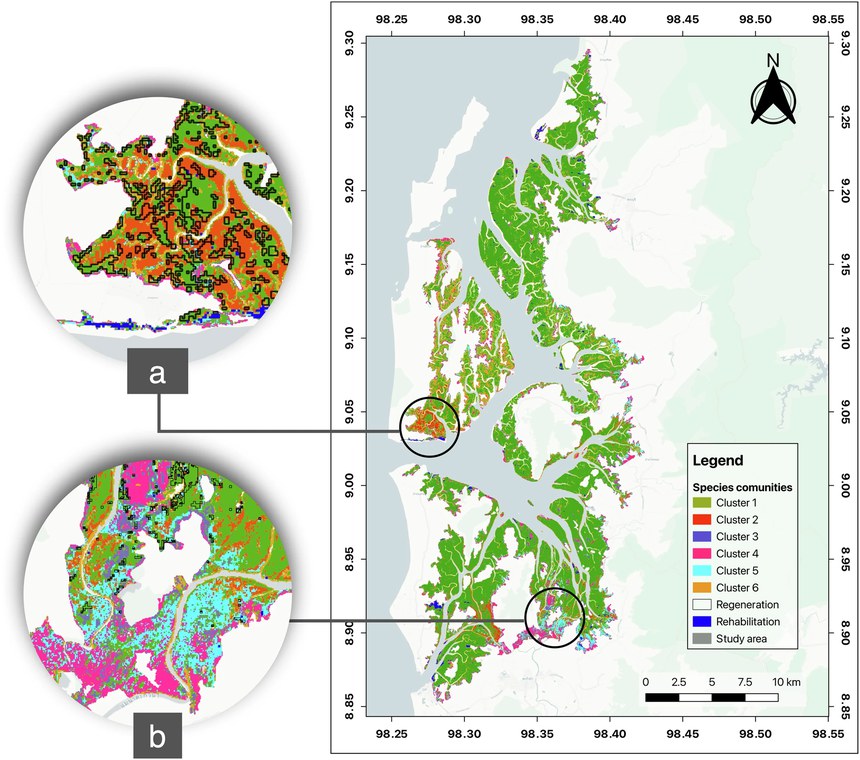
Colored polygons represent seven field-derived mangrove species community clusters, while black borders indicate regenerated areas and blue polygons indicate rehabilitated areas dominated by Rhizophora mucronata and R. apiculata
Many mangrove forests lack formal protection. In their new study now prominently published in Communications Earth & Environment, Uta Berger and her colleagues found that de facto conservation areas may support long-term biodiversity conservation and structurally complex mangrove ecosystems despite the absence of formal protection. They used historical aerial photographs, satellite imagery, institutional maps, and 183 field inventory plots to assess the spatiotemporal dynamics of mangrove areas in Southwestern Thailand, their taxonomic composition and ecological profiling across successional and management gradients. Their results indicate a high value of conserving mature trees and combining natural regeneration with carefully targeted planting.
Pimple, U., Simonetti, D., Thongdon-um, S., Phatanacharoen, R., Sitthi, A., Gond, V., Friess, D. A., Wanthongchai, P., Berger, U. (2026): Multidecadal landscape evolution and natural recovery of mangroves beyond protected areas. Commun Earth Environ 7, 773 (2026).