
Hydrodynamics and Ambient Flow Mixing Induced by Swarms of Mesozooplankton
Table of contents
Project Description
Understanding how swarms of mesozooplankton influence ocean mixing.
Ocean mixing plays a fundamental role in regulating the transport of dissolved oxygen, nutrients, and carbon throughout marine ecosystems. Recent studies have suggested that swarms of self-propelled mesozooplankton, which are widely distributed throughout the world's oceans, may contribute significantly to this process through their collective vertical migration. Although laboratory experiments and numerical studies have demonstrated large-scale fluid transport induced by migrating swimmers, the hydrodynamic mechanisms responsible for this process remain poorly understood.
HyFloz investigates how collective swimming modifies the surrounding flow and ambient fluid mixing. By combining swimmer-resolving numerical simulations with theoretical analysis, the project connects individual swimming behavior, collective migration, and the resulting hydrodynamics of the surrounding fluid, providing new insight into biogenic mixing in the ocean.
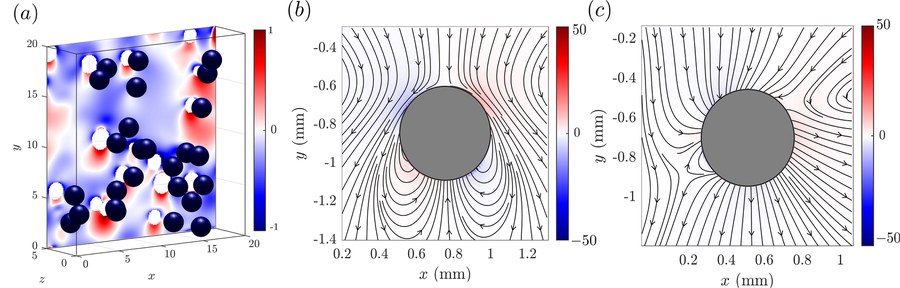
The configuration of the simulations and a slice of the vertical velocity.
The Science
From individual swimmers to large-scale ocean mixing.
Vertically migrating zooplankton have been shown to generate fluid motions extending far beyond the size of individual organisms. However, accurately quantifying their contribution to ocean mixing remains challenging because swimming behaviors observed under laboratory conditions differ considerably from those occurring during collective migration in natural marine environments. As a result, the physical mechanisms linking individual swimming behavior to large-scale mixing are still not fully understood.
Understanding this connection requires investigating both the swimming behavior of individual organisms and the hydrodynamic response of the surrounding fluid. HyFloz therefore focuses on the interactions between swimmers and ambient flow across multiple scales, from individual locomotion to swarm-induced mixing.
Our Method
Swimmer-resolving direct numerical simulations
HyFloz combines fully coupled swimmer-resolving direct numerical simulations (DNS) with theoretical analysis to investigate the interaction between swarms of mesozooplankton and the surrounding flow. Individual mesozooplankton are represented by spherical squirmer models swimming in homogeneous and stratified fluids.
The unsteady Navier–Stokes equations are solved together with the governing equations for swimmer motion. Fluid–structure interactions are resolved using the Immersed Boundary Method (IBM) and the Volume of Fluid (VoF) method, while all simulations are performed with the in-house code PARTIES. The resulting datasets are analyzed to characterize swimming behavior, flow structures, Darwinian drift, energy budget, and mixing efficiency over a broad range of swimming and environmental conditions.
Swimming behavior © TPH
the flow field around the swimmers © TPH
Project Objectives
Two scientific questions guide the HyFloz project.
1. Objective
How does collective migration influence the swimming behavior of individual mesozooplankton?
Collective migration may alter the swimming dynamics of individual organisms through hydrodynamic interactions with neighboring swimmers and the surrounding fluid. HyFloz investigates the evolution of swimming speed, swimming direction, and propulsive force during collective migration, together with the effects of swimmer size, buoyancy, body orientation, swimmer number density, and ambient-fluid stratification.
2. Objective
How do collective swimming behaviors modify ambient-flow mixing?
Different collective swimming behaviors generate different flow structures and mixing characteristics. HyFloz quantifies the surrounding flow through analyses of Darwinian drift, flow structures, energy budget, and mixing efficiency. These results establish the relationship between collective swimming behavior and ambient-flow mixing, providing new insight into the physical mechanisms responsible for biogenic mixing and the redistribution of dissolved oxygen, nutrients, and carbon in marine environments.
Project Team & Funding
Principal Investigator
Prof. Dr.-Ing. Bernhard Vowinckel (TU Dresden)
Lead Research Associate
Dr. Rui Zhu (TU Dresden)
The primary researcher leading the simulation campaigns, code implementation, and data analysis.
Funding Body
This project is proudly funded by the Alexander von Humboldt Foundation (Humboldt Research Fellowship for Postdoctoral Researchers).