
RHeology of INertial particles by means of experimental Observations and numerical Simulations
Inhaltsverzeichnis
Gemeinsam finanziert von der Deutschen Forschungsgemeinschaft (DFG) und der französischen Nationalen Forschungsagentur (ANR).
Projektbeschreibung
Die RHINOS-Gruppe an der TU Dresden kombiniert Experimente und partikelaufgelöste Simulationen, um dichte, partikelbeladene Suspensionen über den viskos-inertialen Übergang hinweg zu untersuchen. Durch Variation der Flüssigkeitsviskosität, der Schergeschwindigkeit, des Granulatdrucks und der Partikel-Partikel-Reibung lassen sich Veränderungen des Volumenanteils, der Spannungsübertragung, der hydrodynamischen Kräfte und der Kontaktnetzwerke über einen weiten Bereich von Stokes-Zahlen aufzeigen. Im Rahmen der Messkampagne werden zudem laminare, druckgetriebene Scherströmungen über idealisierten Sedimentbetten untersucht. Diese hochauflösenden Daten schlagen eine Brücke zwischen Experimenten und numerischer Modellierung, decken Mechanismen auf, die in den für die jeweiligen Grenzbereiche entwickelten Konstitutionsgleichungen fehlen, und unterstützen verbesserte Zweiphasenmodelle für technische und natürliche partikelbeladene Strömungen, einschließlich des Sedimenttransports.
Die Wissenschaft: Vom viskosen zum inertialen
Das Problem
Dichte Suspensionen treten beim Sedimenttransport, in industriellen Prozessen und bei geophysikalischen Strömungen auf, doch das Verhalten im Übergang zwischen der viskos zur inertial domierten Strömung ist nach wie vor nur unzureichend beschrieben. Bei niedrigen Stokes-Zahlen dominieren die Viskosität der Flüssigkeit und die Schmierung die Spannungsübertragung; bei hohen Stokes-Zahlen werden die Trägheit der Partikel und Reibungskontakte entscheidend. Bestehende Konstitutionsgesetze sind in der Regel für eine der beiden Grenzen kalibriert und erfassen den Übergang nicht konsistent. Experimente zeigen zudem, dass sich der Partikelvolumenanteil und die makroskopische Reibung nicht mit derselben Rate ändern, was auf unterschiedliche Übergänge beim Granulatdruck und bei der Scherspannung hindeutet. RHINOS untersucht daher, welche Mechanismen auf Partikelebene diesen Übergang steuern und wie sie in Vorhersagemodellen dargestellt werden sollten.
Rollende vs. gleitende Kontakte
Die Stokes-Zahl St gibt das Verhältnis von Partikelträgheitsspannungen zu viskosen Spannungen an. Partikelaufgelöste Simulationen lokalisieren den Übergang im Granulatdruck bei St ≈ 8, nahe dem experimentellen Wert St ≈ 10. Die Scherspannung ändert sich langsamer. Die Diskrepanz ist auf das Zusammenwirken von tangentialem Kontakt, Schmierung und hydrodynamischen Kräften zurückzuführen. In viskositätsdominierten Strömungen bilden starke, langlebige Kontakte durch Rollen das granulare Netzwerke. Mit zunehmender Trägheit wird das Netzwerk fluidisierter, und Gleitkontakte überwiegen. Ihr Einsetzen hängt nicht nur von St ab, sondern auch vom Abstand zum Jamming. Zunehmende Partikel-Rauhigkeit verzögert den Übergang der Scherspannung zu größeren Stokes-Zahlen.
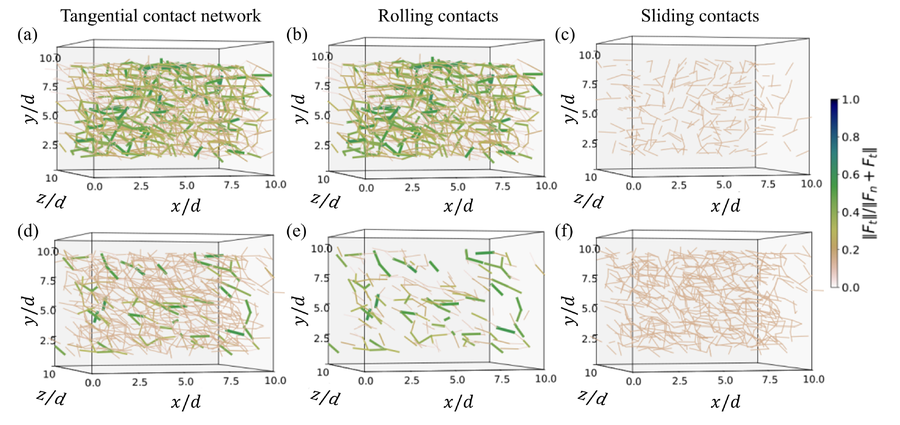
Tangentialkraftnetzwerke trennen sich in überwiegend rollende Kontakte im viskosen Bereich und gleitende Kontakte im Trägheitsbereich.
Unsere Methode
RHINOS kombiniert kontrollierte rheologische Experimente mit kornaufgelösten Simulationen und mikromechanischen Analysen.
Druckinduzierte Rheometrie
Kugeln mit neutralem Auftrieb werden unter kontrolliertem Granulatdruck zwischen aufgerauten Platten geschert. Durch Variation der Flüssigkeitsviskosität und der Schergeschwindigkeit wird der Übergang vom viskosen zum trägen Verhalten abgedeckt, während gleichzeitige Messungen des Packungsgrades und der makroskopischen Reibung die Druckantwort von der Scherspannungsantwort unterscheiden
Druckauferlegte Geometrie © TPH
Partikelaufgelöste Simulationen
Bei den dreidimensionalen Simulationen wird eine Immersed-Boundary-Methode für die Strömung mit einer Diskretelementmethode für Partikelkontakte kombiniert. Dabei werden Schmiereffekte, Hydrodynamik, normale Kontaktkräfte und tangentiale Reibung berücksichtigt. Die numerische Zelle bildet die durch Druck vorgegebene Geometrie korrespondierer Experimente nach und untersucht Stokes-Zahlen im Bereich von etwa 0,01 bis 300.
Mikromechanische Analyse
Die makroskopische Reibung wird in hydrodynamische, normal- und tangentialkontaktbezogene Anteile zerlegt. Durch die Visualisierung des Kraftnetzwerks werden anschließend Roll- und Gleitkontakte voneinander getrennt und der Gleitanteil quantifiziert. Durch die Skalierung dieses Anteils anhand des Abstands zum Versagen lassen sich die Daten über verschiedene Viskositäten hinweg zusammenfassen, wodurch lokale Kontaktumordnungen mit der volumengemittelten Rheologie in Verbindung gebracht werden.
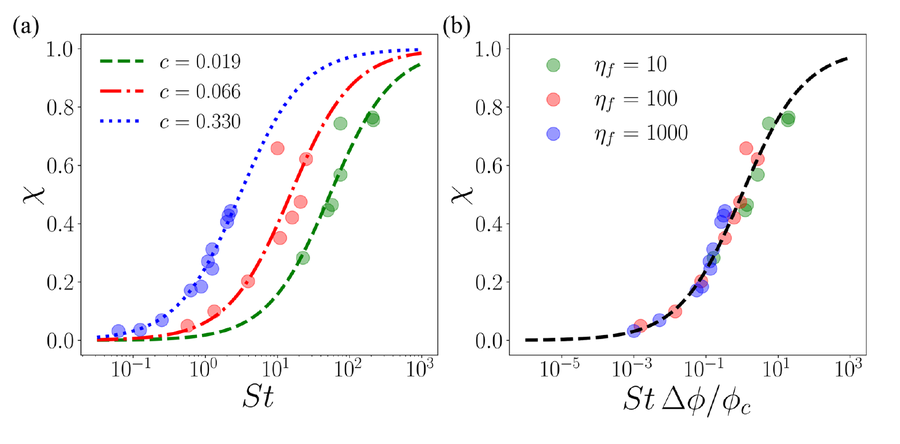
Der gleitende Anteil kollabiert über die Viskositäten, wenn die Stokes-Zahl durch die Entfernung zum Blockieren skaliert wird
Modellintegration
Die ermittelten Zusammenhänge zwischen der Stokes-Zahl, dem Korndruck, dem Packungsgrad und der Scherspannung werden in konstitutive Gleichungen für Zweiphasenströmungsmodelle umgesetzt. Dadurch wird die Mikromechanik auf Kornebene mit makroskopischen Vorhersagen zur Sedimentbewegung unter druckgetriebener Strömung verknüpft.
Projektziele
- Ermittlung des Übergangs von Partikeldruck und Scherspannung im viskos-trägheitsbehafteten Bereich.
- Ermittlung, inwiefern Roll- und Gleitkontakte, hydrodynamische Schmierung, Partikel-Partikel-Reibung und der Abstand zum Staupunkt die Rheologie von Suspensionen beeinflussen.
- Bereitstellung von Referenzdaten und verbesserten Konstitutionsgleichungen für Zweiphasenmodelle des Sedimenttransports und der partikelbeladenen Strömung
Projektteam Finanzierung
Projektleiter
Prof. Dr.-Ing. Bernhard Vowinckel (DFG) and Prof. Pascale Aussillous (ANR)
Wissenschaftliche Koordination und Betreuung der experimentellen, numerischen, rheologischen und sedimenttransportbezogenen Komponenten des Projekts.
Leitende wissenschaftliche Mitarbeiter
- Dr. Sudarshan Konidena
- Dr. Franco Tapia
- Prof. Dr. Élisabeth Guazzelli
Leitende Forscher verantwortlich für Versuchskampagnen, partikelaufgelöste Simulationen, die Implementierung von Methoden, die quantitative Datenanalyse und die mikromechanische Interpretation der Rheologie von dichten Suspensionen.
Förderinstitutionen
Deutsche Forschungsgemeinschaft (DFG) und französische Nationale Forschungsagentur (ANR) im Rahmen der gemeinsamen ANR-DFG-Förderprojekte VO2413/3-1 und ANR-21-CE30-0050.
Gastinstitution
Wissenschaftliche Grundlage und Quelle der Abbildung
S. Konidena et al., “Tangential Forces Govern the Viscous-Inertial Transition in Dense Frictional Suspensions,” Physical Review Letters 136, 248201 (2026)