
SUPERFLOW: Simulations of Sediment Dynamics in Supercritical, Free-Surface Flows
Inhaltsverzeichnis
Unlocking the micromechanics of antidunes using state-of-the-art, particle-resolving supercomputer simulations
Project description
Rivers, flash floods, and coastal channels carve mesmerizing, wave-like patterns into sand and gravel beds. While slow-flow "dunes" are well understood, the rapid, high-energy "antidunes" of supercritical flows remain a mystery. SUPERFLOW uses massive high-performance computing (HPC) to simulate every single grain of sediment and the fluid flowing around it to decode how these morphodynamic structures evolve.
The Science: Dunes vs. Antidunes
The Problem
Bedforms drastically change flow behavior, but we lack detailed physical data on supercritical flows because they are incredibly unstable, shallow, and difficult to measure in a lab.
The Difference
-
Dunes (Subcritical, Fr < 1): Out of phase with the water surface; migrate downstream.
-
Antidunes (Supercritical, Fr > 1): Heavily coupled and in-phase with standing water waves; can migrate upstream (UMA), downstream (DMA), or remain stationary.
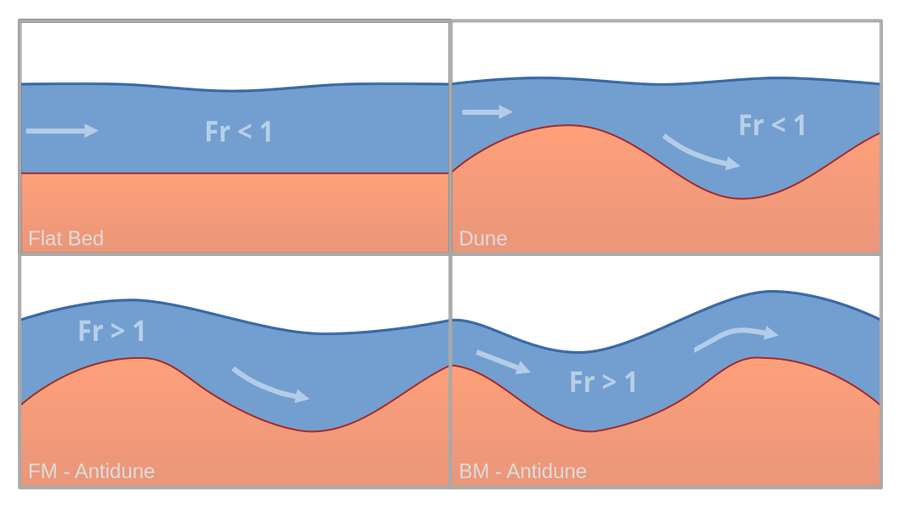
Bedfarms
Our Method: Particle-Resolving Simulations
We bridge the gap where physical experiments reach their limits. Instead of treating the riverbed as a flat wall, our simulation framework (waLBerla) models the exact geometry of every grain, the fluid pathways between them, and the free-water surface.
Lattice Boltzmann Method (LBM): Replicates complex, turbulent fluid flow with high fidelity.
Discrete Element Method (DEM): Resolves contacts, friction, and collisions between individual sediment particles.
Free-Surface VOF Scheme: Explicitly tracks the wildly shifting, deformable water surface.
Particle-Resolving Simulations © TPH
Project Objectives
-
Objective 1: Micromechanical Coupling
We analyze individual particle trajectories to understand exactly how sediment forces and fluid flow interact to maintain stable antidunes. -
Objective 2: Testing Theoretical Frameworks
We compare our ultra-precise simulation data against classical linear stability analyses to see where old mathematical models succeed and where they fail. -
Objective 3: Mapping the Regimes
By varying dimensionless metrics such as the Froude (Fr), Weber (We), Reynolds (Re), and Shields (\theta) numbers, we are building a comprehensive "regime map" to predict bedform behavior in real-world environments.
Project Team & Funding
-
Principal Investigator: Prof. Dr.-Ing. Bernhard Vowinckel (TU Dresden)
-
Lead Research Associate: Mr. Hafiz Rhaman Koshan, M. Sc. (TU Dresden)
The primary researcher leading the simulation campaigns, code implementation, and data analysis. -
Funding Body: This project is proudly funded by the German Research Foundation (DFG).