
Dynamic testing of containers
Overview
The subtitle of Marc Levinson’s paperback on the evolution of the shipping container, The Box, reads: “How the Shipping Container Made the World Smaller and the World Economy Bigger.” Indeed, this ingenious invention has become a symbol of today’s global economic system. As simple as the container may appear, the requirements it must meet in everyday operation are highly complex.
This project focuses on one particular requirement: the dynamic load-bearing capacity of the container structure. The emphasis will be on longitudinal stresses that occur during rail transport, which have been identified as particularly critical. The objective is to analyze and evaluate these stresses and subsequently reproduce them in a simulation model. Ultimately, this simulation model will be validated against practical experiments in order to draw conclusions regarding the predictive capabilities of current calculation methods for the dynamic load-bearing capacity of containers.
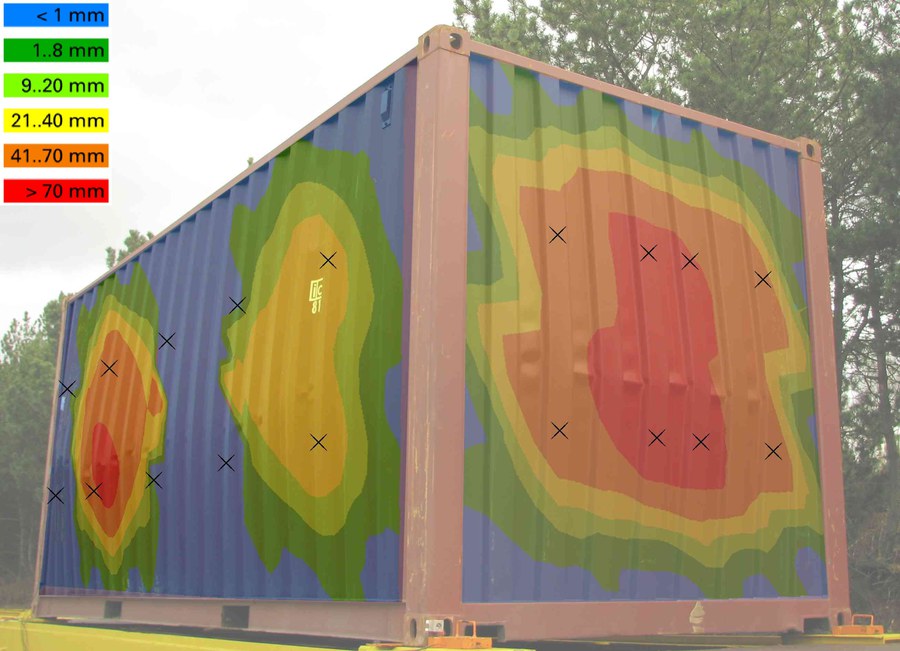
Deformed real container after an impact collision
Standards and current state
The starting point is the question of which standards are currently used to assess the dynamic load-bearing capacity of containers. It will be examined where these standards originate and how they are expected to develop. In analyzing similarities and differences, relevant literature from related testing fields will also be considered—for example, to evaluate whether the approval criteria for container flatcars are comparable to those for containers. It remains to be clarified whether the updated requirements for containers are still reflected in current regulations or whether difficulties arise in their application. Finally, the extent to which simulation tools are incorporated into existing standards will be assessed.
Experimental procedure and evaluation
A detailed description of the procedures involved in conducting dynamic impact tests on containers will be followed by an equally detailed examination of the evaluation of these type-approval tests. This chapter will investigate the physical and mathematical principles underlying the applied shock response spectrum analysis and assess how well it performs in practical applications. Test data from two years of experimental practice at TÜV SÜD Rail GmbH can be utilized for this purpose. These data will also be analyzed and evaluated for possible correlations with other test factors. Finally, the question will be addressed to what extent the testing method meets the updated requirements and whether it is suitable for related testing fields.
© P. Hartwig