
Enhancement of the energy efficiency of diesel-hydraulic railcars
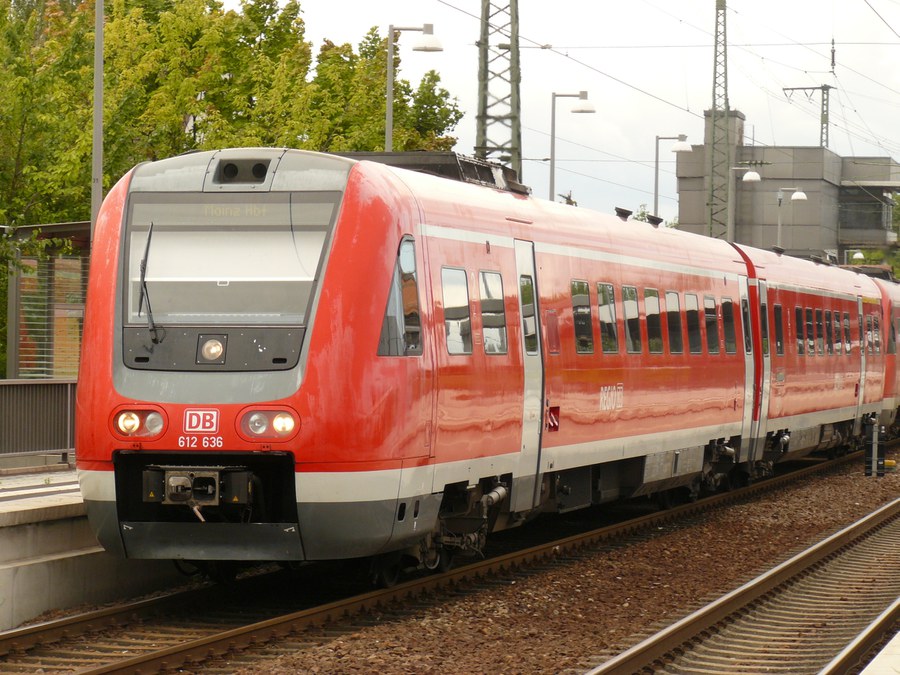
Diesel-hydraulic railcars are widely used in Central Europe. Both Deutsche Bahn AG and other private or (semi-)state operators maintain sizable fleets of these vehicles for use in local and regional transport. Examples include the German classes 611, 612, and 628.
In light of increasing ecological and economic constraints, it is necessary to consider ways to further improve the energy efficiency of diesel-hydraulic railcars to save diesel fuel and reduce emissions. The aim of the research is to gain insights through the simulation of various innovative powertrains. The focus of the investigations is on regenerative braking with intermediate energy storage and exhaust heat utilization through hybridization.
Publications
Subproject 1: Modeling a Diesel-Hydraulic Railcar Using the 1D Multi-Domain Simulation Tool AMESim™
Before the effects of various hybridization options can be investigated, the current state must first be represented. For this purpose, a model of a diesel-hydraulic railcar was developed in the AMESim™ simulation environment, with the core elements being the powertrain and the control logic for simulating railway-specific vehicle dynamics. To gain insights into the driving behavior of train operators and, consequently, the load profiles of the powertrain, operational data (e.g., speed, engine speed, power demand) were recorded and analyzed on a regional line under real-world conditions. The simulation also implements considerations for anticipatory and energy-efficient driving behavior.
Subproject 2: Regenerative Braking and Mobile Energy Storage
Increasing the energy efficiency of a transport operation in fully developed conventional powertrain technology is closely linked to the problem of recovering a portion of the energy converted during braking and storing it. The goal is to convert as much as possible of the kinetic energy supplied to the vehicle during acceleration into a form of energy suitable for reuse in the powertrain and to store it during periods when the vehicle is stationary. For the diesel-hydraulic railcars considered in this research, the conversion into electrical or potential energy is of particular interest for various reasons. In recent years, several actors have developed hydrostatic-based hybrid concepts, such as Bosch-Rexroth for commercial vehicles, Voith Turbo (EcoPack™ concept study) for rail vehicles, and PSA for passenger cars. Hydrostatic pumps/motors are used as energy converters, while the recovered energy is stored in hydraulic or gas pressure accumulators.

The extension of the conventional powertrain with electrical energy converters and storage systems also represents a promising hybridization strategy, which is currently pursued by all major manufacturers of mobile powertrain technology. The focus of Subproject 2 is on the modeling and comparison of different hybrid variants, as well as the interaction between the route profile, hybrid configuration, and operational strategy.

Subproject 3: Exhaust Energy Recovery
The energy balance of a diesel engine shows that, depending on the operating load point, only 30 to 40% of the chemical energy contained in the fuel is available at the crankshaft as mechanical energy. Approximately half of the energy losses are discharged through the exhaust in the form of thermal and kinetic energy. Various strategies currently exist to recover the energy present in the exhaust. These include turbo-compound systems, thermoelectric generators, and latent heat storage devices.
Another approach is the closed steam cycle developed by Voith Turbo for rail vehicle applications. Referred to as the “SteamDrive” or “SteamTrack” system, it is based on the concept of extracting thermal energy from the exhaust gas stream via a heat exchanger to vaporize a liquid working medium. The generated steam is then directed to an expander, where it performs mechanical work that can be used for traction or to generate electrical energy. After expansion, the working medium is fully condensed in a condenser and returned to the evaporator for reuse.
Subproject 3 involves the development of a simulation model of the entire exhaust heat recovery system, including its main components—feed pump, evaporator, expander, and condenser—as well as the configuration and calibration of this highly complex system using test bench data. Subsequently, by combining it with the baseline model developed in Subproject 1, the energy-saving potential can be evaluated depending on driving strategy and route profile. The railway-specific engine load profile, with its high proportion of idling, poses a particular challenge for the process.
Publications
Kache/Löffler: "Simulation hydrostatischer Hybridkonfigurationen für dieselhydraulische Triebwagen", in: Tagungsband 12. Internationale Schienenfahrzeugtagung Rad/Schiene 2012
Kache/Steglich: "Betriebliche Aspekte bei der Simulation dieselhydraulischer Triebwagen", in: ETR Eisenbahntechnische Rundschau, Bd. 60 (2011), Heft 9, S. 42-45
Kache/Steglich: "Fahrdynamische Untersuchungen an dieselhydraulischen Triebwagen mittels 1D-Systemsimulation", in: ZEVrail, Bd. 135 (2011), Heft 6-7, S. 258-264
Kache/Steglich/Löffler/Vogler: "Steigerung der Energieeffizienz dieselhydraulischer Triebwagen", in: Der Eisenbahningenieur, Bd. 61 (2010), Heft 3, S. 25-28,30-32
Kache/Steglich: "Enhancing the energy efficiency of diesel multiple units with hydrodynamic power transmission", in: Proceedings of the 5th International Scientific Conference "Theoretical and Practical Issues in Transport", Conference - CD-ROM, Pardubice, 11th-12th February, 2010 Link
Kache/Steglich/Löffler: "Ways to reduce the fuel consumption and emissions of diesel multiple units with hydraulic power transmission", in: Proceedings of the First International Conference on Road and Rail Infrastructure CETRA 2010, S. 949-955, ISBN 978-953-6272-37-2
Kache: "Investigating an all-hydraulic hybrid system for diesel-hydraulic rail cars", in: European Transport Research Review, Vol. 6, Issue 2(2014), pp.181-189 zum Volltext
Kache: "Modellierung, Simulation und Bewertung parallel-hybrider Antriebskonfigurationen für dieselhydraulische Triebwagen im Nah- und Regionalverkehr", Dissertation, TU Dresden, 2014, http://nbn-resolving.de/urn:nbn:de:bsz:14-qucosa-149909 zum Volltext
Kache: "Hybridlokprojekte - Ein globaler Überblick", in: ETR Eisenbahntechnische Rundschau (Homepage ETR), Bd. 63 (2014), Heft 10, S. 32-36 zum Volltext
Kache: "Diesel-Hybrid-Triebwagen", in: ETR Eisenbahntechnische Rundschau (Homepage ETR), Bd. 63 (2014), Heft 12, S. 50-53 zum Volltext
Kache/Steglich: "Simulation kombinierter Hybridkonfiguration für Dieseltriebwagen", in: ETR Eisenbahntechnische Rundschau (Homepage ETR), Bd. 64 (2015), Heft 1+2, S. 44-49 zum Volltext