
Sep 16, 2026
"Incentive Design for Demand-Side Flexibility in Transmission System Operation: A Bi-Level Market Equilibrium Approach" - New Publication in Energy Strategy Reviews
10.1016/j.esr.2026.102325
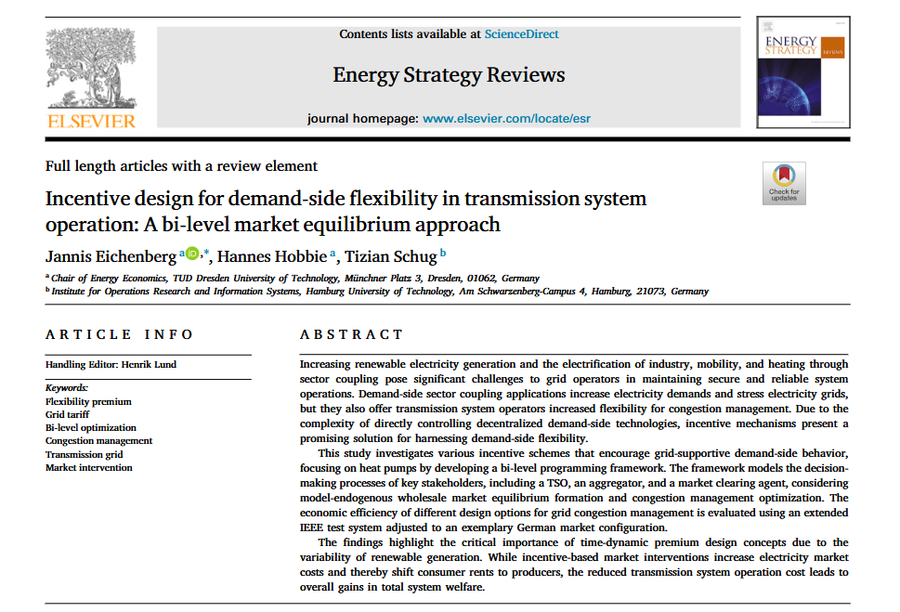
How can flexibility help relieve strain on the power grid without distorting the electricity market too much? Jannis Eichenberg, Hannes Hobbie (ee2), and Tizian Schug (TU Hamburg) explore this question in their new paper, “Incentive design for demand-side flexibility in transmission system operation: A bi-level market equilibrium approach”, published in Energy Strategy Reviews.
In today’s electricity market, market clearing generally occurs independently of transmission capacities and grid bottlenecks. The resulting electricity prices therefore do not account for local grid constraints and consequently reflect only a portion of the actual system costs.
With the increasing expansion of renewable energy and the electrification of heating, mobility, and industry, the importance of flexible electricity demand is growing. Consumers such as heat pumps can shift their electricity consumption over time and thereby respond to grid congestion. However, if price incentives are used in a targeted manner for this purpose, they influence not only grid operation but also market dynamics.
In our study, we examine various concepts for so-called flexibility premiums, which are intended to incentivize flexible consumers to adopt grid-friendly behavior. Using a bi-level optimization model, we jointly analyze the decisions of the transmission system operator, an aggregator, and the electricity market. Using heat pumps as an example, we analyze how time-based and regional incentives of varying levels of detail affect market outcomes and system costs.
The results show that while the activation of flexibility in a targeted manner can help reduce grid congestion, it simultaneously disrupts market equilibrium. Changes in demand shift electricity prices and the market positions of various stakeholders. In particular, time- and location-dependent premiums can lead to higher electricity market costs and alter the distribution of producer and consumer surpluses.
This creates a key conflict of objectives: The more in a targeted manner flexibility is deployed for grid operation, the greater the potential impact on the existing electricity market. Our results show, however, that these market distortions do not necessarily lead to welfare losses. If incentives are designed efficiently, the savings in grid management costs can outweigh the additional costs in the electricity market. It is also crucial that the time-based structure of the premiums be sufficiently precise, as simplified incentives can lead to inefficient load shifting.
This study thus illustrates that the use of flexibility for congestion management is not only a technical challenge but, above all, a market-economic one. The key question is to what extent and in what manner the electricity market should be influenced by grid-related incentives. Regional premiums can represent a compromise between flexibility management in a targeted manner and the necessary implementation effort.