
Apr 27, 2026
New publication "Bridging Economics and Physics in Energy System Analysis: Effects of Flexibility Representation on Model Outcomes"
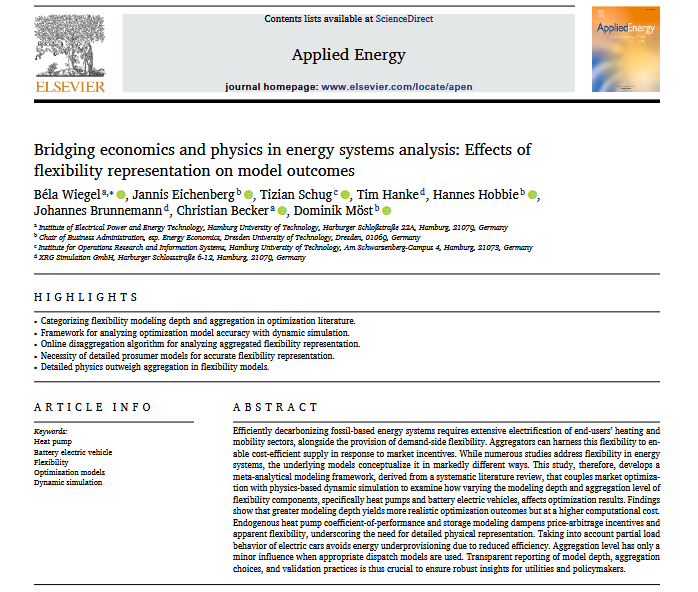
Title page in Applied Energy
How much physics does the market need? We—Jannis Eichenberg, Hannes Hobbie, and Dominik Möst (ee2)—explore this question together with colleagues from the Technical University of Hamburg and developers from XRG Simulation GmbH in our latest publication, which appeared in Applied Energy.
Based on a literature review, we first classify how flexible consumers can be represented in market models, both in terms of the level of detail of individual components and the aggregation of consumers. We then model these different levels of abstraction and compare the results with a detailed, engineering-oriented physical model (benchmark).
The results show that the level of detail required from a physical perspective varies significantly by sector. While it plays a relatively minor role in electromobility, it is essential for the heating sector to accurately represent market behavior regarding flexibility and price arbitrage. At the same time, unlike in electric mobility, heat pumps can be aggregated into clusters in the scenarios under consideration without significant approximation errors. This can significantly reduce computational effort without compromising model accuracy.
The work thus makes an important contribution to the energy economics modeling community and provides guidance for balancing computational time and model accuracy when modeling market behavior across the various sectors.