
Nov 18, 2026
Who Will Import Hydrogen in 2050? New Article Published in iScience
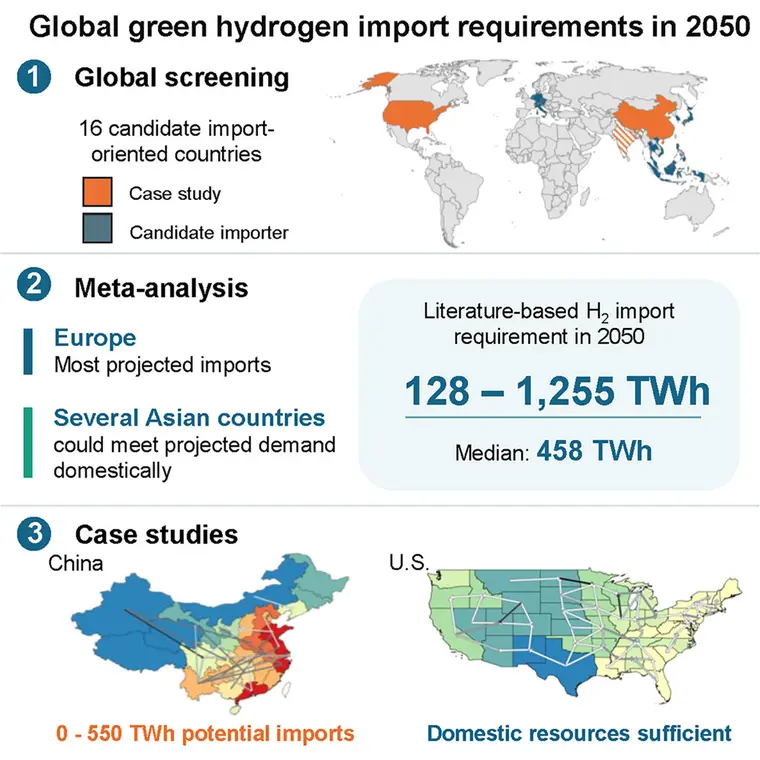
Graphical Abstract
Green hydrogen is considered a key component in the decarbonization of industry, transportation, and the energy system. Many studies are examining which countries could export hydrogen in the future. It is less clear, however, who will actually import it. A new article published in the scientific journal *iScience* addresses this question. The team of authors includes Veronika Brooks and Prof. Dr. Dominik Möst from the Chair of Energy Economics. The article was developed in collaboration with Fraunhofer IEG in Cottbus and Fraunhofer ISI in Karlsruhe.
The study examines three key questions:
- Which countries could become the main importers of renewable hydrogen worldwide by 2050?
- What will be the size of the international hydrogen import requirements by 2050, given the hydrogen demand and potential of the identified countries?
- What are the energy policy implications of such developments?
To answer these questions, the team first examined which countries worldwide have renewable energy potential that will not be sufficient to meet future energy demand. Subsequently, approximately 390 literature sources on hydrogen demand and domestic production potential were evaluated in a meta-analysis. This is supplemented by region-specific case studies for China and the U.S.
The key findings: Global import demand in 2050 will range between 128 and 1,255 TWh. This is significantly less than many previous studies have assumed. The primary drivers are European countries such as Germany, Italy, the Netherlands, and Belgium. Several Asian countries, on the other hand, could largely meet their demand from their own resources. The U.S. can meet its demand domestically. In China’s eastern provinces, however, imports of up to 550 TWh may be necessary. Overall, the hydrogen trade is likely to be organized regionally rather than globally, because renewable resources are widely distributed and hydrogen transportation is expensive.
The article is freely accessible (Open Access): Who will import hydrogen in 2050? Global assessment with China and U.S. case studies