
MUst – Modellierung von Unsicherheiten für eine systeminte-grierte Marktgebietskopplung
HINTERGRUND UND MOTIVATION
Die lastflussbasierte Marktkopplung (Flow-Based Market Coupling, FBMC) ist heute das zentrale Verfahren zur effizienten Koordination des grenzüberschreitenden Stromhandels in Europa. FBMC berücksichtigt reale Netzrestriktionen und physikalische Lastflüsse direkt im Markträumungsprozess und ermöglicht so eine präzisere und wirtschaftlichere Nutzung der Übertragungsnetze. Die Gestaltung der sogenannten Handelsdomänen, die den zulässigen Handelsspielraum zwischen den Marktgebieten definieren, ist dabei von entscheidender Bedeutung für die Markteffizienz und Netzsicherheit.
Mit der zunehmenden Komplexität und Dynamik der europäischen Stromsysteme, insbesondere durch fluktuierende Einspeisung und sich verändernde Lastprofile, steigen jedoch die Unsicherheiten bei der Bestimmung dieser Handelsdomänen deutlich an. Bisherige deterministische Methoden können diese Unsicherheiten nur unzureichend abbilden, was zu konservativen Kapazitätsgrenzen oder erhöhten Risiken für Netzengpässe führen kann. In der wissenschaftlichen und regulatorischen Diskussion wächst daher das Interesse an probabilistischen Ansätzen, die Unsicherheiten explizit modellieren und so robustere und zugleich effizientere Handelsdomänen ermöglichen. Das Projekt MUst setzt an dieser Stelle an und verfolgt das Ziel, die Methodik der lastflussbasierten Marktkopplung durch innovative probabilistische Verfahren gezielt weiterzuentwickeln und für die Praxis anwendbar zu machen.
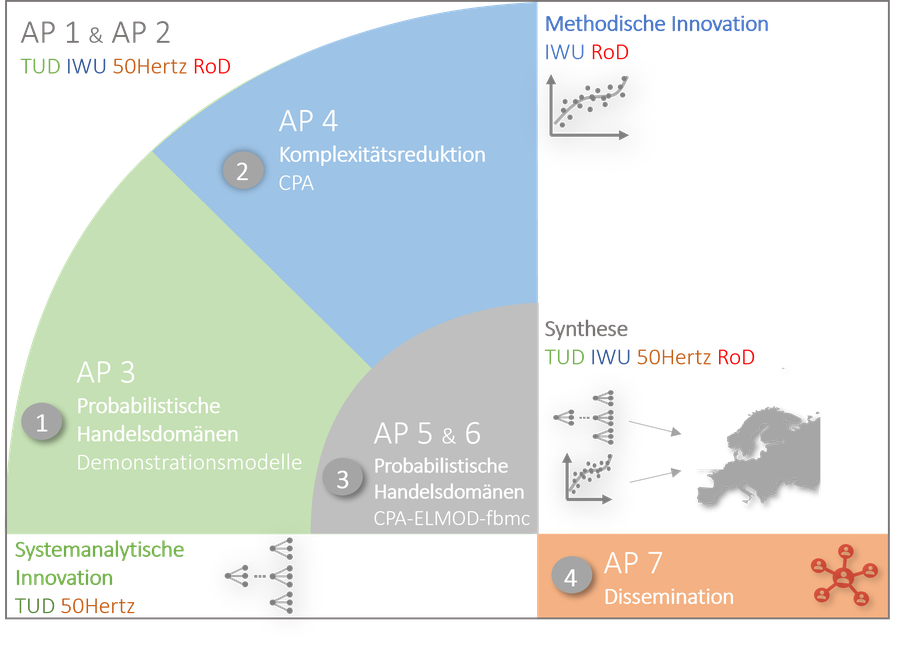
Somit trägt das Projekt dazu bei, Unsicherheiten im Stromsystem systematisch zu berücksichtigen, die Effizienz und Robustheit der lastflussbasierten Marktkopplung zu steigern und zukunftsfähige, wissenschaftlich fundierte Grundlagen für regulatorische Entscheidungen bereitzustellen.
PROJEKTINHALTE
Das Projekt MUst verfolgt einen interdisziplinären Ansatz zur Weiterentwicklung der lastflussbasierten Marktkopplung. Im Mittelpunkt steht die Entwicklung probabilistischer Handelsdomänen, die Unsicherheiten in Last, Erzeugung und Netzzuständen systematisch berücksichtigen. Dazu wird ein industriell erprobtes, datengetriebenes Modellierungsverfahren aus der Fertigungs- und Prozesstechnik erstmals auf die Energiesystemanalyse adaptiert. Dieses Verfahren ermöglicht es, netzrelevante Nebenbedingungen effizient und datenbasiert abzuleiten, ohne auf aufwändige deterministische Simulationen angewiesen zu sein.
Die entwickelten Methoden werden zunächst an stillisierten Modellen validiert und anschließend auf reale Marktdaten des mitteleuropäischen Verbundnetzes angewendet. Die probabilistischen Handelsdomänen werden in das etablierte Strommarkt- und Netzmodell ELMOD integriert, um ihre Auswirkungen auf Markteffizienz, Engpassmanagement und Netzstabilität quantitativ zu bewerten und methodisch vergleichend zu analysieren.
Die enge Zusammenarbeit mit den Praxispartnern gewährleistet die Praxisrelevanz der entwickelten Ansätze und ermöglicht eine industrienahe Validierung unter realen Betriebsbedingungen. Die Projektergebnisse werden im Sinne der Open-Science-Prinzipien über Workshops, wissenschaftliche Publikationen und offene Energieplattformeng zu liefern.
Laufzeit: 2026 - 2029
Mittelgeber: Bundesministerium für Wirtschaft und Energie (BMWE)
Partner: TU Dresden (Koordinator), Frauhnhofer IWU, Return on Data UG, 50Hertz Transmission GmbH
Projetbearbeitung: Dominik Möst, Hannes Hobbie, Dimitrios Glynos, Jannis Eichenberg
Ansprechpartner: Dimitrios Glynos