
SOffie - Systemintegration Offshore-Windenergie
BACKGROUND AND MOTIVATION
In order to achieve Germany's climate protection targets and the associated energy transition, the extensive expansion of offshore wind energy in the North Sea and Baltic Sea is essential. Offshore wind energy is set to become a key component of Germany's future energy mix, with current capacity of just about 9 GW expected to rise to about 30 GW by 2030 and around 70 GW by 2045. At the same time, there are still central challenges to be overcome in the coming twenty years for the expansion and integration of large-scale capacities into the German and European energy systems.
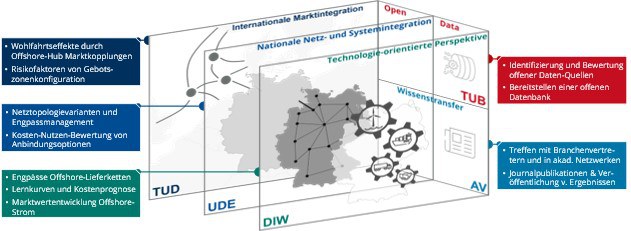
The technological advancement of offshore installations and their system integration, as well as the further development of energy policy and energy markets in a European and global context, present substantial potential. However, the associated uncertainties hinder the timely and efficient implementation of offshore wind projects through the stakeholders. In particular with regard to the period after 2030, it is essential to set the course for the efficient and resilient integration of planned German offshore wind energy into a climate-neutral energy system in cooperation with the neighboring countries of the North Sea and Baltic Sea. Decision-makers in politics and business are faced with a variety of options for action and are required to make crucial decisions on system design that will greatly influence the future role of offshore wind energy and may also affect the resilience of the German electricity system.
PROJECT SCOPE
The project therefore aims to examine key determinants and pivotal milestones for the expansion and integration of large-scale offshore wind energy and associated infrastructure into the German electricity system. One focus is on the role of offshore hubs and related questions of market coupling and the impact on the German energy system. This further includes analyses of combined hydrogen-wind hubs and regulatory aspects of the design of financing instruments for offshore infrastructure projects. In this context, particular research focus is placed on the effects on investor behavior, including the role of risk assumption, and aspects of cooperation between infrastructure planners. As part of the analyses, detailed electricity market and grid models will be developed further and open technology and grid data will be made available. Scientific findings will be used to provide practical recommendations and guidance for policymakers, project developers, and infrastructure developers to assist in the assessment and selection of key policy measures. As a result, the project will contribute directly to the future design of efficient and resilient offshore wind energy systems.
Laufzeit: 2025 - 2028
Mittelgeber: Bundesministerium für Wirtschaft und Energie (BMWE)
Partner: TU Dresden (Coordinator), TU Berlin, DIW Berlin, Universität Duisburg-Essen, AquaVentus Förderverein e.V.
Projetbearbeitung: Dominik Möst, Hannes Hobbie, Lisa Lorenz, Akshay Singh Yadav
Ansprechpartner: Hannes Hobbie