
Aug 06, 2026
Researchers Discover Molecular "Brakes" on Nerve Regeneration
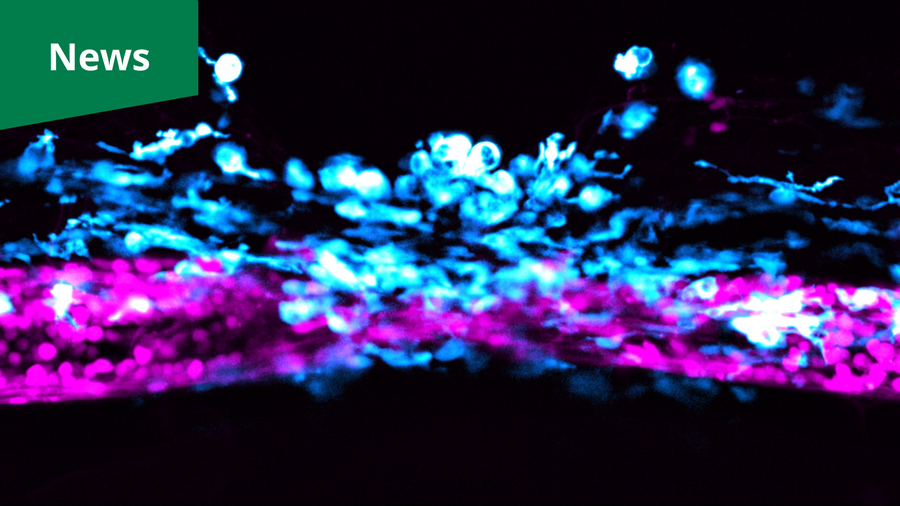
A microscopy image showing immune cells interacting with neurons to promote neural regeneration and tissue healing. Immune cells (macrophages) are highlighted in blue while neurons and axons are visible in magenta.
Unlike humans, zebrafish possess the incredible ability to heal their own spinal cords and grow back lost nerve cells after an injury. However, even in these master regenerators, the healing process has a built-in speed limit. In a new study published in the journal PLOS Biology, researchers from the Becker group at the Center for Regenerative Therapies Dresden (CRTD) at TUD Dresden University of Technology and the University of Edinburgh have identified a protein that acts as a molecular brake, slowing down the creation of new neurons after a spinal cord injury.
When a spinal cord is injured, the immune system sends in specialized defender cells called microglia. These cells act as the brain and spinal cord's clean-up crew. However, over the years, researchers have observed that microglia might do far more at the injury site than just clean debris. Using advanced single-cell sequencing technology, the Becker team analyzed microglia present at the spinal cord injury site in zebrafish larvae. They identified a specific protein produced by these cells when responding to the injury: sema4ab.
To better understand the function of microglia at the spinal injury site, the researchers genetically removed the protein sema4ab. The results were dramatic: the zebrafish doubled the number of new neural stem cells and newly made neurons at the injury site.
"We always knew zebrafish were amazing at regenerating nervous tissue. Now, we found what controls the speed of that repair," says Dr. Alberto Docampo-Seara, a postdoctoral scientist in the Becker group who conducted the study. "By removing this single protein, sema4ab, we essentially took the brakes off the system, allowing the fish to produce twice as many new nerve cells. The fact that these brakes exist shows us that the environment around a spinal injury actively controls how fast the healing can happen."
A Complex Cellular Dance
Looking closer at the microglia and sema4ab, the group observed that the braking mechanism is a finely tuned conversation between several different cell types.
The sema4ab protein produced by microglia holds back the signals from fibroblasts - cells that form tissue structure. However, when sema4ab is gone, this brake is released, and the fibroblasts suddenly pump out a molecule called tgfb3. This molecule acts as a super-booster, massively speeding up the growth of new nerve cells.
“More neurons sound better, right? Not necessarily,” says Dr. Docampo-Seara. “Surprisingly, while turning off the sema4ab creates way more new neurons, the fish actually struggle to rebuild the axons – the long nerve fibers needed to fully recover their swimming abilities.”
This shows that the immune system, and specifically the microglia, plays an active role in timing the regeneration processes to keep a perfect balance between creating new cells, maturing them, and rewiring the connections properly.
Why It Matters
Humans and other mammals do not naturally replace lost neurons after a spinal cord injury. Instead, our bodies create a rapid and prolonged inflammation that results in the formation of permanent scar tissue. Understanding how zebrafish immune system is tuned helps us understand the molecular requirements for regeneration.
“We are constantly expanding our map of interactions during a regenerative response. The ultimate goal is to reach a point where we have enough understanding to actually start gently adjusting these same pathways in human patients and create a similar healing environment around the injured spinal cord,” concludes Prof. Catherina Becker, who led the study.
About the Study
The research was conducted by an international team at the Center for Regenerative Therapies Dresden (CRTD) at TU Dresden, the Cluster of Excellence Physics of Life (Dresden), and the Centre for Discovery Brain Sciences at the University of Edinburgh. The study was supported by the core facilities of the Center for Molecular and Cellular Bioengineering (CMCB) of TU Dresden, especially the Light Microscopy Facility and the DRESDEN-concept Genome Center. The work was funded by the Biotechnology and Biological Sciences Research Council (BBSRC) and the Alexander von Humboldt Foundation.
Original Publication
Alberto Docampo-Seara, Mehmet Ilyas Cosacak, Kim Heilemann, Friederike Kessel, Ana-Maria Oprişoreanu, Markus Westphal, Özge Çark, Daniela Zöller, Josi Arnold, Anja Bretschneider, Alisa Hnatiuk, Nikolay Ninov, Catherina G. Becker, Thomas Becker: The microglia-derived protein Sema4ab attenuates regenerative neurogenesis after spinal cord injury in zebrafish. PLOS Biology (June 2026)
Link: https://doi.org/10.1371/journal.pbio.3003865