
Jul 15, 2026
Maestros of Healing: How “Good” Immune Cells Help Regenerate Spinal Cord Injuries

Xiaobo Tian and Prof. Thomas Becker.
Humans cannot fully heal spinal cord injuries. When the spinal cord is damaged, the body's immune system often spirals into chaos. This overwhelming, inflammatory response creates permanent scar tissue that stops nerve cells from ever repairing themselves or their connections. Zebrafish, however, have mastered the biological art of managing this cellular chaos to completely heal spinal cord damage. In a new study published in the Journal of Neuroinflammation, scientists from the Becker group at the Center for Regenerative Therapies Dresden (CRTD) at TUD Dresden University of Technology and the University of Edinburgh have discovered exactly how zebrafish deploy a specific type of immune cells to gently restore harmony and pave the way for nerve regeneration.
The immune system is a complex orchestra with many cell types, each having its own part to play. When an injury occurs, the very first cells to arrive at the site are neutrophils. Historically, researchers thought of these cells as a simple clean-up crew that just clears away debris from the injury site. However, the Becker team discovered that a specific subgroup of these neutrophils has a crucial job: like a conductor in an orchestra, these cells signal the rest of the immune system to dial down their response back into a harmonious rhythm of regeneration. Their secret? A signaling molecule called Il-4.
First Responders Restore Balance
The Becker group worked with larval zebrafish to understand the role of neutrophils and the Il-4 signaling molecule at the injury site. When this specific cell group was inactivated in the experiment, the situation spiraled completely out of balance. Other immune cells began overproducing highly inflammatory proteins, leading to an uncontrolled overreaction. This effectively stalled the fish's ability to regrow nerve fibers and recover their movement.
However, when the researchers artificially added the Il-4 signaling molecule to the injury sites, the inflammation calmed down and the spinal cords regenerated perfectly – even without the physical presence of neutrophils.
"For the first time, we have shown that neutrophils play a massive, active role in successfully repairing a spinal cord," says Prof. Thomas Becker, who led the study. "They aren't just there to clear away debris; they act like conductors that tell other immune cells to return to a harmonious rhythm. Without them, the immune system locks into a destructive cycle and prevents healing. By using the Il-4 molecule, the neutrophils smooth out the inflammation, allowing the delicate nerve fibers to grow right through the injury zone."
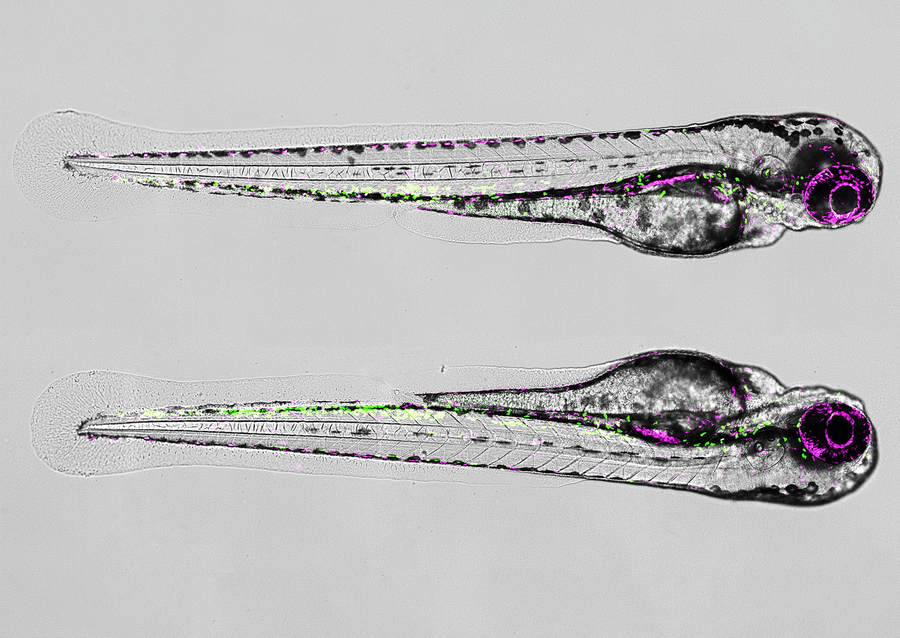
A microscopy image of two 3-day-old zebrafish larvae. The immune cells are labeled with fluorescent proteins: the neutrophil cells are visible in green and the other immune cells in magenta. The similar pattern of distribution of immune cells shows the remarkable consistency within their immune responses, even among distinct individuals. It is precisely these intrinsic mechanisms of regeneration that the researchers in the Becker group at the CRTD are exploring.
Lessons for Humans
The stark contrast between how zebrafish and humans respond to spinal cord injuries is a major puzzle in regenerative medicine. While a human's immune response to injury often causes permanent damage to the central nervous system, the zebrafish provides a roadmap for unrealized medical potential. The study not only cements the finding that the fine regulation of inflammation is crucial for healing but also shows exactly how unleashing the right signals at the right time can reactivate nerve regeneration.
“Of course, the question is to what extent our results apply to humans. It remains to be seen if Il-4 plays a similar role in humans and whether it can finely balance the inflammation, allowing for better healing at the injury site,” says Xiaobo Tian, who conducted the study. “It is definitely a very promising avenue for future studies in humans.”
About the Study
The study was led by Xiaobo Tian and an international team of scientists at the Center for Regenerative Therapies Dresden (CRTD) at TU Dresden, the Cluster of Excellence Physics of Life (Dresden), and the Centre for Discovery Brain Sciences at the University of Edinburgh. It was funded by the Chinese Scholarship Council and the Alexander-von-Humboldt Foundation.
Original Publication
Xiaobo Tian, Alberto Docampo-Seara, Kim Heilemann, Friederike Kessel, Daniela Zöller, Anja Bretschneider, Thomas Becker & Catherina G. Becker: A reparative neutrophil subpopulation accelerates spinal cord regeneration in zebrafish by controlling macrophage inflammation via Il-4. Journal of Neuroinflammation (June 2026)
Link: https://doi.org/10.1186/s12974-026-03878-0
About the Center for Regenerative Therapies Dresden (CRTD)
The Center for Regenerative Therapies Dresden (CRTD) of TUD Dresden University of Technology is an academic home for scientists from around 25 nations. Their mission is to discover the principles of cell and tissue regeneration and leverage this for the recognition, treatment, and reversal of diseases. The CRTD links the bench to the clinic, scientists to clinicians to pool expertise in stem cells, developmental biology, gene-editing, and regeneration towards innovative therapies for neurodegenerative diseases such as Alzheimer's and Parkinson's disease, hematological diseases such as leukemia, metabolic diseases such as diabetes, bone and retina diseases. The CRTD was founded in 2006 as a research center of the German Research Foundation (DFG) and funded until 2018 as a DFG Research Center, as well as a Cluster of Excellence. Since 2019, the CRTD is funded by the TU Dresden and the Free State of Saxony.
The CRTD is one of three institutes of the central scientific unit Center for Molecular and Cellular Bioengineering (CMCB) of the TU Dresden.