
Mar 04, 2026
New policy paper by IW and the Chair of Responsible Management sheds light on CEO activism and its impact on social perception
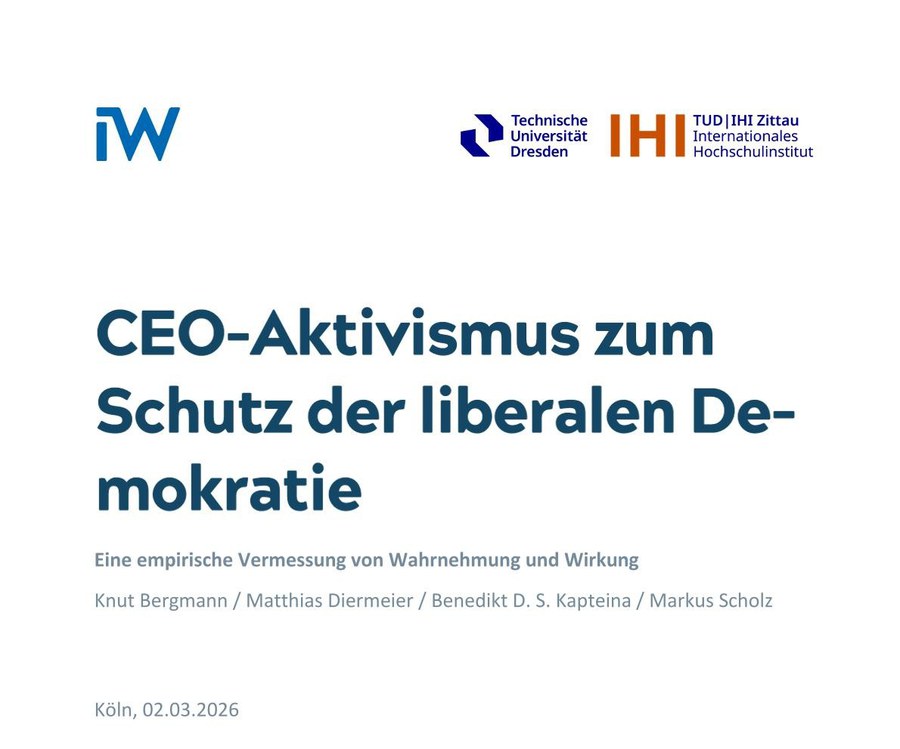
In their latest policy paper entitled "CEO activism to protect liberal democracy: An empirical measurement of perception and impact" , Prof. Dr. Markus Scholz and Dr. Benedikt Kapteina from IHI Zittau (TU Dresden), together with Dr. Knut Bergmann and Dr. Matthias Diermeier from the Institute of German Business (IW), analyze the political engagement of CEOs in Germany. In particular in the context of public criticism of the Alternative for Germany (AfD). For the first time, they provide systematic data on the perception and impact of such positions among the population.
In recent years, several CEOs of German companies have publicly positioned themselves against the AfD, emphasizing political risks to the free and democratic Fundamental Principles or potential economic damage. Until now, however, it has been largely unclear how these positions are perceived by the population and what effects they have. The new IW study uses a specially designed survey to systematically record perception, legitimacy and evaluation effects. It thus adds extensive empirical evidence to the debate on corporate political responsibility.
The results show a differentiated picture. Around a third of the population state that they have heard the CEOs' arguments. Nevertheless, only around one in six respondents consider such public statements to be legitimate. In general, there is a skeptical understanding of the influence of companies on political discourse in Germany. Only around a quarter of the population trust companies to act responsibly in the interests of society. While AfD supporters have relatively more trust in companies than supporters of established left-of-centre parties, there are clear feedback effects. Criticism of the AfD by CEOs often leads to a loss of trust in the criticized companies among AfD sympathizers and in some cases strengthens their ties to the party.
The authors emphasize that the empirically diagnosed limited persuasion effects do not fundamentally question the legitimacy of corporate statements. Rather, they shift the focus from the question of "whether CEOs should speak out" to "how strategically thought-out engagement can be designed".
Three key recommendations for management practice are as follows:
- Political engagement should be long-term, strategic and organized as part of a coherent engagement portfolio, rather than relying on individual statements.
- The company's own core values, such as the defense of liberal-democratic principles and human rights, should serve as a guideline and not be dependent on managers
- Criticism should be factual, solution-oriented and responsibly formulated in order to avoid polarization effects.
These recommendations underline the need for reflected political engagement that aims to create trust rather than divide.
For the first time, the IW study provides empirically sound insights into a political field that has so far been debated primarily in normative terms: the interference of company management in socio-political disputes. The results paint a complex, sometimes contradictory picture with clear implications for corporate governance, political consulting and democracy research.
While CEO activism can be understood as an expression of societal responsibility, the study also illustrates the limits of its persuasive power. Public positions encounter a heterogeneous audience that evaluates and classifies them very differently.
You can find the policy paper here under this link.