
MAYA-CO2 - Materials for Adsorptive Yield and Action for Carbon Offset
Bioeconomic valorisation of the macroalgae Sargassum for CO2-storing constructions
Description: For years, massive quantities of the brown macroalgae Sargassum spp. have been washing ashore along the coasts of the Atlantic, the Caribbean, and the Gulf of Mexico (see the photo below of the beach in Yucatán, Mexico, March 2025). This damages marine ecosystems, burdens the local economy, primarily tourism, and can also endanger the health of coastal populations through the release of toxic gases.
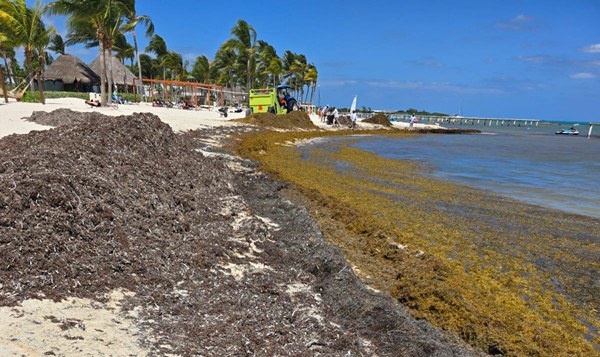
At the same time, this alga holds considerable untapped potential: the carbon stored within it could be sustainably sequestered over the medium term through efficient treatment systems.
This is the idea behind MAYA-CO2. The project aims to transform Sargassum into durable, climate-friendly building materials, such as bricks made from clay and algae biomass. This biogenic material could store CO2 instead of releasing it. In addition, the integration of bio-based metal-organic frameworks (MOFs) into the material is being investigated. These tiny structures are expected to adsorb pollutants such as hydrogen sulphide or formaldehyde from indoor air. These are caused in the affected regions both by conventional building materials and by the uncontrolled biodegradation of stranded sargassum.
The project brings together multiple disciplines: materials science, environmental science, chemistry, and sustainability research. It investigates how Sargassum can best be processed, how the building materials perform under real-world conditions, and whether they are economically and ecologically viable. This is done through the application of life cycle assessment (LCA) and techno-economic analyses.
Collaboration between German and Mexican partners is essential to the project. The German partners contribute expertise in material development and sustainability assessment. The Mexican partners provide scientific assessment, access to Sargassum at real scale, as well as local ecological and cultural knowledge.
The anticipated outcome: a troublesome waste material could become a valuable resource with real benefits for the climate, human health, and the people living along affected coastlines.
This gives rise to three key research questions
- Which pre-treatment methods maximise long-term carbon sequestration in Sargassum-based building materials?
- Which bio-based MOF frameworks are suitable for structural integration into a clay-Sargassum matrix and how does this affect their adsorption capacity for target pollutants?
- Under what conditions (pre-treatment, material matrix) does the full life cycle of Sargassum-based building materials yield a favourable CO2 balance compared to conventional concrete?
Lead: Prof. Dr. Remmer Sassen
Status: Preparation of third-party funding applications (DFG)
(Potential) Project Partners:
Centro de Investigación Científica de Yucatán (CICY), Mérida
Centro de Investigación y de Estudios Avanzados del IPN (CINVESTAV), Mérida
If our research initiative has caught your interest and you would like to find out more or become a (potential) partner, please feel free to send an email to and .