
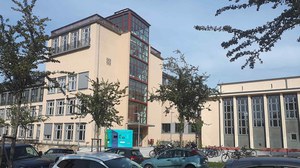
Research at the Institute of Automation (IfA)
Under the direction of Prof. Dr.-Ing. Leon Urbas, the Chair of Process Control Engineering develops descriptive frameworks, methods, and tools for designing process control strategies in the process industry.
Professor Janschek headed the Chair of Automation from 1995 until September 30, 2026, and, following his retirement, has continued to serve as a senior professor (Automation Technology) at the Institute of Automation Technology since October 1, 2026, focusing on research projects.
Since October 1, 2026, the Institute of Automation has housed the Chair of Robotics, headed by Professor Dr.-Ing. Giang Nguyen. Research at the Chair of Robotics focuses on the intersection of Physical AI, network software engineering, and machine learning.
Research Areas and Research Projects
The research activities at the Chair of Process Control Systems fall under the following main areas:
- Industrial process control systems (PCS):
Investigation and evaluation of industrial systems with regard to user interfaces, bus systems, process-related components, program design, and verification - Object-oriented and component-based concepts and technologies:
Modeling, design, and simulation of complex automation systems - Intelligent commissioning and diagnostic strategies in process control engineering:
Design of commissioning systems, use of expert systems - CAE systems: Design and implementation of software tools for control and regulation design
- Real-time / Embedded Systems: Design and implementation of real-time operating systems for process-related components; implementation of computer-process interfaces; PLC function block libraries.
Research at the Chair of Robotics explores the nexus of physical artificial intelligence, network softwarization, and machine learning. We focus on developing adaptive control strategies, deterministic algorithms, and low-latency communication frameworks to enable seamless real-time interaction between humans and robots. Grounded in the principle that true innovation requires the interplay of theory, software, and hardware, our algorithms are rigorously validated on advanced experimental testbeds. Through close collaboration with academic and industrial partners, we translate cutting-edge research into resilient key technologies for future automation and collaborative robotic environments.
The following medium-term research priorities were addressed by the Chair of Automation:
- Research Area - SYSTEMS DESIGN: The Systems Design research area addresses issues related to the model-based design of heterogeneous, complex technical systems for automation, robotics, and mechatronics. The goal is to derive reliable metrics for performance and behavioral properties early in the development process based on abstract system models. Current work focuses on the modeling, analysis, and verification of dependability properties (RAMS—Reliability, Availability, Maintainability, Safety) using state-of-the-art system models (UML-SysML, AADL, MATLAB/Simulink).
-
Research Area - ROBOTICS: The Robotics research area encompasses the development of low-effort concepts and solutions for guidance, navigation, and control of autonomous vehicles (aerial and space vehicles, service robots), the development of control algorithms and system concepts for aerial manipulation using drones, and the system design of hardware-in-the-loop (HIL) test benches for the ground-based verification of spacecraft docking dynamics.
-
Research Area - MECHATRONICS: The Mechatronics research area focuses on the development of optomechatronics system solutions and technologies. Research and development activities range from the control of MEMS micromirrors and wavefront shaping to the development of high-performance, compact optical Fourier processors and optical correlators and their application in smart imaging systems for remote sensing and visual navigation, as well as optical measurement systems for industrial visual inspection systems.
-
Research Area - INDUSTRIAL AUTOMATION: The Industrial Automation research area focuses on the application of innovative information technologies —such as model-driven and communication technologies—and the challenges and risks they pose for automation solutions. The goals are the conception and design of formal models and languages for the systematic and consistent design of automation systems to support essential use cases throughout the life cycle of automation systems, such as Plug&Produce or Continuous Engineering. One area of application is the development of submodels for human-machine interface fragments to enable self-description within Industry 4.0 components in accordance with industrial requirement definitions. Another field is the conception and development of novel multimodal user interfaces to intelligently connect people and remote product surfaces using Internet and telecommunications technologies (Web, XML, Web services, 5G technologies).