
Feb 05, 2026
Terezín: Vision 2025 I International Urban LAB in Terezín (CZ)
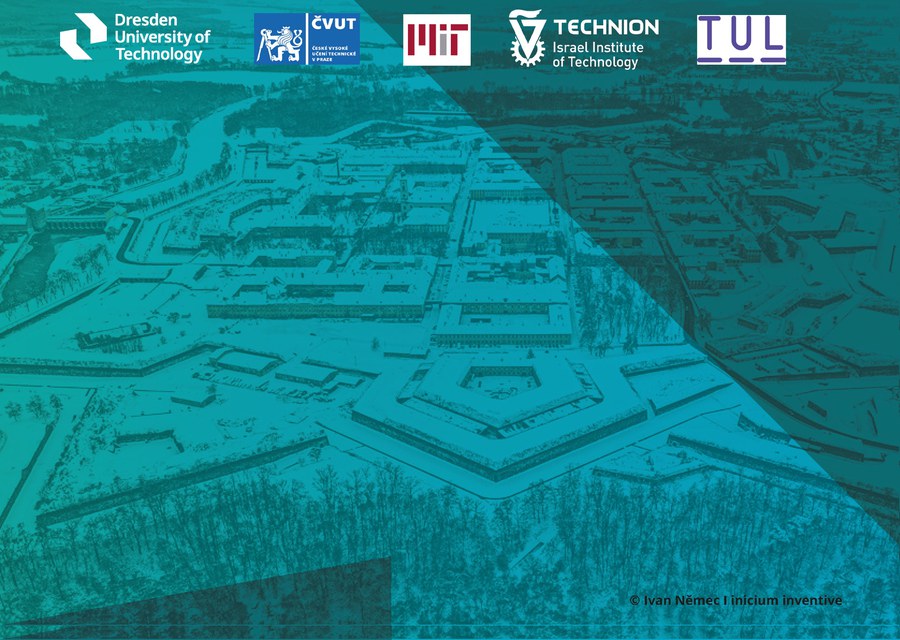
Terezín: Vision 2050 is aninternational, transdisciplinary teaching and research project of the architecture faculties of ČVUT Prague and TU Dresden in cooperation with MIT Boston, IIT Haifa and TU Liberec. The aim of the project is to analyze the complex history of the Czech city of Terezín and at the same time to develop sustainable perspectives for a historically highly charged place - once a Habsburg fortress, then a National Socialist ghetto, today a small town and a central European place of remembrance at the same time. The focus is on the question of how sustainable urban development, a culture of remembrance and social justice can be reconciled. Methodologically, the project combines archival research, oral history, spatial documentation, 3D scans, mapping, environmental measurements and film formats.
Terezín is exemplary for the overlapping of trauma, memory and urban development. While the Small Fortress has been established as a memorial site since the post-war period, the Great Fortress is confronted with the typical challenges of post-military cities: underused buildings, limited resources and a lack of long-term development prospects. A central challenge is to reconnect both parts of the city - spatially and conceptually - and to understand Terezín as a coherent urban space.
Architecture and urban structure are understood as an active "spatial archive" : as a palimpsest of military order, history of violence, memory and future potential. Based on this interpretation, the project teams in the Urban LAB (29.03.-04.04.2026 on site in Terezín) will develop future scenarios for different development paths for the city. These scenarios will be elaborated in visual and narrative formats - including maps, collages, films and text projections - and condensed into a coherent vision.
The Chair of Urban Design will work on the project as a main or in-depth design . The aim is to develop an urban development and open space planning vision as well as a development strategy tailored to it, which enables a gradual, process-based implementation. The strategic plan forms the interface between research and design and addresses in particular
-
the interplay of landscape, fortifications and settlement structures
-
historical and cultural narratives
-
social and inclusive use programs
-
new and adaptive building typologies
-
the reactivation of underused structures and spaces
-
the redesign of open spaces and landscapes
-
climate adaptation strategies
If you are interested in participating, please register by e-mail by Thursday, 12.02.2026 at the latest at