
Mar 16, 2026
Federal Minister of Health Nina Warken visits the PEDNET-LC project in Dresden
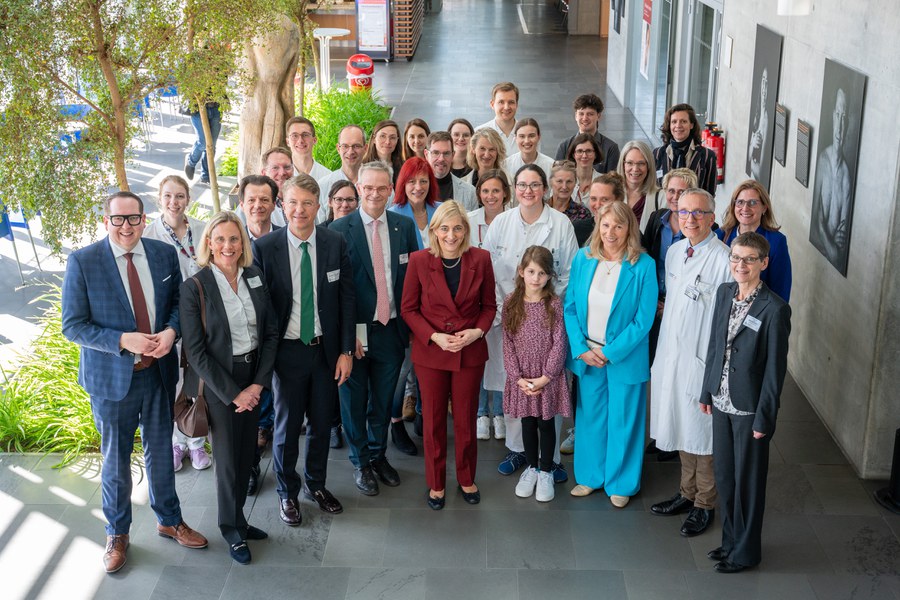
On March 13, 2026, Federal Minister of Health Nina Warken visited the PEDNET-LC project team at the Dresden University Hospital Carl Gustav Carus. PEDNET-LC is a nationwide consortium of 65 clinics and research institutes. The project aims to significantly improve the diagnosis and treatment of Long COVID-like diseases in children and adolescents, providing comprehensive and effective care for those affected. The focus is on 20 specialized, interdisciplinary care centers that have been treating children and adolescents throughout Germany since the beginning of 2025. The Department of Pediatrics and Adolescent Medicine at Dresden University Hospital is one of these centers. PD Dr. Nicole Töpfner, Senior Consultant Paediatric Infectiology, coordinates these care centers nationwide and serves as the deputy project manager of PEDNET-LC. The Federal Ministry of Health is funding the project with EUR 41 million over four years.
"Especially for children and young people suffering from Long Covid, we need to create nationwide care structures that help them in a targeted manner. That is why we are funding projects that pursue precisely this goal. PEDNET-LC is making a decisive contribution here and shows that the funding is working. By setting up special outpatient clinics in which different departments work closely together, young patients receive the best possible support on their road to recovery. In this way, care in this area can be sustainably improved. My special thanks go to all those involved, who are working with great commitment for the affected children and young people and their families," says Federal Minister of Health Nina Warken.
"PEDNET-LC is a wonderful example of the responsibility we assume as a university hospital. It is about offering comprehensive care and holistic help to children and young people with complex symptoms. We are very proud that our expertise has been recognized by the Federal Ministry of Health. This appreciation is our incentive in the interests of the patients we care for," says Prof. Uwe Platzbecker, Medical Director at Dresden University Hospital.
For a year now, the outpatient clinic for post-acute infection and vaccination syndromes (PAIVS) and ME/CFS at Dresden University Hospital has been treating children and adolescents who suffer from a variety of symptoms following an infection or vaccination. These include, for example, pathological exhaustion, low resilience, hypersensitivity to stimuli, circulatory problems and persistent pain. The PAIVS & ME/CFS outpatient clinic is part of the nationwide model measure PEDNET-LC – a pediatric network of 65 institutions for the care and research of post-acute consequences of Covid-19 (Long COVID), similar post-acute infection and vaccination syndromes (PAIVS) and myalgic encephalomyelitis/chronic fatigue syndrome (ME/CFS) in children and adolescents. A team of doctors, psychologists, social pedagogues and nursing staff work together on an interdisciplinary basis to help those affected. In recent years, an increasing number of children and adolescents have been treated in the outpatient clinic. The majority of patients are between twelve and 18 years old.
Families who contact the outpatient clinic receive standardized anamnesis questionnaires covering symptoms such as exhaustion, pain, concentration, sleeping patterns and everyday stress. If there are clear indications of a post-infectious syndrome, the diagnosis is made in the pediatric clinic. Post-infectious symptoms can occur after infections with SARS-CoV-2, influenza virus or Epstein-Barr virus as well as many other infectious triggers. Children and adolescents with symptoms after COVID-19 vaccination as well as patients with ME/CFS regardless of the trigger are also cared for in the centers.
In addition to its work in the outpatient clinic, Dresden University Medicine plays a central role in the PEDNET-LC project. The Dresden Biobank supports the national collection of paediatric biosamples for future research projects. Prof. Christian Beste, Department of Child and Adolescent Psychiatry and Psychotherapy, is the project lead for psychiatry at the Dresden Care Center. Additionally, Prof. Martin Sedlmayr's team at the Institute for Medical Informatics and Biometry is contributing its expertise in the integration of clinical and research data.
Myalgic encephalomyelitis/chronic fatigue syndrome (ME/CFS)
Myalgic encephalomyelitis/chronic fatigue syndrome (ME/CFS) is a severe multi-organ disease that often leads to a high degree of physical disability. Children and adolescents suffer from severe fatigue, which significantly limits their level of activity, low resilience and unrefreshing sleep, as well as neurocognitive, autonomic and immunological symptoms. Typical for ME/CFS is a pronounced and long-lasting intensification of all symptoms after minor physical and mental exertion (post-exertional malaise, PEM for short). Many sufferers also experience severe pain such as muscle and joint pain and headaches.
Before the pandemic, most people, including doctors, were unaware of ME/CFS. Additionally, no government funding was available in Germany for researching the disease. Now, as long-term consequences of the virus can manifest as ME/CFS, the disease has gained attention. ME/CFS is one of the most severe forms of post-COVID-19 syndrome. The urgent need for action on ME/CFS is being discussed at the state and federal levels of German politics, and the first state-funded research projects have begun. PEDNET-LC is one such project.
Currently, there are no biomarkers or specific treatment procedures. In routine care, doctors rely on symptom-oriented measures. The focus is on providing guidance on consistent energy management by means of pacing. "Pacing means adapting all everyday activities to the patient's own energy reserves so that overload with subsequent PEM is avoided. It takes a lot of experience, for example by keeping a diary, to be able to assess individual energy reserves. The affected children and young people are also advised on sleep hygiene, circulation exercises, noise and light protection and the best possible schooling. They are supported by medical certificates and, if necessary, by a personal exchange with the schools. Depending on the symptoms, pain-relieving, sleep-promoting or circulation-stabilizing medication and aids that make everyday life easier are prescribed.