
Aug 24, 2026
International research partnership in Radiation Oncology: Humboldt Postdoc Fellow joins Oncoray
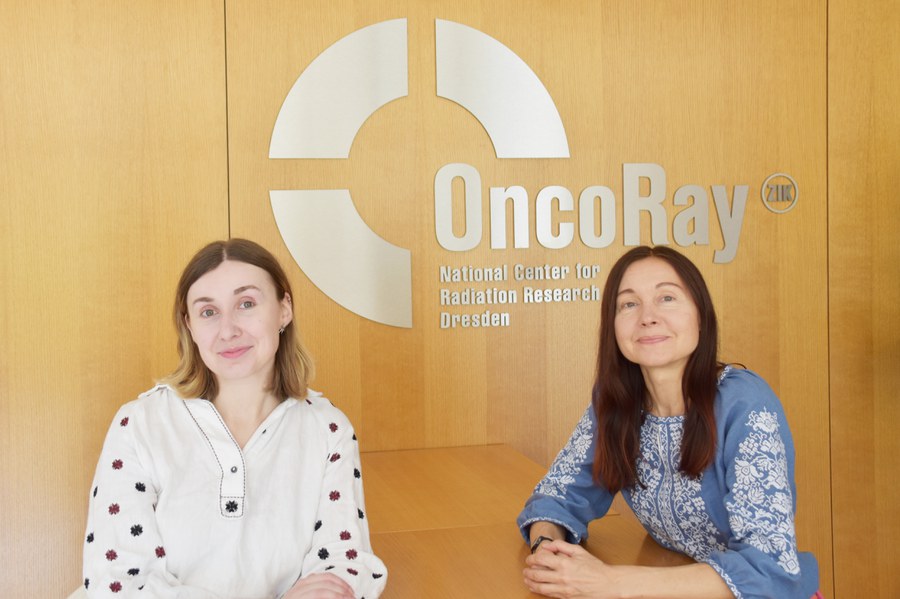
Dr. Anna Bdzhola (left) and Prof. Anna Dubrovska (right).
Since July, Dr. Anna Bdzhola of the National Academy of Sciences of Ukraine has been conducting research at OncoRay – Center for Radiation Research in Oncology. During her research stay in Dresden as a Humboldt Research Postdoc Fellow, she is hosted by Prof. Anna Dubrovska, whose research group investigates translational issues in radiation oncology. In an interview, the scientists answered questions about their collaboration and shared research goals.
Prof. Dubrovska, what motivated you to host a Humboldt postdoctoral fellow in your department? What makes this program valuable from your perspective?
The main scientific focus of our group at OncoRay is developing clinically relevant tissue and liquid biopsy biomarkers for personalized radiation therapy. As a scout for the Alexander von Humboldt Foundation, I have a great opportunity to bring the brilliant minds from across the globe to OncoRay. Training and mentoring such young scientists with outstanding potential is essential for driving constant progress in the field of translational radiation oncology, and for growing the next generation of international leaders in this field.
How would you describe your research collaboration with the fellow thus far? Are there specific projects or topics you hope to explore?
The Humboldt Fellow, Dr. Bdzhola, is working in Kyiv, Ukraine. Conditions for scientific research in Ukraine have greatly deteriorated since the Russian full-scale invasion began in 2022. The war has substantially reduced research capacity, particularly in the natural sciences, with sharp declines in publications and international collaborations. Russia is purposefully bombarding centers and institutes that carry out fundamental scientific research. More than one-third of these institutions have been destroyed or damaged, and many researchers have been internally or internationally displaced. Despite the destruction of the Ukrainian science sector, Dr. Bdzhola has demonstrated very high resilience and productivity under these challenging conditions. Since 2022, she has published several high-quality manuscripts indexed in international scientific databases. I learned about her scientific work while serving as a reviewer for the National Research Foundation of Ukraine. Impressed by the quality of her research and its relevance to our field, I offered her collaboration.
The project that Dr. Bdzhola will perform at OncoRay is highly novel and clinically relevant. For the first time, it will evaluate the role of a newly discovered posttranslational regulation mechanism, called CoAlation, in the development of cancer cell resistance to conventional therapies such as radiotherapy. The results of this study may contribute to developing robust biomarkers for radiation oncology and therapeutic strategies to improve the efficiency of radiotherapy, particularly for patients with aggressive prostate, breast, and head and neck cancers associated with poor clinical outcomes.
Dr. Bdzhola, could you tell us about your background and the main focus of your research during your Humboldt Fellowship?
I started my journey in biology quite accidentally. After graduating from school, I was torn between what I loved most – mathematics or literature and languages – and was “fooled” by my mom into thinking that biology was the golden middle between them. She just had always loved biology herself. Now, however, I am very grateful for that turn of events.
I began my research career at the Institute of Molecular Biology and Genetics of the National Academy of Sciences of Ukraine in Kyiv during my second year of university, and I fell in love with it. After the typical ups and downs of a PhD student, I successfully defended my thesis in 2024.
The topic I am working on, protein CoAlation – a CoA-dependent redox post-translational modification, is quite novel and therefore super fun to explore as a young scientist. You can to choose almost any direction, from oncology and neurodegeneration to cataracts and beyond. It is also a great advantage to be able to work on this topic alongside the brilliant Ukrainian minds who discovered this phenomenon, Prof. Valeriy Filonenko and Dr. Oksana Malanchuk. During my Humboldt fellowship, I will focus on understanding how protein CoAlation and CoA metabolism regulate tumor behavior, especially in response to radiation and oxidative stress. I am interested in how these mechanisms influence radiosensitivity, oxidative stress tolerance, and tumor adaptation. By combining my existing knowledge with the radiooncology expertise at OncoRay, I hope to uncover new CoA-dependent pathways and identify potential new biomarkers or therapeutic targets.
What made you choose Dresden and this particular research group for your Fellowship? What has your experience been like so far?
As a young postdoc, I have many opportunities to share my project ideas outside the laboratory and to participate in a broad range of projects. I had heard of OncoRay and Prof. Anna Dubrovska before. When she offered me the Humboldt position and expressed interest in my work, I was thrilled. I have already spent one and a half months here, and I have to say that I haven’t been this excited to work for quite a long time. The chance to exchange ideas with her group gives me a fresh perspective on my own project. I have so many more ideas and so much more motivation. Access to unique facilities and resources also allows me to advance my research at a pace that I hope to achieve someday in Ukraine.
Nowadays, it is quite hard for a lot of Ukrainians to stay abroad long-term. Not only do you leave your loved ones behind under constant threat, but it is also difficult see that many people do not fully realize what is happening next to them and what sacrifices Ukrainians are making to keep Europe safe. It breaks your heart even more. I am very lucky to have joined Anna Dubrovska’s group. She and her kind and supportive team, including brilliant Ukrainian minds like Vasyl Lukianchuk and Ielizaveta Gorodetska, have created a comforting environment that makes me eager to return and work more here from time to time.
What are your plans after completing your Fellowship?
Since Russia's full-scale invasion in 2022, one of my greatest motivations has become elevating Ukrainian science and creating opportunities for Ukrainian scientists to reach their full potential. That’s why I actively participate in various grant programs, bringing funding, international visibility, and experience back to Ukraine. I don't plan to stop doing this anytime soon. Collaborating with Anna Dubrovska’s lab has allowed both of us to identify shared research interests, particularly in CoA metabolism, CoA-mediated PTMs, and radiooncology, which we plan to explore further together. I believe that by combining the expertise and the beautiful minds of our two labs, we can contribute to scientific and medical advancements.
Background
The Humboldt Research Fellowship of the Alexander von Humboldt Foundation supports highly qualified researchers from all countries and disciplines in carrying out independent research projects in Germany. As part of the Global Minds Initiative of the Federal Ministry for Research, Technology and Space, the fellowship provides extensive funding and personalized support for postdoctoral and experienced researchers. Funding periods range from six to 24 months and may be divided into up to three stays within three years. A selection committee of 60 to 70 experts from various fields makes award decisions based on a scientific peer-review process.