
Mar 25, 2026
Intraoral probe enables 3D caries diagnostics without X-rays
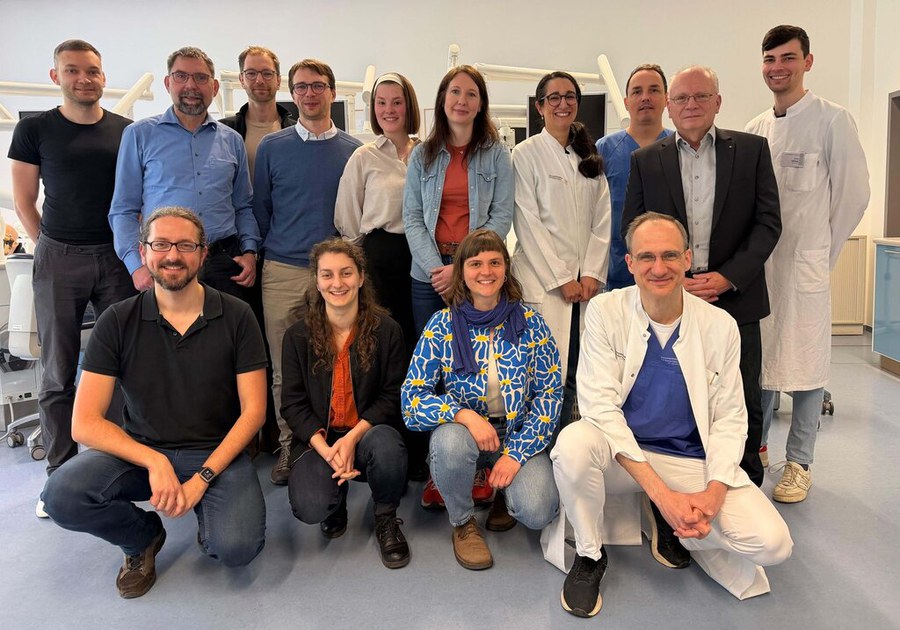
Das Projektteam des Verbundprojekts KARiSO-3D.
The University of Applied Sciences Zwickau (WHZ) is developing a hand-guided intraoral probe together with the Polyclinic for Dental Preservation (PK-ZER) of the Medical Faculty of TU Dresden at Dresden University Hospital as part of the KARiSO-3D joint project. This is designed to image tooth structures non-invasively, with depth resolution and in three dimensions.
Today, caries is mainly assessed visually in dental practices and, if necessary, clarified by X-ray. Early stages and concealed carious lesions can only be detected to a limited extent - at the same time, it is important to reduce radiation exposure in medicine to the necessary level. "Our aim is to develop clinically practicable imaging that makes early changes in the tooth structure more reliably visible than current routine procedures," says Prof. Dr. rer. nat. habil. Peter Hartmann, Head of the Optical Technologies working group at the WHZ. "To this end, we are developing a specially adapted probe for use in the oral cavity."
OCT instead of X-rays: 3D view of the tooth structure
The technological basis of the probe is optical coherence tomography (OCT). The process uses the interference of near-infrared light to visualize internal structures in high resolution. Unlike conventional camera systems, OCT not only provides surface images, but also layer information from deeper structures. This creates a volumetric 3D image from many individual measurements. One focus of KARiSO-3D is on 3D data fusion: measurement data is to be coordinated and merged in such a way that findings can be documented in a comparable manner and evaluated reproducibly over time. In the future, this will support clinical decision-making, for example when it comes to the question of whether a lesion should be treated non-invasively or minimally invasively.
From development to pilot study
Following technical development and experimental validation, a pilot study with test subjects is planned. The aim is to systematically record image data sets of carious lesions with the new probe for the first time. This data basis is crucial for reliably interpreting image characteristics, comparing evaluation procedures and preparing for later clinical application.
Alliance of dentistry and engineering sciences
In the project, the partners complement each other along the entire chain from technology to clinical application: PK-ZER at Dresden University Hospital, led by Prof. Christian Hannig, contributes the clinical perspective, expertise on oral bioadhesion processes as well as issues from cariology and the practical framework conditions of application. "The project fits in perfectly with the core research areas of the Polyclinic for Dental Conservation: medical technology, prevention and surface interactions in the oral cavity at the interface of smart technology and life sciences," explains Hannig.
The WHZ is responsible for the technical development of the probe, the optical concepts and the methods of 3D data fusion and evaluation. In the medium term, KARiSO-3D should not only strengthen minimally invasive dentistry, but also support training - for example through new possibilities for objective visualization and documentation of findings.
About the KARiSO-3D project
Project name: KARiSO-3D - Caries diagnostics with an intraoral probe and optical 3D data fusion
Project partner: University of Applied Sciences Zwickau (WHZ), TU Dresden / University Hospital Dresden (PK-ZER)
Duration: 10/2025 - 12/2027
Funding body / funding program: SAB / EFRE InfraProNet 2021-2027
Funding code: 100759301
About the "Optical Technologies" working group at WHZ
The "Optical Technologies" working group at the Leupold Institute for Applied Natural Sciences at WHZ develops solutions for metrological tasks in medical technology, photonics, semiconductor and automotive applications, among others. The focus is on optical sensor technology, imaging and data-driven evaluation - with a clear focus on the transfer to robust applications.
About the Polyclinic for Tooth Preservation (PK-ZER)
The Polyclinic for Dental Preservation (PK-ZER) with its Periodontology and Paediatric Dentistry departments at the Faculty of Medicine of TU Dresden at Dresden University Hospital specializes in the prevention, diagnosis and treatment of diseases of the dental hard tissue and periodontium. In research and teaching, the PK-ZER develops and evaluates evidence-based concepts of minimally invasive dentistry and investigates new procedures for objective diagnosis and treatment planning. In patient care, the polyclinic combines modern clinical standards with scientifically sound treatment strategies.
This measure is co-financed by tax funds on the basis of the budget approved by the Saxon state parliament.
Contact
University of Applied Sciences Zwickau
Faculty of Physical Engineering/ Computer Science
Kornmarkt 1, 08056 Zwickau
Prof. Dr. rer. nat. habil. Peter Hartmann
Peter.hartmann[at]whz.de
+49 375 536-1538
+49 1522 9262090
Source: Press release of the University of Applied Sciences Zwickau