
Sep 23, 2026
Staying healthy for longer: Carolin Schneider appointed to new Chair of Digital Precision Medicine at TU Dresden
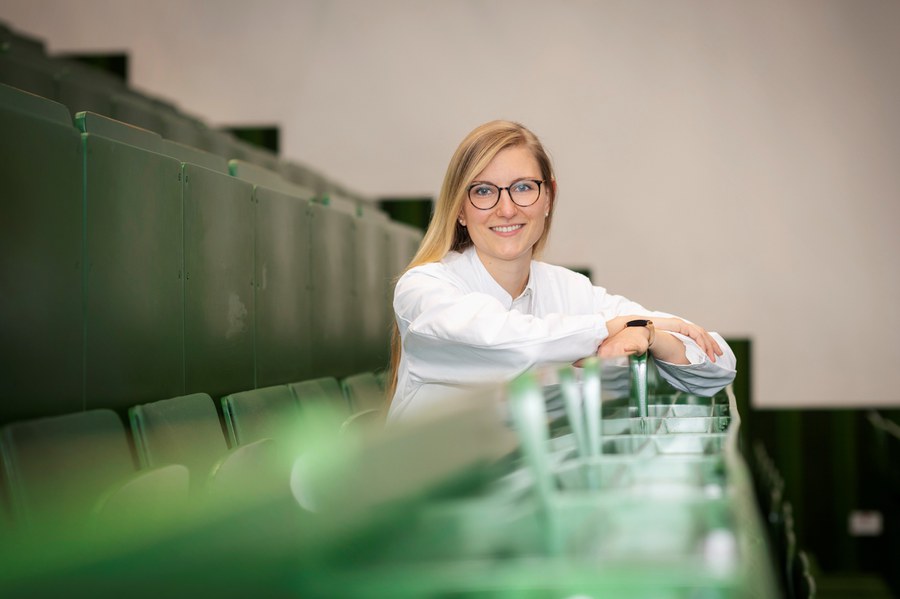
On September 1, 2026, Carolin Schneider was appointed as the new Chair of Digital Precision Medicine in Cancer Prevention and Early Detection at the Faculty of Medicine at TUD Dresden University of Technology (MF-TUD). This is a joint appointment by MF-TUD and the German Cancer Research Center (DKFZ). Carolin Schneider conducts research at the intersection of medicine and computer science. As head of a DKFZ department in Dresden, she will support the first DKFZ facility located outside of Heidelberg, where she is establishing the first office of the National Cancer Prevention Center located in another city.
Carolin Schneider is one of the youngest women to hold a professorship in Germany. With her research in data analysis, population biostatistics, and artificial intelligence (AI), she is contributing to a field of science that is still in its infancy in Germany. “My key question is: How can I help healthy people to stay healthy?” Schneider sums up her approach. “Approaching this question from a research perspective, I would like to figure out how we can use digital technologies to create a care system best suited to helping people stay healthy for longer, and how a system of this kind could be brought into being.”
The DKFZ’s Dresden site, which focuses on innovative basic research in the fight against cancer, is the first and, to date, only branch of the German Cancer Research Center to be located outside of Heidelberg. By leveraging AI, robotics, data science, and smart technologies, the aim is to pioneer innovative treatments. The focus is on interdisciplinary collaboration: Researchers from biology, chemistry, computer science, materials science, and other disciplines work alongside each other to develop new approaches to the diagnosis, prevention, and treatment of cancer.
As a branch of the National Cancer Prevention Center located outside of Heidelberg, another prevention research clinic is being established in Dresden, which will be open to the public. The objective is to map out all key components of early detection, ranging from basic research and prevention studies to evidence-based public health counseling. There will be a new, state-of-the-art research building at Dresden University Medicine's oncological campus, where the public can gain comprehensive, research-based information and counseling on cancer prevention and early detection. There will also be the opportunity to participate in ongoing studies on cancer prevention.
Carolin Schneider: From metabolic research to digital precision medicine
The implementation of these plans begins with the appointment of Carolin Schneider. Schneider started her academic career at RWTH Aachen University, where, after completing her medical degree, she earned her doctorate with a dissertation on genetic liver diseases. She then moved to the University of Pennsylvania (USA), where she conducted research using large patient datasets to develop personalized prevention recommendations. During her subsequent career as a doctor, research group leader, and assistant professor at RWTH Aachen, she came full circle: Using large datasets, Schneider investigated the risk of metabolic diseases, focusing on fatty liver disease and its progression to liver cancer. Her interdisciplinary research group consisted of about 20 members, including clinicians, technicians, psychologists, and economists.
“Prevention is often considered synonymous with bans. I’d like to move away from that and ask instead: What is genetically determined, and what can each individual do to reduce an increased risk of disease?” Schneider explains her scientific approach. This applies not only to the liver, but also to many (oncological) diseases as well as cardiovascular risk factors.
A key prerequisite for this is the establishment of the largest possible cohort study using patient data from Germany. The transferability of existing large datasets from the United States, the United Kingdom, or China is limited due to differences in lifestyles. “I see it as my top priority to establish a cohort study on the preventive care clinic in order to obtain meaningful data,” she explains, outlining her long-term goal. This will be supplemented by data from electronic patient records.
The benefits of Dresden: BioBank, technical innovations, and our own cohort study
For Carolin Schneider, the move to the DKFZ as head of a research department, combined with a Chair at the Faculty of Medicine, was a significant and logical next step: “Dresden offers ideal conditions: the Chair’s integration into the Dresden University Medical Center campus with its focus on oncology, the collaboration with BioBank Dresden, and TUD’s numerous technical innovations that make it possible to develop and test cutting-edge treatment options,” she says.
“We don't want to wait until cancer has developed to start fighting it; instead, we want to get better and better at preventing people from getting it in the first place. Digital precision medicine opens up new possibilities for us in this regard. By intelligently combining and analyzing health data, we can identify individual cancer risks earlier and tailor prevention programs more specifically to each person. With this new department, the DKFZ is strengthening and expanding the strategically important field of prevention research,” says Prof. Michael Baumann, Chairman of the DKFZ Management Board.
“The new Chair in Digital Precision Medicine for Cancer Prevention and Early Detection is an essential strategic component for Dresden as a center of Excellence,” emphasizes Prof. Esther Troost, Dean of the Faculty of Medicine. “By focusing on prevention research, we are expanding our existing oncology profile: While we at NCT/UCC Dresden already excel in curative and translational cancer research, the new Chair and the prevention research outpatient clinic will help us bridge the gap to primary prevention and evidence-based early detection. This will make Dresden a comprehensive Competence Center, covering everything from prevention and early detection to personalized therapy.”
Research contact:
Prof. Dr. med. Carolin Schneider
Chair of Digital Precision Medicine in Cancer Prevention and Early Detection
DKFZ Dresden, Department C250
German Cancer Research Center
+49 351 31566-81220
Media contact:
Anne-Stephanie Vetter
Public Relations Office Carl Gustav Carus Faculty of Medicine
of TUD Dresden University of Technology
+49 351 458 17903