
20.04.2026
Studie aus Dresden nutzt optische Täuschungen, um Wahrnehmung bei psychischen Erkrankungen besser zu verstehen
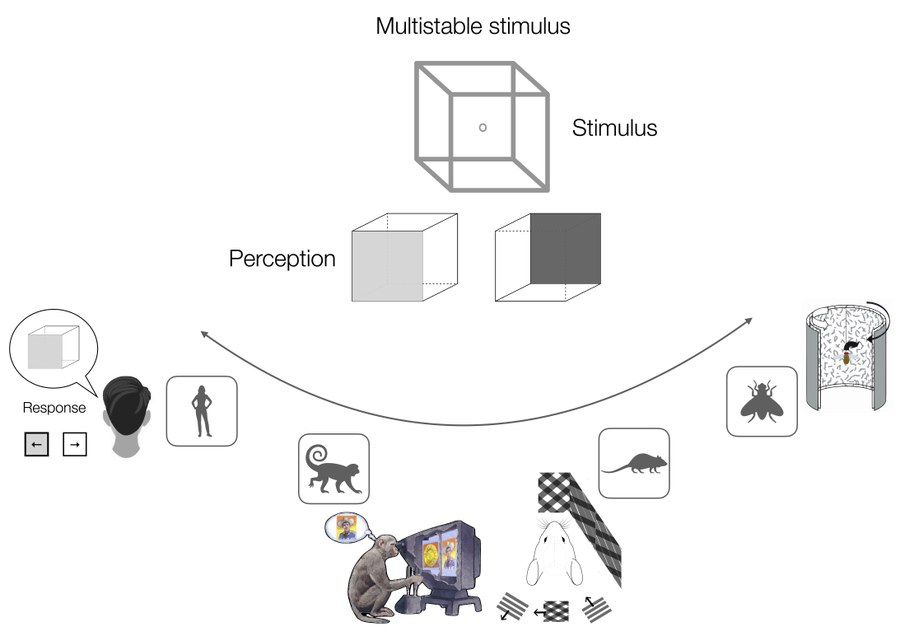
Oben: Ein multistabilen Stimulus, der Necker-Würfel, der auf beide Arten wahrgenommen werden kann, wobei unser Gehirn ständig zwischen diesen beiden Wahrnehmungen wechselt. Unten: Multistabile Stimuli bei verschiedenen Arten.
Die menschliche Wahrnehmung ist nicht so eindeutig, wie sie scheint. Manchmal kann das Gehirn ein und dasselbe Bild auf verschiedene Arten sehen, etwa wenn bei einer optischen Täuschung zwei Motive abwechselnd erkannt werden. In der Wissenschaft heißt dieses Phänomen „perzeptuelle Multistabilität“. Dresdner Forschende machten sich dieses Phänomen jetzt zu Nutze, um computergestützt und vor allem nicht-invasiv Denken und Wahrnehmen von Menschen mit psychiatrischen Erkrankungen und Neurodiversität besser zu verstehen. Die Ergebnisse wurden gerade im renommierten Fachjournal Trends in Cognitive Sciences (Cell Press) veröffentlicht.
Für die sogenannte perzeptuelle Multistabilität gibt es genügend Beispiele: Fast alle kennen das Bild, das gleichzeitig eine Vase oder zwei sich anschauende Gesichter darstellen könnte. Oder den Necker-Würfel, eine zweidimensionale Darstellung, bei der einmal die obere Ecke des Würfels näher ist und einmal die untere. Die Untersuchungen der Wissenschaftler:innen um Jun.-Prof. Shervin Safavi, Junior-Professor für computergestützte Neurowissenschaften am Deutschen Zentrum für Kinder- und Jugendgesundheit (DZKJ), zugeordnet der Abteilung für Kinder- und Jugendpsychiatrie und der Einheit für „Kognitive Neurophysiologie“ an der Hochschulmedizin Dresden, zeigen, wie das Gehirn mit mehrdeutigen Sinneseindrücken umgeht bzw. Wahrnehmung, Gehirnfunktion und psychische Gesundheit zusammenhängen.
„Visuelle Aufgaben können eine methodische Brücke zwischen dem Verhalten beim Menschen, Tiermodellen und den zugrunde liegenden neurobiologischen Mechanismen bilden. Multistabilität ist dabei ein besonders aufschlussreicher Zugang zur psychischen Gesundheit, weil mehrere Ebenen gleichzeitig sichtbar sind. Die Studie legt dar, dass etwa Menschen mit Schizophrenie, Autismus oder Depressionen mehrdeutige Bilder oder Reize oft anders wahrnehmen. Sie bilden die Wahrnehmung teils unterschiedlich schnell, und auch der Wechsel zwischen möglichen Deutungen kann sich deutlich unterscheiden“, erläutert Shervin Safavi, Erstautor der Studie.
Mit Hilfe computergestützter Ansätze wie der Bayesianischen Inferenz und dem Reinforcement Learning konnten die Forschenden darstellen, dass die Unterschiede in der Wahrnehmungsdynamik auf Abweichungen in der Integration von Vorwissen und Sinnesreizen zurückgehen. Solche Unterschiede helfen letztlich, psychische Erkrankungen nicht nur nach Diagnosen, sondern nach gemeinsamen oder unterschiedlichen Denk- und Wahrnehmungsmechanismen zu untersuchen.
„Insgesamt macht dies perzeptuelle Multistabilität zu einem vielversprechenden, nicht-invasiven Werkzeug, um psychische Gesundheit besser zu verstehen und individuell zu erfassen“, fasst Safavi zusammen.
Die Ergebnisse der Studie wurden im renommierten Fachjournal Trends in Cognitive Sciences (Cell Press) veröffentlicht, das zu den international führenden Publikationen im Bereich der Kognitions- und Neurowissenschaften gehört. Die Arbeit der Forschenden baut auf Erkenntnissen zur multistabilen Wahrnehmung aus dem Jahr 2022 auf, an denen Jun.-Prof. Shervin Safavi ebenfalls beteiligt war.
Die Studie:
Perceptual multistability: a multifaceted window into brain dysfunctions. (S. Safavi, R. Jardri): https://www.sciencedirect.com/science/article/pii/S136466132600032X
Hintergrund
Safavi, S, Dayan, P (2022) Multistability, Perceptual Value and Internal Foraging Neuron: https://doi.org/10.1016/j.neuron.2022.07.024
Kapoor, V., Dwarakanath, A., Safavi, S., Werner, J., Besserve, M., Panagiotaropoulos, T. I., Logothetis, N.: Decoding internally generated transitions of conscious contents in the prefrontal cortex without subjective reports. Nat Commun 13, 1535 (2022): https://doi.org/10.1038/s41467-022-28897-2
Kontakt:
Jun.-Prof. Dr. Shervin Safavi
Computational Neuroscience
E-Mail: /
Tel.: +49 351 45817367
Anne-Stephanie Vetter
Stabsstelle Öffentlichkeitsarbeit Medizinische Fakultät Carl Gustav Carus
der Technischen Universität Dresden
Tel.: +49 (0) 351 458 17903
E-Mail:
www.tu-dresden.de/med