
Jul 14, 2026
Study investigates discontinuing unnecessary medication for the first time, using levothyroxine as an example

Appropriate medical care means a treatment that is tailored to patients’ needs, effective, and patient-centered. This also means regularly and critically reviewing the administration of medications. This ranges from ensuring appropriate dosages and discontinuing medications to making an informed decision together with patients, not to prescribe a drug if its benefits are not sufficiently proven or if potential health risks outweigh them. This research project, led by the Department of General Practice at the Faculty of Medicine of TUD Dresden University of Technology (MF-TUD) and conducted at three sites in central Germany, is funded with approximately EUR 3.5 million by the Federal Ministry of Research, Technology and Space.
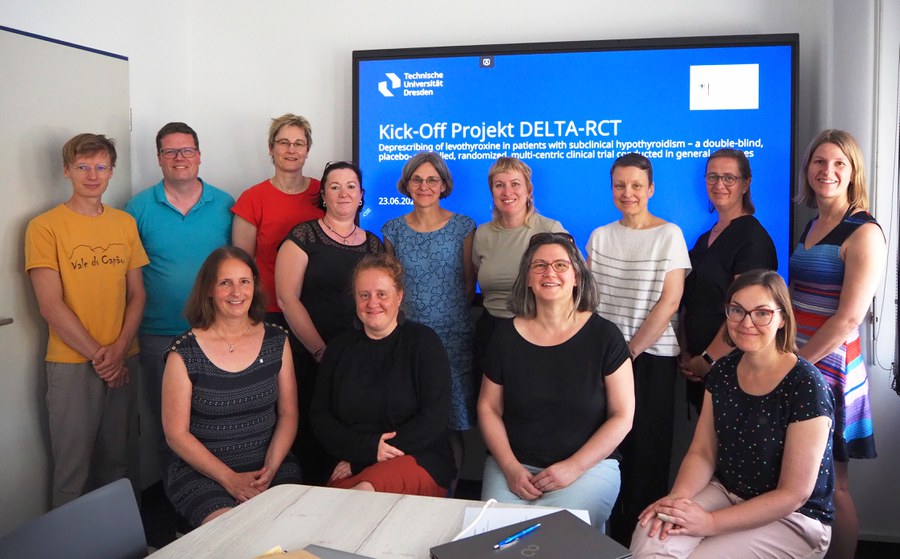
Back row (left to right): Martin Bortz (TUD, MUL-CT), Stefan Lippmann (Uni Leipzig), Silke Beßert (TUD), Franziska Brosse (TUD), Jana Erwin (Uni Leipzig), Melanie Rennert (Uni Leipzig), Yvonne Silber (TUD), Peggy Borchers (TUD), Jeannine Schübel (MUL-CT). Front row (left to right): Karen Voigt (TUD, MUL-CT), Anika Langer (TUD), Evelyn Trips (TUD), Amelia Simon (MUL-CT)
Initiated by a joint general practice research team from the Faculties of Medicine of the universities in Dresden, Leipzig, and Cottbus, the research project “DELTA-RCT: Discontinuation of Levothyroxine in Patients with Latent Hypothyroidism” has now begun. Hypothyroidism is a relatively common condition characterized by an underactive thyroid gland, affecting women and older adults in particular. Subclinical hypothyroidism is characterized by the absence of symptoms and a slightly elevated TSH level, which is often only discovered incidentally. TSH (thyroid-stimulating hormone) regulates thyroid hormone production when the thyroid gland produces too little or too much hormone.
The multicenter clinical trial, led by the TUD Faculty of Medicine, will run through June 2030. It is investigating whether and how levothyroxine doses of up to 50 micrograms can be safely discontinued in patients with latent hypothyroidism under the care of their primary care physician. Participants are randomly assigned to different groups: They either continue taking levothyroxine as before, or the tablets are faded out gradually or discontinued all at once. The study is double-blind, meaning that neither the participants nor the physicians know who has been assigned to which group. The reason for this is that the benefits of levothyroxine for latent hypothyroidism have not yet been scientifically proven, yet the medication is frequently prescribed, often for many years. The study aims to determine whether discontinuing the medication is just as safe for patients as continuing treatment and does not result in any adverse effects.
Participants will be monitored by their primary care physicians over several months. Regular monitoring of thyroid function, along with tracking symptoms and quality of life, is intended to enable a comprehensive assessment of the effects of the various treatment strategies. “If it is demonstrated that safe discontinuation is possible, we will publish corresponding recommendations for physicians,” says project leader Dr. Karen Voigt, summarizing the study’s goal.
A distinctive feature of the project is the involvement of a patient and primary care physician advisory board, which critically monitors all phases of the project. The advisory board is also involved in the publication of the protocol and the study results for both specialist and lay audiences.
“With DELTA-RCT, we are breaking new ground. I am all the more pleased that we, as the TUD Faculty of Medicine, are coordinating this project, because publicly funded studies in general practice remain rare,” says Prof. Esther Troost, Dean of the TUD Faculty of Medicine.
“The project is also relevant to health policy decision making, since it aims to examine how medically unnecessary measures can be eliminated without compromising patient safety,” adds Prof. Uwe Platzbecker, Chief Medical Officer of Dresden University Hospital.
The project is led by the Dresden Division of General Practice at the TUD Faculty of Medicine and is being carried out in close collaboration with the TUD Faculty of Medicine’s Clinical Trials Coordination Center, the Institute of General Practice at the University of Leipzig, and the Department of Primary Care – General Practice at the Medical University of Lusatia – Carl Thiem in Cottbus, as well as their respective general practice research practice networks. Dr. Karen Voigt (MF-TUD, MUL-CT Cottbus) serves as the overall project director, while Dr. Martin Bortz (MUL-CT Cottbus, MF-TUD) and Prof. Jeannine Schübel (MUL-CT Cottbus) serve as the medical directors.
Research contact:
Dr. Karen Voigt MPH
Media Contact
Anne-Stephanie Vetter
Public Relations Office Carl Gustav Carus Faculty of Medicine
of TUD Dresden University of Technology
+49 351 458 17903