
04.02.2026
Weltkrebstag am 4. Februar: Die Dresdner Hochschulmedizin setzt Maßstäbe in der Behandlung seltener Hirntumoren
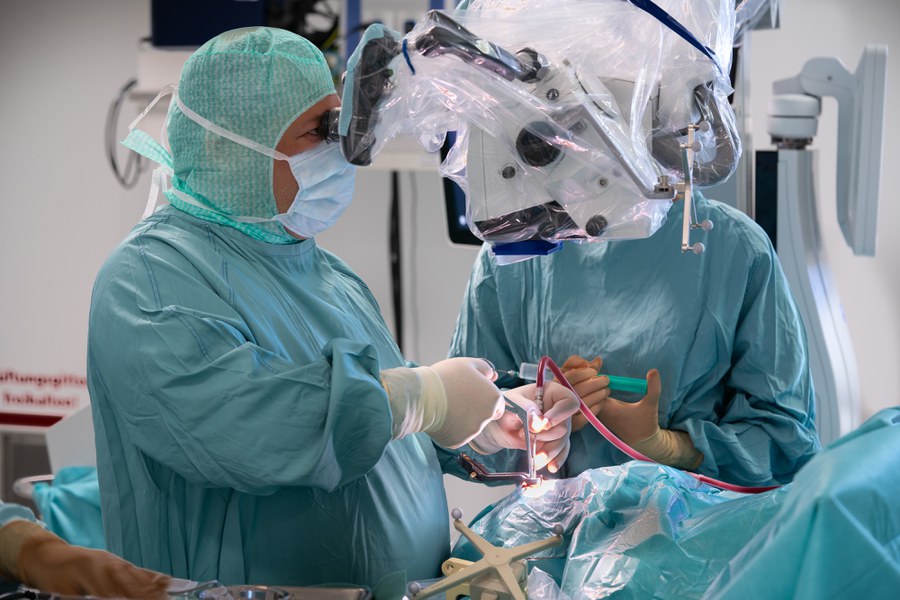
Prof. Ilker Eyüpoglu im OP.
Der Weltkrebstag am 4. Februar bietet Anlass, auch seltene Tumorerkrankungen wie primäre Hirntumoren in den Blick zu nehmen. Diese stellen aufgrund ihrer Lage eine besondere Herausforderung für Betroffene, Angehörige und das Gesundheitssystem dar. Die Diagnostik ist komplex und die Therapie hochspezialisiert, da sie in unmittelbarer Nachbarschaft von Gehirn, Hirnnerven, Sinnesorganen und zentralen Blutgefäßen entstehen. Pro 100.000 Einwohner:innen in Deutschland gibt es jährlich nur 20 bis 25 Neuerkrankungen, doch die funktionellen Auswirkungen primärer Hirntumore können gravierend sein.
Die Klinik für Neurochirurgie am Universitätsklinikum Carl Gustav Carus Dresden zählt zu den wenigen spezialisierten Zentren in Deutschland, die sich der Behandlung und Erforschung von Hirntumoren und ihrer Untergruppe, den Schädelbasistumoren widmen. Unter der Leitung von Prof. Ilker Eyüpoglu werden hier jedes Jahr zahlreiche hochkomplexe Eingriffe durchgeführt. Parallel treibt das Team gemeinsam mit nationalen und internationalen Partnern intensive Forschungsarbeiten voran, um die biologischen Grundlagen dieser Erkrankung besser zu verstehen und die operative sowie funktionelle Behandlung kontinuierlich zu verbessern.
Wie wichtig diese hochspezialisierte Versorgung ist, zeigt der Fall von Karl Maximus Seidemann. Die Sehkraft des jungen Mannes verschlechterte sich über einen Monat kontinuierlich. Als er nur noch Umrisse erkennen konnte, stellte er sich in der Klinik für Neurochirurgie am UKD vor. Die Diagnose: ein Tumor der Schädelbasis, genauer ein Kraniopharyngenom, das unmittelbar auf den Sehnerv drückte. Weil Karl Seidemann zu erblinden drohte, musste er sofort operiert werden.
„Unser Ziel bei diesen Eingriffen ist es, sie so sicher wie möglich durchzuführen und zugleich die neurologischen Funktionen der Patientinnen und Patienten bestmöglich zu erhalten“, erläutert Prof. Ilker Eyüpoglu, Direktor der Klinik für Neurochirurgie am UKD. Er leitete auch die Notfall-Operation des jungen Mannes. „Die Kombination aus großer operativer Erfahrung, modernster Technologie und einem tiefen biologischen Verständnis der Tumoren erlaubt uns heute selbst bei extrem komplexen Befunden eine hochgradig individualisierte Therapie.“
Die klinische und wissenschaftliche Arbeit des Teams am Universitätsklinikum Dresden und der Medizinischen Fakultät der TU Dresden umfasst dabei das gesamte Spektrum primärer Hirntumoren, darunter Gliome, Meningeome und weitere seltene Tumorarten. Primäre Tumoren des zentralen Nervensystems machen rund zwei Prozent aller Krebserkrankungen aus.
Ein zentraler Standortvorteil ist die enge Verzahnung modernster operativer Technologien mit umfassender klinischer Expertise. Zum Einsatz kommen unter anderem während der Operationen: MRT-Bildgebung, Angiographie sowie ein kontinuierliches elektrophysiologisches Monitoring, um jederzeit prüfen zu können, ob Gefäße oder Nervenstrukturen gefährdet sind. Hinzu kommen hochpräzise, modernste Navigationssysteme sowie mikrochirurgische und endoskopische Hochleistungsverfahren. Diese Ausstattung ermöglicht selbst bei hochkomplexen Tumoren, wie Tumoren an der Schädelbasis, sichere Eingriffe.
Karl Maximus Seidemann haben diese Expertise und das schnelle Eingreifen gerettet. Der Tumor konnte vollständig entfernt und die Sehkraft wiederhergestellt werden. Jetzt befindet sich Karl Seidemann in der ambulanten Nachsorge. „Die Mitbetreuung durch Experten für den Hormonhaushalt (Endokrinologie) erfolgt weiterhin, was bei dieser Tumorerkrankung erwartbar ist. Unter der bestehenden Hormontherapie ist der Patient klinisch stabil und im Alltag voll belastbar“, sagt Prof. Eyüpoglu.
Starke Forschung verbessert die Patientenversorgung unmittelbar
Die Versorgung in der Klinik profitiert erheblich von der engen Verbindung zur Forschung. In den vergangenen zwei Jahren konnten internationale Multicenter-Studien und eigene Dresdner Untersuchungen neue molekulare Zusammenhänge bei Schädelbasistumoren identifizieren. Diese Erkenntnisse fließen unmittelbar in die klinische Praxis ein und ermöglichen eine präzisere Operationsplanung sowie zunehmend individualisierte Therapiekonzepte.
Konkret zeigte eine große internationale Multicenter-Studie zu Olfaktorius-Meningeomen (Alkhatib et al., Journal of Neurosurgery 2025), dass ein Großteil dieser Tumoren charakteristische genetische Veränderungen aufweist, die ihr Wachstum und ihr biologisches Verhalten bestimmen. Ergänzend belegte eine Dresdner Untersuchung (Podlesek et al., Cancers 2024), dass für den Erhalt des Riechvermögens neben dem molekularen Profil insbesondere anatomische Faktoren wie Tumorgröße, knöcherne Veränderungen und Schwellungen des umliegenden Gewebes entscheidend sind. Die Kombination dieser Daten liefert wertvolle Hinweise für die operative Planung und die Lebensqualität nach dem Eingriff.
Auch bei den seltenen Foramen-magnum-Meningeomen am Übergang von Schädel und Wirbelsäule konnten internationale Forschungsteams unter Dresdner Federführung zentrale genetische Zusammenhänge entschlüsseln (Hua/Alkhatib et al., J Neurosurg 2024). Bestimmte molekulare Veränderungen korrelieren hier mit Lage und feingeweblicher Struktur der Tumoren. Dieser Erkenntnisgewinn ist insbesondere für sicherere Operationsstrategien von Bedeutung.
Fortschritte bei hormonaktiven Tumoren
Einen weiteren wichtigen Baustein dieser Forschungsserie liefert die Studie von Emmanouilidis et al. (Pituitary 2025), die sich mit Hypophysenadenomen befasst – Tumoren der Hirnanhangsdrüse, die durch hormonelle Fehlregulationen unter anderem zu Erkrankungen wie Akromegalie, also der Vergrößerung von Händen, Füßen und Gesichtszügen führen können. Die Dresdner Arbeit identifiziert erstmals klinische und biologische Faktoren, die nach einer operativen oder medikamentösen Therapie zu Abweichungen zwischen Wachstumshormon- und IGF-1-Werten führen. Diese Erkenntnisse sind von hoher praktischer Relevanz, da sie eine präzisere Bewertung des Therapieerfolgs ermöglichen und die Basis für individuell angepasste Nachsorge- und Kontrollkonzepte schaffen.
Bereits in Vorbereitung befinden sich zwei weitere Publikationen zu Schädelbasismeningeomen und Hypophysentumoren, die die bisherigen Ergebnisse systematisch ergänzen werden. Gemeinsam zeichnen sie ein konsistentes Bild einer Forschungsstrategie, die molekulare, funktionelle und klinische Aspekte zusammenführt.
Wissenschaft, Klinik und Interdisziplinarität als gemeinsamer Nenner
„Diese Forschungsarbeiten zeigen exemplarisch, wie eng in Dresden Grundlagenforschung, interdisziplinäre Zusammenarbeit und patientenorientierte Spitzenmedizin miteinander verknüpft sind, um Diagnostik, Therapie und Nachsorge kontinuierlich weiter zu verbessern. Gerade bei seltenen Tumorerkrankungen wird dies besonders deutlich“, erklärt Prof. Esther Troost, Dekanin der Medizinischen Fakultät an der Technischen Universität Dresden.
Eine Schlüsselrolle spielt dabei das Nationale Centrum für Tumorerkrankungen (NCT/UCC) Dresden. Als strukturierte Plattform bringt es spezialisierte Expertise aus Neurochirurgie, Onkologie, Strahlenmedizin, Bildgebung und weiteren Fachdisziplinen zusammen und ermöglicht es, innovative Forschungsergebnisse gezielt und zeitnah in die Patientenversorgung zu überführen.
„Diese enge Verzahnung bildet die Grundlage für eine hohe Behandlungsqualität und kontinuierlichen medizinischen Fortschritt. So sind wir hier in der Lage, auch komplexe Fälle aus ganz Deutschland und sogar Europa auf höchstem Niveau versorgen zu können“, ergänzt Prof. Uwe Platzbecker, Medizinischer Vorstand des Universitätsklinikums.
Die Studien:
Molecular landscape and clinical correlates of olfactory groove meningiomas: a multi-institutional study.
Alkhatib M, Hua L, Beyer F, Prilop I, Podlesek D, Jeyaretna S, Fujio S, Zolal A, Günther L, Cicek B, Herold S, Zeugner S, Juratli JH, Cahill DP, Wakimoto H, Teo M, Gong Y, Pinzer T, Schackert G, Eyüpoglu IY, Brastianos PK, Juratli TA.J Neurosurg. 2025 Sep 5;143(6):1458-1466. doi: 10.3171/2025.4.JNS242619. Print 2025 Dec 1.
Correlation of Molecular Status with Preoperative Olfactory Function in Olfactory Groove Meningioma.
Podlesek D, Beyer F, Alkhatib M, Daubner D, Hijazi MM, Juratli JH, Weise S, Eyüpoglu IY, Schackert G, Juratli TA, Hummel T.Cancers (Basel). 2024 Apr 22;16(8):1595. doi: 10.3390/cancers16081595.
Genetic characterization and mutational profiling of foramen magnum meningiomas: a multi-institutional study.
Hua L, Alkhatib M, Fujio S, Alhasan B, Herold S, Zeugner S, Zolal A, Hijazi MM, Clark VE, Wakimoto H, Shankar GM, Brastianos PK, Barker FG, Cahill DP, Ren L, Eyüpoglu IY, Gong Y, Schackert G, Juratli TA.J Neurosurg. 2024 Jan 26;141(1):72-78. doi: 10.3171/2023.11.JNS231936. Print 2024 Jul 1.
Predictive factors for post-therapeutic biochemical discordance in acromegaly: a monocentric analysis of 156 cases.
Emmanouilidis D, Polanski W, Juratli T, Sobottka SB, Tsourdi E, Gruber M, Pinzer T, Eyüpoglu IY.Pituitary. 2025 Jun 22;28(4):74. doi: 10.1007/s11102-025-01547-8.
Wissenschaftlicher Kontakt:
Prof. Dr. Ilker Y. Eyüpoglu
Direktor der Klinik und Poliklinik für Neurochirurgie
Universitätsklinikum Carl Gustav Carus
an der Technischen Universität Dresden
+49 351 458-2883
Neuchirurgie im Web: www.ukdd.de/nch
Kontakt für die Medien:
Anne-Stephanie Vetter
Stabsstelle Öffentlichkeitsarbeit Medizinische Fakultät Carl Gustav Carus
der Technischen Universität Dresden
Nationales Centrum für Tumorerkrankungen (NCT/UCC) Dresden
+49 351 458 17903