
Dec 02, 2025
At the interface of theory and experiment: New Heisenberg Chair of Particle Physics and its Simulation at TU Dresden
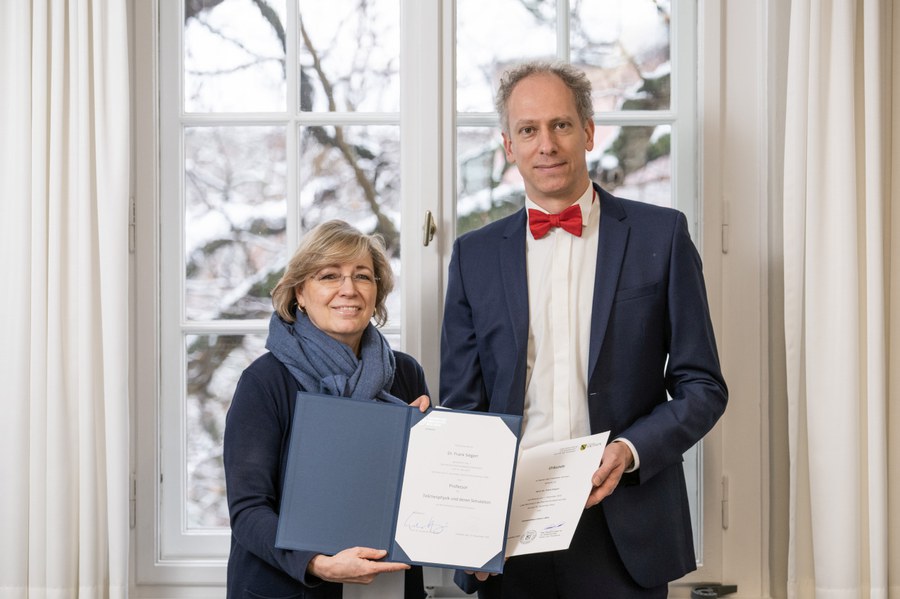
Vice-Rector Research and Technology Transfer, Prof. Angela Rösen-Wolff, presented Prof. Frank Siegert with his certificate of appointment.
Prof. Frank Siegert took up the Heisenberg Chair of Particle Physics and its Simulation at the Institute of Nuclear and Particle Physics (IKTP) at TU Dresden on December 1, 2025. He and his group are dedicated to the precise theoretical prediction of particle collisions, such as those studied experimentally at the Large Hadron Collider (LHC) at CERN in Geneva.
The basic building blocks of our matter are elementary particles such as electrons or quarks. They interact on the basis of a few fundamental interactions, which, in addition to everyday phenomena such as electromagnetic forces, can also explain the stability of atomic nuclei or transformation processes with the short-term formation of new unstable particles. In 2012, experiments at the Large Hadron Collider led to the discovery of the existence of the Higgs boson, a previously only theoretically postulated missing component in the standard model of particle physics. Since then, the properties of this particle and the associated theory have been scrutinized and deviations from the standard model have also been sought. Theoretical predictions are an essential basis for all these experimental investigations.
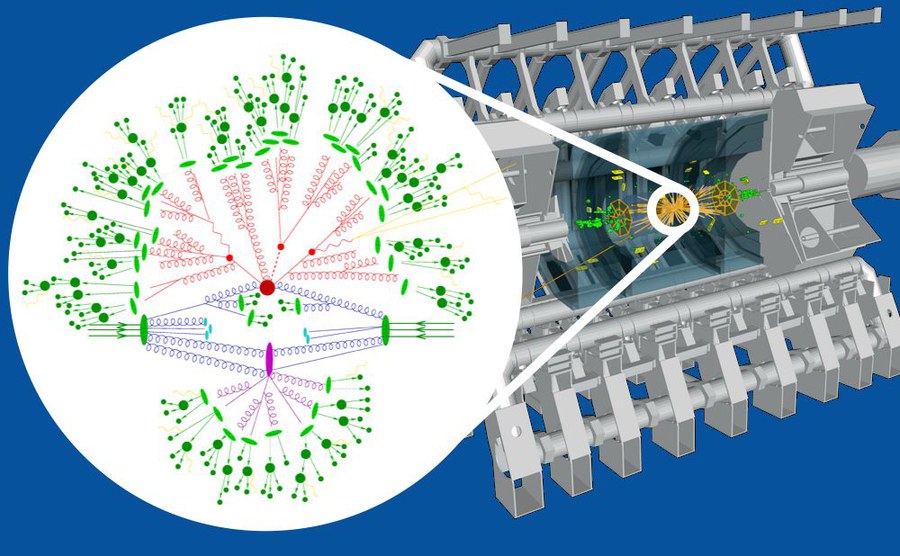
Theoretische Simulation eines Kollisionsereignisses im ATLAS-Detektor
"With our theoretical simulation methods, we want to create both an accurate and realistic image of what nature produces in particle collisions at the highest energies," explains Prof. Frank Siegert. "Only on this basis can we reliably design experimental analyses and test hypotheses for fundamentally new models of physics beyond the standard model." In particle physics, theoretical simulation also benefits from existing experimental findings, especially in areas where theoretical calculations are unreliable and need to be improved by experimental data. Prof. Frank Siegert: "This is why we are also actively involved in the ATLAS experiment, one of the large detectors at the LHC. Doctoral students in my group are working in an interdisciplinary way on both the experimental and theoretical side to further develop this interface."
"The Heisenberg funding enables me to consolidate this exceptional research profile and to continue to be actively involved in teaching in the Faculty of Physics," says Prof. Frank Siegert. The Director of the Institute of Nuclear and Particle Physics also welcomes the appointment: "This gives particle physics a great perspective in our Institute and we are very much looking forward to working together," emphasizes Prof. Dominik Stöckinger.
About Prof. Frank Siegert
Frank Siegert studied physics in Dresden and completed his doctorate in particle physics at Durham University (UK) in 2010. After a postdoctoral stay at the University of Freiburg, he successfully applied for an Emmy Noether group of the German Research Foundation (DFG), which he established at the Institute of Nuclear and Particle Physics at TU Dresden. He was a substitute professor (Chair of Particle Physics) since 2021 before being accepted into the DFG's Heisenberg Program.
About the Institute of Nuclear and Particle Physics
The Institute of Nuclear and Particle Physics conducts basic research in the field of experimental and theoretical elementary particle physics on the structure and formation of our universe as well as on interactions between its smallest components and also conducts research in the field of experimental nuclear astrophysics and the measurement of radiation doses in technical and medical applications of nuclear and particle physics. In addition, the Institute leads several national and international projects to communicate science to the public.
About the DFG Heisenberg Program
The Heisenberg Program of the German Research Foundation supports excellent early-career researchers on their way to a scientific leadership position with the aim of acquiring a lifetime professorship. The Heisenberg Professorship provides funding for a temporary Chair (W2 or W3) at a German university and flexible research funding. The Heisenberg Professorship enables researchers to establish themselves permanently as a Chair at a German university.
Contact:
Prof. Frank Siegert
Chair of Particle Physics and its Simulation
Institute of Nuclear and Particle Physics
Phone: +49 351 463-33700
Email: