
Jul 02, 2026
Recognition for Excellence in Research and Emerging Talent in Photonics
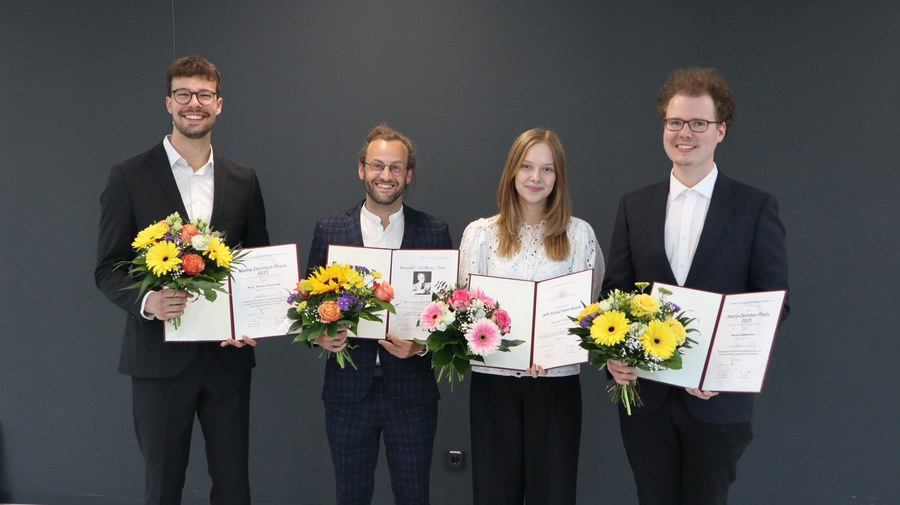
As part of the 31st Dresden Photonics Colloquium on June 12, 2026, the Institute of Applied Physics and the Dresden Integrated Center for Applied Physics and Photonic Materials (DC-IAPP) honored outstanding scientific achievements in photonics and optoelectronics. The awardees were Dr. Jakob Wolansky, Moritz Flemming, and Marius Döbberthin. For the first time, the IAPP also presented a Young Talent Award to high school student Hannah Sophie Ferenz.
Emanuel Goldberg Prize for Dr. Jakob Wolansky
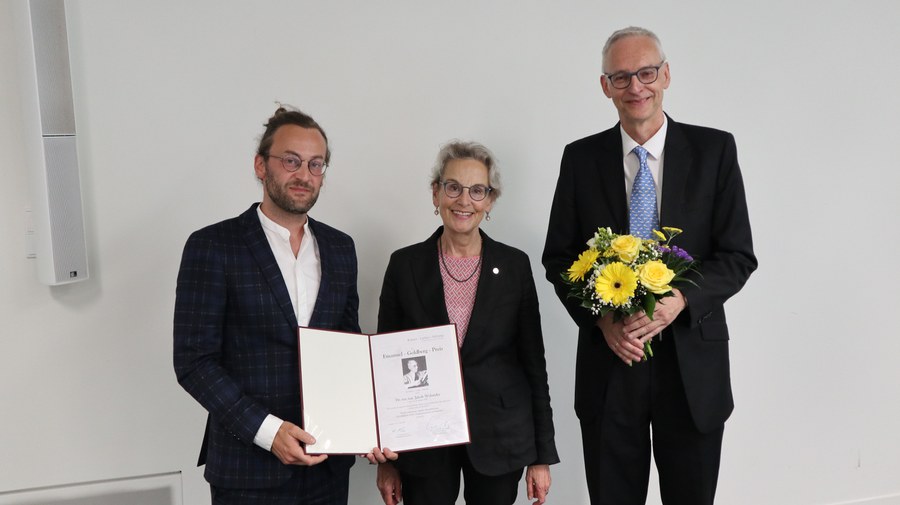
The 2025 Emanuel Goldberg Prize was awarded to Dr. Jakob Wolansky for his dissertation “Single-component organic photodetectors: Investigation of the charge generation mechanism.” In his work, he investigated novel optical sensors based on organic semiconductors, which are significant for applications in the Internet of Things and autonomous vehicles, among others. Wolansky was able to demonstrate that even simply structured and particularly stable material systems possess excellent properties for photodetectors. The results open up new perspectives for the development of sensors with high capabilities and could also be relevant for solar cells.
The Emanuel Goldberg Prize is awarded annually to recognize particularly outstanding dissertations at TU Dresden in the fields of optoelectronics and photonics. It honors the physicist and scientific pioneer Emanuel Goldberg, who set new standards in both basic research and industrial applications. The award is endowed with 2,000 euros.
Harry Dember Prizes for Moritz Flemming and Marius Döbberthin
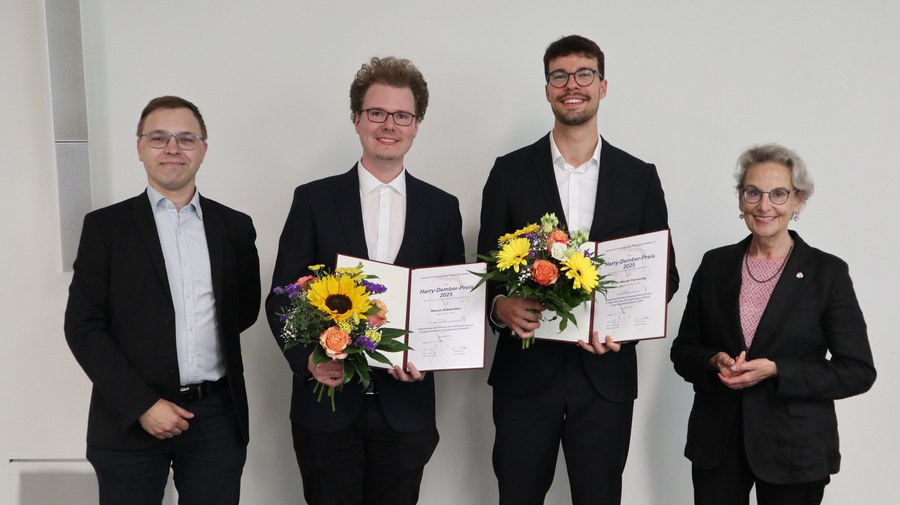
Moritz Flemming received the award for his master’s thesis, “Exploring structure-property relationships in high-viscosity printable organic mixed ionic-electric conductor gels.” In it, he investigated organic electrochemical transistors that are particularly well-suited as interfaces between electronic and biological systems. By developing novel electrolytes and using flexible fabrication methods such as screen printing, he was able to create devices with significant capabilities.
Marius Döbberthin was honored for his state examination thesis titled “Optimization of the Thermal Deactivation of Programmable Luminescent Labels.” He developed a new method for resetting switchable luminescent labels in a targeted manner using integrated thin-film heating elements. Such systems are considered a promising technology for minimalist data exchange and intelligent labeling solutions.
The Harry Dember Prize is awarded annually to recognize particularly outstanding theses in the fields of optics, optoelectronics, photonics, and imaging scanning probe methods. The prize honors the Dresden physicist Harry Dember, who was expelled by the Nazis in 1933. The award is endowed with 1,000 euros each.
Young Talent Award for Hannah Sophie Ferenz
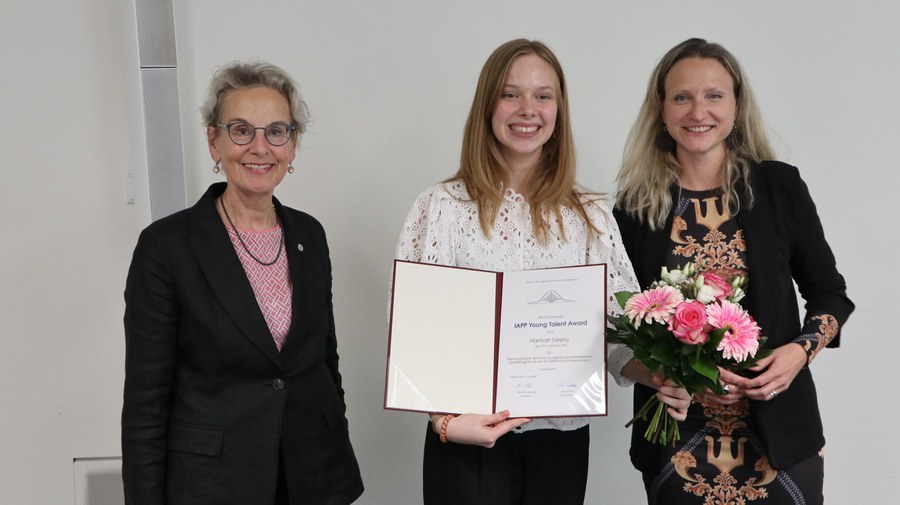
The Institute of Applied Physics (IAP) presented the Young Talent Award for the first time. The award went to Hannah Sophie Ferenz from the Landesgymnasium Sankt Afra in Meissen for her research on biodegradable electronics. At an event organized by futureSAX, she met Prof. Karl Leo, who invited her to continue her research at TU Dresden. Her work focuses on cultivating so-called cable bacteria on natural leaf structures. The goal is to use the bacteria to remove metals from soil and bind them to the leaf structures. It is particularly noteworthy that Hannah Ferenz succeeded in cultivating these demanding bacteria outside their natural environment—an important step for further research into these organisms. Hannah’s example impressively demonstrates the potential of early support for scientific talent.
Contact:
Dr. Angelika Wolf
Dresden Integrated Center for Applied Physics and Photonic
Materials (IAPP) and Institute of Applied Physics
TUD Dresden University of Technology
Phone: +49 (0351) 463 42268
Email: