
Feb 19, 2026
Fascination of Physics: DPG's largest spring conference comes to TUD - public events as special highlights
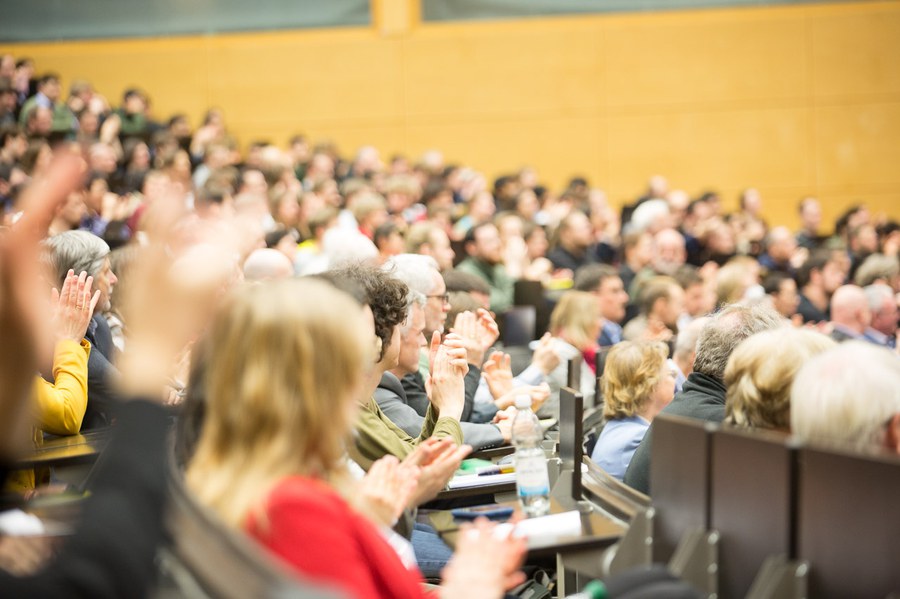
The largest spring conference of the German Physical Society (DPG) will take place at the TUD Dresden University of Technology (TUD) from March 8 to 13, 2026. Around 5,300 participants from all over the world will discuss topics ranging from solid-state physics to biophysics as well as environmental, material and quantum physics, artificial intelligence and the didactics of physics. Public events allow interested parties to experience the fascination of physical research. Teachers also have the opportunity to attend the conference free of charge.
The spring conference in Dresden is one of three major international conferences of the DPG this year and offers researchers, teachers and young scientists a broad forum for exchange and interdisciplinary discussions. With over 4,700 contributions and more than 5,300 participants, it is the largest physics conference in Europe. As the guest country, France will give participants an insight into its research landscape.
Focus on future issues
The conference will address key issues of the future with the help of physics - from sustainable energy and materials research, AI-supported materials development and data analysis to the investigation of complex urban and social systems as well as tipping points in climate and society. In addition, contributions and sessions will shed light on how teaching and learning processes and innovative teaching concepts can strengthen the action-taking capacity of learners and how scientific findings can lead to social transformation. As in previous years, teachers have the opportunity to take part in the event free of charge.
Science meets society: public events with free admission
A special highlight of the conference are the public events and lectures, which are aimed at a wider audience and promote dialog between science and society. These include the popular "Einstein Slam" and other lectures that bring the fascination of physical research to life:
Monday, March 9, 2026, 20:00 - 21:00, Audimax in the Auditorium Center
Einstein Slam "Physics in 10 minutes"
Scientists bring their research to the stage. In entertaining slams, Verena Brehm (TU Eindhoven), Eloise Lardet (Imperial College London), Kuan Meng (University of Stuttgart) and Manuel Zahn (University of Augsburg) present what they research on a daily basis - clearly and briefly. Listeners can look forward to slams on magnetism, the collective behavior of active matter, atomic sample tomography, atomic force microscopy and the biomechanics of moving joints in plants.
Tuesday, March 10, 2026, 16:00 -18:00, Audimax in the Auditorium Center
Ceremonial session with award ceremonies and keynote speech "Quantum computers as large research instruments - what can we expect and how do we develop them?"
Frank Wilhelm-Mauch (Forschungszentrum Jülich) classifies the current state of quantum computing, separates realistic perspectives from exaggerated promises and shows why quantum computers should currently be understood above all as open research instruments.
Wednesday, March 11, 2026, 19:00 - 20:00, Audimax in the Auditorium Center
Evening lecture "Gravitational wave astronomy - quo vadis?"
Michèle Heurs (Leibniz Universität Hannover) takes the audience on a journey into the universe. She explains the physical principles of interferometric gravitational wave detection and shows the technological limits of what can be measured. How can quantum noise, seismic interference and thermal effects be overcome and what role does "squeezed" light play?
Platform for young scientists and networking
A trademark of the DPG Spring Meetings is the comprehensive involvement of early-career researchers. Students and doctoral candidates have the opportunity to present their research results to an international audience of experts and to make valuable contacts with colleagues and established scientists. The book and industry exhibition as well as the Industry Day of the Industry and Business Working Group offer direct insights into the industry.
Conference website: https://dresden26.dpg-tagungen.de
About the German Physical Society
The Deutsche Physikalische Gesellschaft e. V. (DPG), whose tradition dates back to 1845, is the oldest national physics society in the world and, with more than 50,000 members, also the one with the largest membership. As a non-profit organization, it does not pursue any commercial interests. With conferences, events and publications, the DPG promotes the transfer of knowledge within the scientific community and aims to open a window to physics for all those who are curious. Special emphasis is placed on the promotion of young scientists and equal opportunities. The DPG is based in Bad Honnef on the Rhine. In Berlin, the DPG maintains its capital city representative office for networking with stakeholders from politics and society.
Contact:
Melanie Rutowski, M.A.
German Physical Society
Communications
Phone +49 (2224) 9232-82