
23.06.2026
Millionenförderung von der EU – ERC Advanced Grants für Prof. Stephan Grill und Prof. Anton Wallner
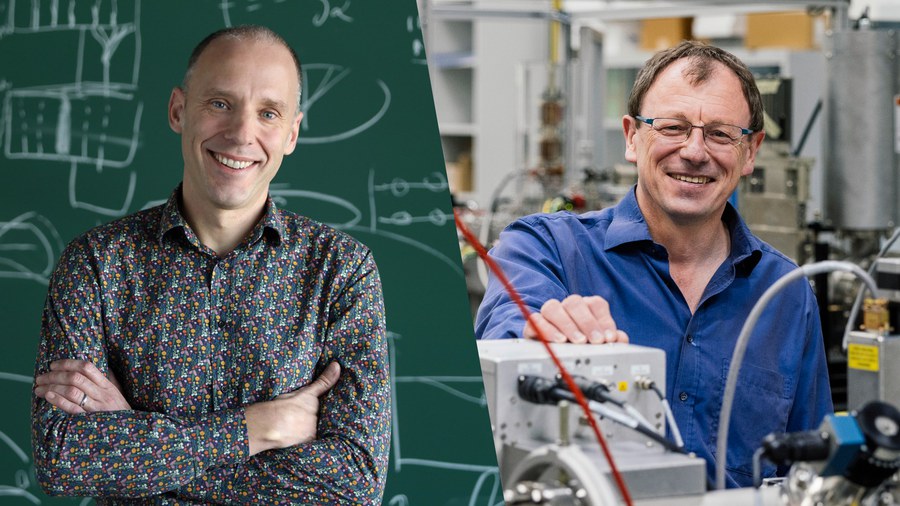
Der Europäische Forschungsrat (ERC) fördert die Besten der Besten in Europa in allen Bereichen der Wissenschaft. Die Förderlinie „Advanced Grants“ richtet sich gezielt an etablierte Spitzenforschende mit einer herausragenden Leistungsbilanz, die mit ihrer Arbeit neue, bahnbrechende Wege gehen wollen. Damit gehört dieser Grant zu den renommiertesten Forschungspreisen der Europäischen Union. Die Auszeichnung ist mit einer Förderung von jeweils bis zu 2,5 Millionen Euro über eine Laufzeit von fünf Jahren dotiert.
In der jüngsten Auswahlrunde des ERC haben sich auch zwei mit der Technischen Universität Dresden (TUD) verbundene Wissenschaftler mit ihren wegweisenden Projekten durchgesetzt: Prof. Stephan Grill vom Max-Planck-Institut für molekulare Zellbiologie und Genetik in Dresden und Prof. Anton Wallner vom Helmholtz-Zentrum Dresden-Rossendorf. „Die ERC Advanced Grants für Prof. Stephan Grill und Prof. Anton Wallner sind eine großartige Anerkennung ihrer Leistungen, die Prof. Grill seit vielen Jahren u.a. in das Excellence Cluster ‚Physics of Life‘ eingebracht hat und Prof. Wallner in die Beschleuniger-Massenspektrometrie und Isotopenforschung. Als Prorektorin Forschung und Technologietransfer der TU Dresden gratuliere ich zu diesem großen Erfolg“, sagt Prof. Angela Rösen-Wolff.
Auch Sachsen Wissenschaftsminister Sebastian Gemkow gratuliert: „Herzlichen Glückwunsch an die Preisträger zu diesem großartigen Erfolg! Es ist eine enorme Leistung, eine der anspruchsvollsten Forschungsförderungen der EU einzuwerben. Diese Auszeichnung ist nicht nur ein Meilenstein für die persönliche wissenschaftliche Karriere, sondern auch ein bedeutender Gewinn für den Forschungsstandort Sachsen.“
Zu den Projekten:
- Prof. Stephan Grill vom Max-Planck-Institut für molekulare Zellbiologie und Genetik erhält die Förderung für seine Forschung im Rahmen des ERC-Projekts „DNA Sequence-Dependent Structure Formation in the Cell Nucleus.“ Dieses Projekt verbindet Biologie und Physik sowie Theorie und Experiment und verfolgt das Ziel, eine physikalische Theorie der Genomorganisation über verschiedene Skalen hinweg zu entwickeln. Damit lassen sich Erkenntnisse darüber gewinnen, wie DNA-Sequenzen die Strukturbildungsprozesse im Zellkern steuern, was weitreichende Auswirkungen auf Entwicklung und Krankheitsentstehung hat.
- Mit dem Vorhaben SUPREME (Supernova and r-process radionuclides engraved on million-years old archives from Earth and Moon) untersuchen Prof. Anton Wallner und sein Team vom Helmholtz-Zentrum Dresden-Rossendorf, wie in kosmischen Explosionen, zum Beispiel in Supernovae oder Neutronensternverschmelzungen, schwere Elemente gebildet werden und ob derartige Ereignisse Auswirkungen auf das Erdklima und die Biosphäre hatten. Mithilfe einer neuartigen Variante der Beschleuniger-Massenspektrometrie werden am HZDR in Mondproben der NASA, in Proben vom Tiefseeboden und in Eisbohrkernen einzelne Atome nachgewiesen, die von diesen interstellaren Ereignissen der letzten 500 Millionen Jahre stammen.
Hintergrund:
Der Europäische Forschungsrat (European Research Council, ERC) ist Teil des Schwerpunkts „Wissenschaftliche Exzellenz“ des EU-Rahmenprogramms für Forschung und Innovation Horizont Europa. Ziel ist die Förderung von Einzelforschenden mit bahnbrechenden Ideen. Der ERC bietet dazu verschiedene Förderlinien für unterschiedliche Karrierestufen an – von den „Starting Grants“ für Nachwuchsforschende bis hin zu den „Advanced Grants“ für erfahrene Pioniere der Wissenschaft. Darüber hinaus fördert der ERC exzellente Nachwuchsforschungsgruppen und Maßnahmen, um ERC-Projektideen in Innovationen zu überführen.
https://www.eubuero.de/de/nks-erc-advanced-grants-2450.html
Kontakte für Medien:
Max Planck Institute of
Molecular Cell Biology and Genetics
Katrin Boes
Public Relations Office
E-Mail
Tel.: +49 351 210 2080
www.mpi-cbg.de
Helmholtz-Zentrum Dresden-Rossendorf
Abteilung Kommunikation und Medien am HZDR
Simon Schmitt | Leitung und Pressesprecher
Tel.: +49 351 260 3400
E-Mail: