
Sep 29, 2026
New method enables tailor-made organic 2D materials
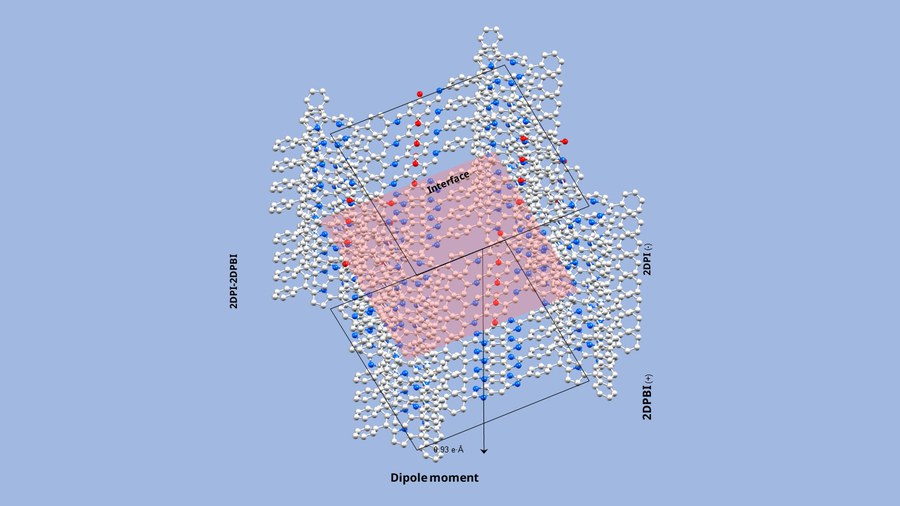
Design and Synthesis of Lattice-Matched 2D Polymer vdW Heterostructures with Sharp Interfaces
An international research team has developed a method that allows two-dimensional organic materials to be specifically combined to form novel layered systems. The research, published in the renowned journal ‘Nature’, opens up new prospects for quantum electronics, sensor technology and novel electronic components.
Two-dimensional materials consist of extremely thin layers, some of which are only a few atoms or molecules thick. When these different layers are combined, new electronic and optical properties can arise at their interfaces. These so-called van der Waals heterostructures therefore offer interesting possibilities for the development of new electronic and optoelectronic components.
Whilst such layered systems can already be produced in a controlled manner using inorganic 2D materials, applying the same principle to organic materials has so far proved difficult. This is because organic layers are held together only by comparatively weak interactions. As a result, it has hitherto been virtually impossible to align the individual layers precisely and to design their interfaces in a controlled manner.
A research team led by Prof. Thomas Heine and Prof. Stefan Mannsfeld from TU Dresden, together with Prof. Xinliang Feng from the Max Planck Institute for Microstructure Physics in Halle, has now developed a solution to this problem in collaboration with international partners. In this synthesis method, polymerisation takes place on the water surface for each individual layer of the organic 2D crystals. This allows different layers to be deposited sequentially. Intermolecular interactions control the relative orientation of the polymers parallel to the water surface.
Using five different 2D polymers, the researchers were able to produce ten different heterostructures. Heterostructures are possible even with differences in lattice constant ranging from 0 to 18 per cent. This so-called lattice mismatch is crucial for the properties of the interface. If the lattices fit together well, particularly well-defined interfaces are formed. In the case of larger deviations, however, characteristic patterns, the so-called moiré patterns, may form, or the materials may deform to relieve stress.
Precise control of these interfaces has a direct impact on the electronic properties of the materials. Experiments and theoretical studies show that electrical charges can be selectively separated at the interfaces, thereby generating electric fields. This enables the researchers to influence how electrons are transported through the layered system. This is particularly evident in the transport of current through the interface of the heterostructure: when the lattices are perfectly aligned, the current is 10 million times greater than when the lattices do not match.
“Here, for the first time, we demonstrate that individual layers of organic 2D crystals, that is, atomically thin, periodically arranged polymers, can be stacked in a controlled manner. When stacked ideally, these polymers couple chemically and electronically, thereby enabling the targeted development of novel materials, such as optically active materials for photocatalysis or miniaturised solar cells. As the perfectly stacked materials are porous and therefore permeable to ions and molecules, they could also be suitable for selective ion-exchange membranes,” explains Thomas Heine, Professor of Theoretical Chemistry at TU Dresden.
For more information, see the first author's article.
The research was funded by the ERC Synergy Grant “2DPolyMembrane”, the German Research Foundation (DFG) through the REC² Cluster of Excellence, the Collaborative Research Centre SFB 1415, and the Research Training Group GRK 2861.
Original publication:
Prasoon, A., Nguyen, N. N., Hambsch, M., Singhvi, P., Terres, S., Xiao, Z., Goyal, N., Qi, H., Mücke, D., Auras, F., Wang, Z., Chung, S., Položij, M., Wang, H. I., Cho, K., Kaiser, U., Chernikov, A., Bonn, M., Mannsfeld, S. C. B., Heine, T. & Feng, X. Organic two-dimensional van der Waals heterostructures. Nature (2026). https://doi.org/10.1038/s41586-026-11074-6
Contact:
Prof Dr Thomas Heine
TUD Dresden University of Technology
Chair of Theoretical Chemistry
Tel.: +49 351 463-37637
E-Mail: