
23.03.2026
Unterstützung des psychischen Wohlbefindens bei Paaren: Studie untersucht Stressübertragung und Trainingswirkung

Psychische Erkrankungen gehören in Europa zu den häufigsten Gesundheitsproblemen: Mehr als jeder dritte Mensch ist im Laufe eines Jahres betroffen. Neben dem individuellen Leid gehen damit erhebliche soziale und ökonomische Belastungen einher. Ein zentraler Faktor in Entstehung und Verlauf affektiver Störungen – insbesondere depressiver Erkrankungen – ist Stress. Allerdings entsteht Stress nicht nur „im Individuum“, sondern ist häufig in soziale Kontexte eingebettet. Partnerschaften spielen hierbei eine besondere Rolle: Sie können Belastungen abpuffern, aber auch dazu beitragen, dass sich Stress und negative Stimmung zwischen Partnern übertragen.
Vor diesem Hintergrund sucht ein Forschungsprojekt Paare für die Teilnahme an einer Studie, die zwei Ziele verfolgt: (1) die Untersuchung, wie Stressereignisse innerhalb von Partnerschaften weiterwirken („Stressübertragung“), und (2) die Prüfung, ob sich psychisches Wohlbefinden und Stressresilienz durch zwei unterschiedliche Trainingsansätze gezielt unterstützen lassen.
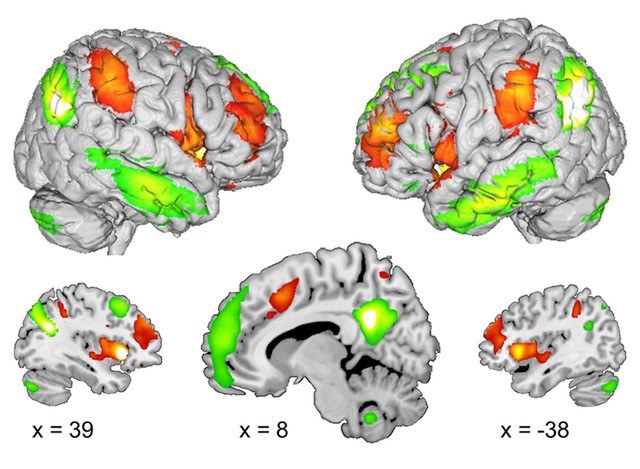
Hirnregionen die mit Empathie assoziiert sind in rot und mit Perspektivenübernahme in grün.
„In Vorstudien haben wir Trainings entwickelt, die auf eine Verbesserung des sozialen Miteinanders und eine Reduzierung von Stress in sozialen Beziehungen abzielen. Diese zeigen bei Menschen ohne eine psychische Erkrankung gute Effekte. Nun haben wir diese Trainings angepasst für Menschen mit Depression und ihre Partner“, erläutert Philipp Kanske, Professor für Klinische Psychologie und Behaviorale Neurowissenschaft an der Technischen Universität Dresden. Die Studie ist ein Kooperationsprojekt mit Professorin Nina Alexander von der Universität Marburg und Dr. Elisabeth Leehr von der Universität Münster.
Ablauf der Studie:
Im Rahmen einer Laborerhebung nehmen Paare gemeinsam teil, um das Stresserleben innerhalb der Partnerschaft zu erfassen. Ergänzend dazu werden neuronale Prozesse analysiert, während die Teilnehmenden Berichte anderer Menschen anhören. Daran schließt sich ein achtwöchiges Online-Training an, bei dem – je nach Studienbedingung – entweder beide Partner oder nur eine Person teilnimmt. Ziel des Trainings ist es, die Stressresilienz zu stärken sowie mentale Gesundheit und soziale Kompetenzen zu fördern, etwa durch die Reduktion von Stress, eine gesteigerte Klarheit, höhere Lebenszufriedenheit und eine verbesserte Perspektivübernahme.
Wer kann teilnehmen? (Einschlusskriterien)
Gesucht werden Paare im Alter von 18 bis 56 Jahren, und zwar
- Paare, bei denen ein Partner bereits an einer Depression erkrankt war, sowie
- Paare, bei denen bisher kein Partner depressiv erkrankt war.
Interesse / Kontakt (unverbindlich):
Wenn Sie sich für eine Teilnahme interessieren oder zunächst Fragen klären möchten können Sie hier können Sie ein Online-Screening ausfüllen und einen Termin für ein kurzes Telefongespräch vereinbaren: https://tud.link/gt5h44. Oder Sie schreiben uns eine E-Mail an
Das Projekt ist Teil einer weltweit einzigartigen, groß angelegten Studie zur Untersuchung des Krankheitsverlaufs affektiver Erkrankungen (SFB-TRR393) und wird durch die Universitäten Marburg, Dresden und Münster durchgeführt. Informationen zu diesem Verbundprojekt finden Sie hier: https://www.uni-marburg.de/de/trr-393
Kontakt:
Prof. Philipp Kanske
Klinische Psychologie und Behaviorale Neurowissenschaft
TU Dresden
E-mail:
Tel. +49 351 463-42225