
Nov 25, 2026
New Paper By Michael Höfler: Statistical Tests Should Inform Behaviour in Theory and Practice
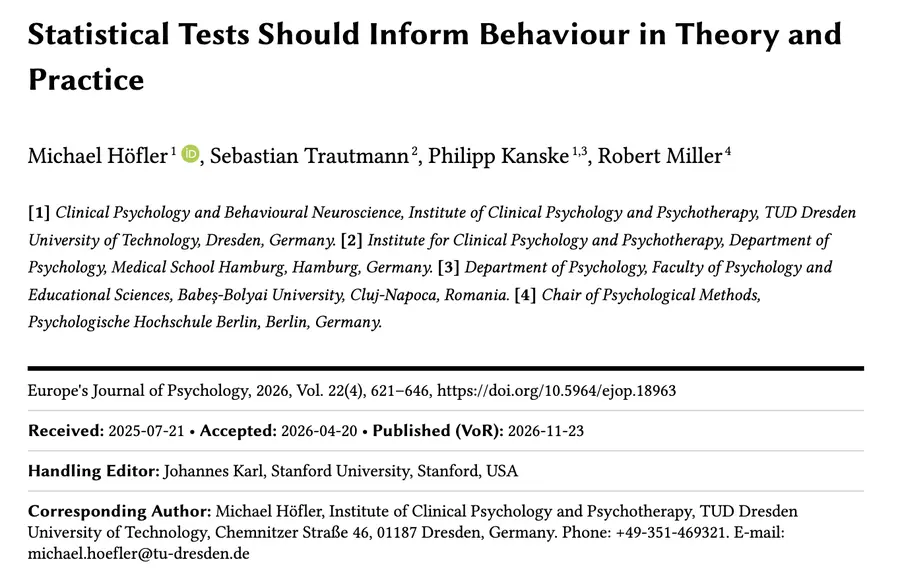
We congratulate Michael Höfler on a new publication in Europe's Journal of Psychology!
In his paper, they argue that statistical tests must always balance two types of errors. Detecting an effect that does not exist (α error) or failing to detect a real effect (β error). To set the α/β ratio in an informed way, one must consider the costs of both errors. Michael Höfler and colleagues examine this balance separately for six different decision-making questions in psychological research for which statistical tests are used: (1) Should a hypothesis be considered tentatively accepted? (2) Should a model or theory cover a newly proposed effect? (3) Should a new hypothesis be proposed? (4) Should a new intervention be introduced? (5) Are the psychometric properties of an instrument sufficient to use it? (6) Are the assumptions of a statistical method met so that it may be used?
They conclude that scientific parsimony (α < β) often has advantages in terms of fewer, larger, and more robust effects. However, this general recommendation may be overridden in cases where other cost considerations apply — for example, when deciding whether to add a promising supplementary component with few expected side effects to an established intervention.
Höfler, M., Trautmann, S., Kanske, P., & Miller, R. (2026). Statistical Tests Should Inform Behaviour in Theory and Practice. Europe’s Journal of Psychology, 22(4), Article e18963. https://doi.org/10.5964/ejop.18963