
Sep 11, 2026
Boysen-TUD Graduate Students at the 19th IAEE European Conference in Munich
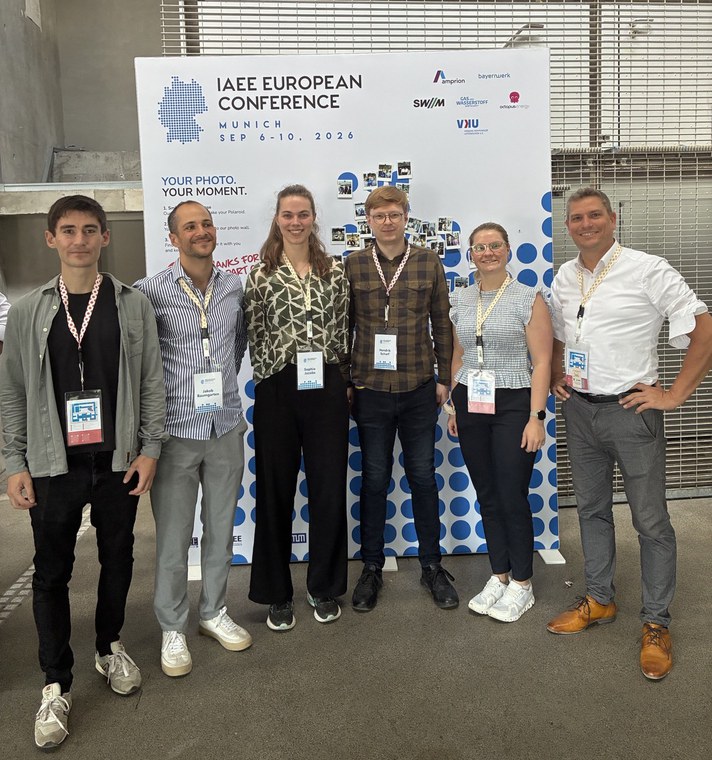
J. Baumgarten (2. v.l.) und S. Jacobs (3. v.l.) sowie weitere Wiss. Mitarbeiter:innen von Prof. Möst
From September 6 to 10, 2026, the 19th Conference of the International Association for Energy Economics (IAEE) took place in Munich, hosted on the campus of the Technical University of Munich. Under the theme “Energy Security, Sustainability & Affordability – Rebalancing the Trilemma,” the international conference brought together leading experts in energy economics to discuss one of the most pressing challenges of our time: How can energy systems rebalance security of supply, sustainability, and affordability?
Against the backdrop of increasing complexity and the pressure to transform energy systems worldwide, the conference provided a timely platform for critical reflection, interdisciplinary dialogue, and forward-looking approaches to solutions. A key focus was on how regulatory and market-based approaches can contribute to a resilient, equitable, and climate-friendly energy future.
Two doctoral researchers from the Boysen-TU Dresden Graduate School participated in the conference.
Jakob Baumgarten presented his research in a talk entitled “GIS-Based Multi-Criteria Assessment of PV-Driven Green Hydrogen Sites in the MENA Region.” He presented a GIS-based, multi-criteria approach for assessing suitable locations for photovoltaic-based green hydrogen production in the MENA region. The aim is to identify, from a large number of potential sites, those offering the greatest potential for competitive PV-based hydrogen production while taking technical, economic, and institutional constraints into account.
After excluding a total of 27% of land area as unavailable, spatial and water-related criteria were combined with economic factors (LCOH) and investment risk indices at both macro and micro levels. The criteria were normalized and evaluated, while sensitivity scenarios complemented the baseline scenario to test the robustness of the results under different stakeholder priorities. The weighting of the individual criteria was based on the Analytic Hierarchy Process (AHP). The results were validated against existing and planned PV projects documented in the Global Solar Power Tracker. The presentation generated considerable interest among the conference audience.
Sophie Jacobs also contributed to the development of the presentation “Electricity Prices under Alternative System Flexibility Scenarios: A Case Study of Small-Scale Biogas Plant Profitability in Germany.” The contribution focuses on modelling future electricity markets. Based on five scenarios reflecting different assumptions regarding the electrification of individual sectors and their use of hydrogen, the resulting electricity price trajectories were derived and subsequently applied to three use cases for biogas plants. The central question was the future economic viability of flexible electricity generation from biogas in Germany under changing system conditions.
The conference featured an extensive programme of keynote speeches, panels, plenary sessions, and presentations, bringing together professors, industry practitioners, and international experts from across the energy sector.
Beyond the formal sessions, the breaks also provided valuable opportunities for professional and academic exchange and for international networking across the boundaries of academia, industry, and policymaking. The social programme was equally engaging: at the gala dinner, participants were offered an enjoyable glimpse into Bavarian culture and the opportunity to round off an intensive conference day in a convivial atmosphere.