
Sep 25, 2026
Sharing Responsibility, Steering Together: Impressions from the ICSEI Conference in Dortmund
How can collective governance be organized when responsibility is shared among multiple stakeholders? This question was the focus of the international conference “Reframing Leadership for School Improvement: Roles, Relationships, and Responsibilities in a Demanding World,” which took place on September 10 and 11, 2026, at TU Dortmund as part of the International Congress for School Effectiveness and Improvement (ICSEI).
As the scientific coordinator of the Boysen-TU Dresden-Research Training Group,
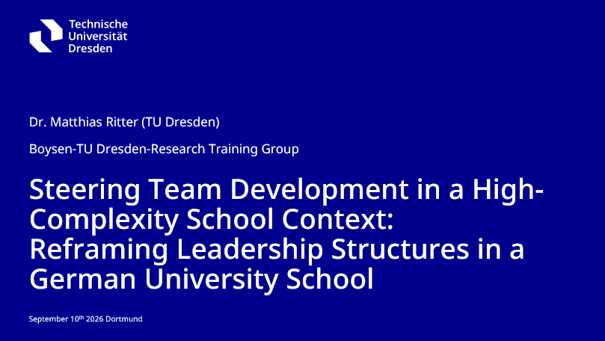
Dr. Matthias Ritter attended the conference and presented findings from his research on school development and the organization of school governance at the Dresden University School. The study examines a central school governance group and investigates which issues it addresses over the course of a school year, how these are handled collectively or through a division of labor, and how the group’s working methods and organizational structure change in the process.
The Dresden University School offers a unique case study for this purpose: As a growing experimental school, it combines the development of an innovative pedagogical and organizational concept with the day-to-day demands of school operations. Accordingly, the range of topics addressed by the steering group under study is broad—from issues of school organization and learning formats to staff and students, and on to communication, cooperation, and school development.
The analysis shows that the distribution of responsibility does not automatically mean that governance becomes less collective. Over the course of the school year under study, the group increasingly developed different ways of working: information is shared, certain issues are discussed collectively, and other tasks are delegated to smaller working groups. At the same time, the group’s own working methods repeatedly became the subject of discussion. The steering group thus organizes not only school development but also the conditions under which collaborative governance can take place at all.
Dr. Ritter also moderated the entire paper session titled “Distributed and Collaborative Leadership in School Development: Potentials and Limits.” In addition to his presentation, two other studies were presented: a study from Germany on the relationship between leadership practices of school administration teams and teachers’ professional engagement in the context of digital school development, as well as a study from Morocco on the limits of distributed leadership within the framework of an integrated school project. The different contexts provided starting points for a discussion on how shared responsibility and collective governance are structured under various organizational conditions.

The building housing the Faculty of Education, Psychology and Educational Research at TU Dortmund University, where the conference took place.
The question of the connection between personal responsibility, shared responsibility, and joint coordination extends beyond the school context. Within the Boysen-TU Dresden-Research Training Group, doctoral students, principal investigators, the spokesman, the executive board, and the coordination team work toward common research goals, each with different roles and responsibilities. Here, too, it is essential to combine responsibilities, facilitate coordination, and at the same time support independent research work.
The conference in Dortmund thus not only offered insights into international research on leadership and school development but also provided an opportunity to examine the question of organizing joint governance under conditions of distributed responsibility from various organizational perspectives.