
Oct 26, 2026
Research Exchange at the 58th Power Plant Technology Colloquium 2026
On October 6 and 7, 2026, the 58th Power Plant Technology Colloquium 2026 (KWTK) took place at the Dresden International Congress Center. Organized by the Chair of Energy Process Engineering at TU Dresden, this annual conference brings together approximately 1,000 participants from industry and research to discuss current developments in energy and power plant technology. The program combines technical presentations with discussions and an accompanying trade exhibition.
This year’s colloquium addressed a broad spectrum of topics related to the transformation of energy systems and the technological challenges of future electricity generation. Key topics included the integration of renewable energy sources, energy storage technologies, the flexibility and reliability of conventional power plants, and the development of modern power generation systems. Further discussions focused on carbon dioxide capture and storage (CCS), emission reduction technologies, process simulation, digitalization, and innovative approaches to plant operation and maintenance.
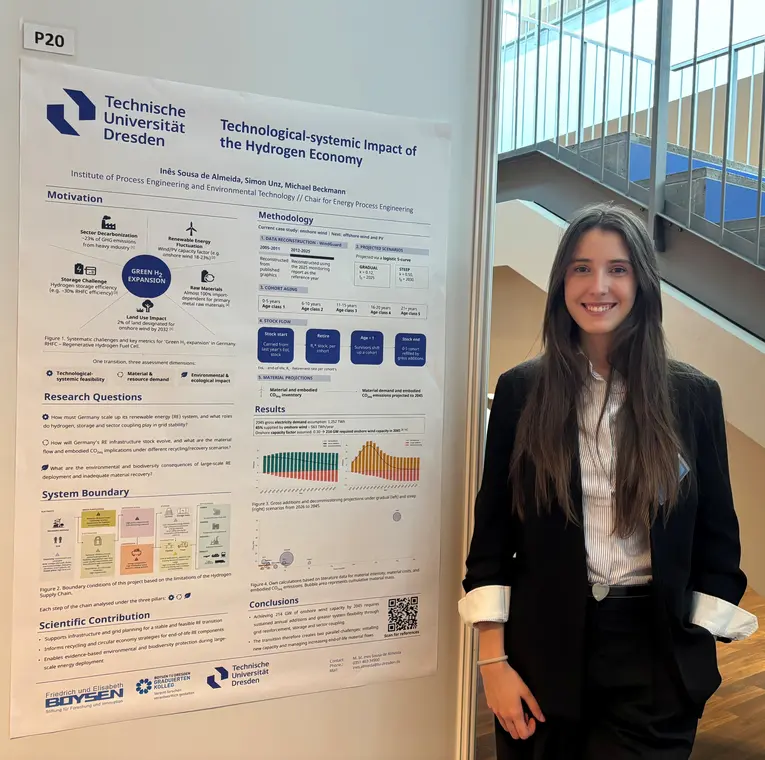
Inês Sousa de Almeida with her poster for the 58th KWTK 2026 in Dresden.
Among the participants was Inês Sousa de Almeida, a doctoral student in the Boysen-TU Dresden-Research Training Group (subproject F1: “Technological and Systemic Impacts of the Hydrogen Economy”) and at the Chair of Energy Process Engineering at TU Dresden. As a member of the Chair’s organizing team, she was also involved in organizing the event. Ms Almeida presented her ongoing research on the technological and systemic impacts of the hydrogen economy in a poster of the same name, which she had authored together with her advisors, Prof. Michael Beckmann and Dr. Simon Unz. In addition, a paper titled “Stock-Flow Modeling of the German Onshore Wind Energy System: Decommissioning Dynamics and Impacts on Material Flows” was published in the conference proceedings. The study examines the technological, material, and environmental impacts of expanding renewable energy infrastructure in Germany, with a particular focus on onshore wind energy. By modeling various expansion and decommissioning scenarios through the year 2045, the study examines future infrastructure development, material requirements, and the associated CO₂-equivalent emissions. The results underscore the need to address both the expansion of renewable energy capacity and the growing challenges in the areas of resource management, recycling, and end-of-life infrastructure.
The 58th KWTK 2026 provided an opportunity for a lively exchange of ideas with researchers and industry experts, as well as for the presentation of research findings on the technological and environmental dimensions of the energy transition.
Further information:
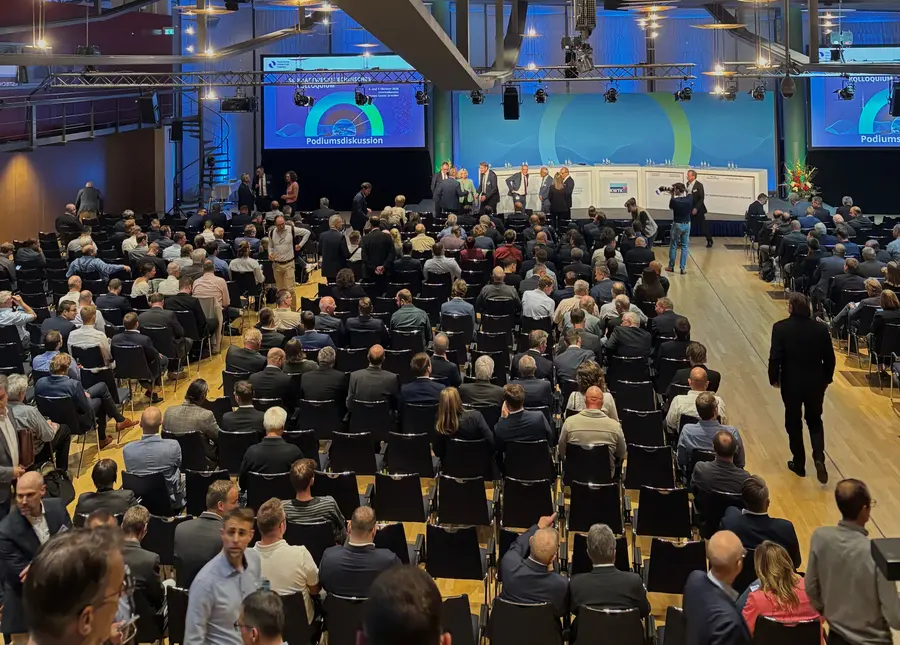
A view inside the conference hall at the 58th KWTK.