
Jul 24, 2026
Doctoral researchers present their research at IFORS 2026 in Vienna
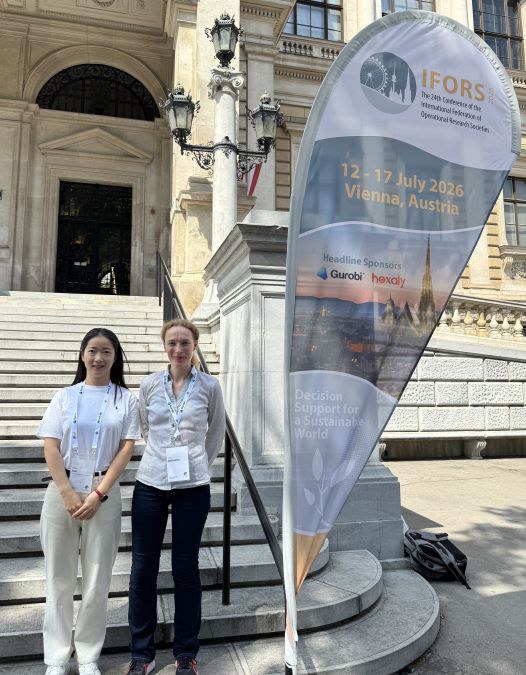
From July 12 to 17, 2026, the 24th Conference of the International Federation of Operational Research Societies (IFORS) took place in Vienna, Austria. Under the theme “Decision Support for a Sustainable World,” the conference brought together researchers and practitioners from the international operations research community to exchange the latest research findings and discuss how quantitative methods can help address complex economic, industrial, and societal challenges.
Representing the Boysen-TU Dresden Research Training Group, doctoral researchers Julia Erdmann (Project H1) and Shiyu Guo (Project H2) presented their latest research on the planning and operation of sustainable hydrogen systems.
The conference program featured plenary lectures, keynote speeches, tutorials, and numerous research presentations covering a broad range of operations research topics, including mathematical optimization, game theory, artificial intelligence, and sustainable energy and hydrogen systems.
Julia Erdmann presented her paper “A Multi-Stage Stochastic Model for a European Hydrogen Infrastructure: Balancing Cost and Risk.” Her research addresses uncertainties in the long-term development of hydrogen demand and technology costs, which represent some of the key challenges in planning a future European hydrogen infrastructure. By incorporating financial risk measures, her optimization model identifies robust, risk-averse investment pathways that provide protection against worst-case scenarios.
Shiyu Guo presented her research entitled “Game-Theoretic Bilevel Optimization of Investment and Operations for Green Hydrogen Supply Chains with Salt Cavern Storage.” Her work investigates how investment and operational decisions between a hydrogen producer and a salt cavern storage operator can be coordinated within a decentralized green hydrogen supply chain. Based on a one-year case study, the results demonstrate that hydrogen production can help absorb surplus renewable electricity and reduce renewable energy curtailment, while salt cavern storage provides seasonal flexibility by shifting hydrogen availability over time.
Participation in IFORS 2026 provided Julia Erdmann and Shiyu Guo with an excellent opportunity to present their research to an international audience, receive valuable feedback on their modeling approaches, and exchange ideas with researchers from around the world. At the same time, the conference offered new insights into current methodological developments in operations research and their application to sustainable hydrogen systems.