
Jul 10, 2026
Hydrogen Research in Dialogue: Cluster G Returns to Dresden Science Night 2026
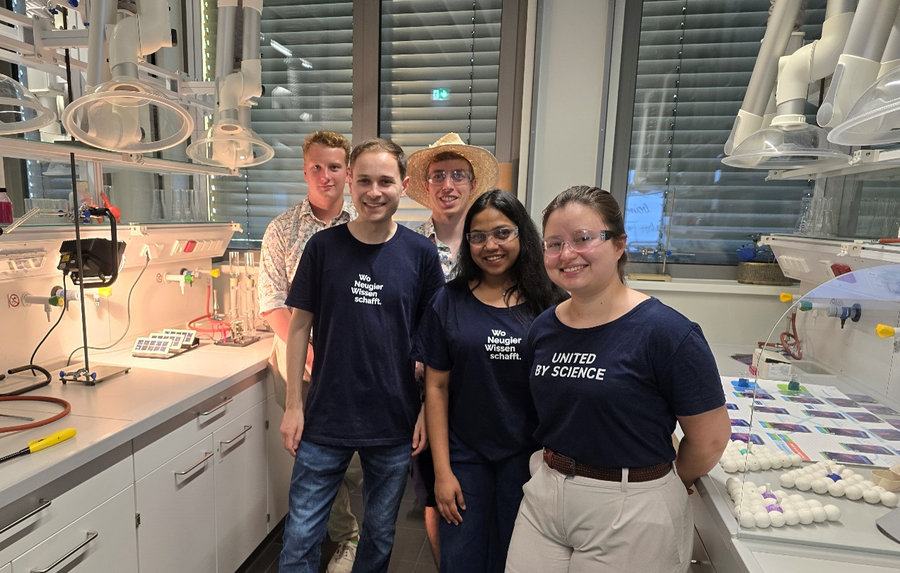
Cluster G's booth at the Dresden Science Night in the LernLaborFarbe (from left to right: Student Assistant Friedtjoff Wilkening, doctoral student Jannik Amon, Stefan Röher, Student Assistant Athira Vijay, and doctoral student Lairana Lima Duarte).
Under the motto “Where Curiosity Creates Knowledge,” Dresden Science Night took place on June 26, 2026. Despite record-high summer temperatures, numerous interested visitors took the opportunity to discover science, research, art, and culture at Dresden’s scientific institutions. Cluster G of the Boysen-TU Dresden Research Training Group also participated in the TU Dresden program for the fourth time. Doctoral students Lairana Lima Duarte (Project G1) and Jannik Amon (Project G3), together with former doctoral student Stefan Röher (formerly Project G2), presented engaging experiments and interactive games centered on the hydrogen economy and catalysis research.
For the first time, Cluster G’s booth was located at the LernLaborFarbe at Münchner Straße 1—the new home of the Faculty of Education at TU Dresden. The lab setting provided the ideal conditions to present, in addition to the activities familiar from previous years—such as the model experiment on hydrogen as an energy carrier and the board game “Journey of an Oxygen Molecule”— a new model experiment on “Green Blast Furnace Hydrogen Use for Iron Reduction.”
The experiment illustrates how hydrogen can be used as a reducing agent for iron oxides, thereby replacing carbon as a fossil fuel. The chemical reaction was immediately visible to visitors through the color change of the iron oxide and the magnetic properties of the resulting iron, clearly demonstrating the potential of climate-friendly steel production.
The wide range of hands-on activities provided numerous opportunities for discussions about the role of hydrogen in the energy transition, as well as the opportunities and challenges of the transformation toward a climate-neutral industry and energy supply. The direct exchange with visitors once again demonstrated how important events like Dresden Science Night are for communicating research in an accessible way, bringing scientific findings to the public, and strengthening the dialogue between science and society.
Through its participation, Cluster G once again contributed to knowledge transfer in line with the “Third Mission” concept of universities. The team would like to thank all visitors for their interest and the stimulating conversations. Special thanks go to the Student Assistants Friedtjoff Wilkening and Athira Vijay (see photo above) for their support in organizing the event. We would also like to thank the Faculty of Education and the LernLaborFarbe for giving us the opportunity to be part of Dresden Science Night 2026.