
Sep 22, 2026
The IBK at BauSIM 2026 in Zurich
BauSim 2026 Logo
The Institute of Building Climatology at TU Dresden was represented by three presentations. They covered topics ranging from individual building components to entire buildings and neighborhoods.
Active Facade: Renovation Without Interfering with Living Space
Simulation and Laboratory Validation of a Thermally Activated Exterior Facade (AktivDHKS)
Dirk Weiß, Katja Tribulowski – Presentation: Dirk Weiß
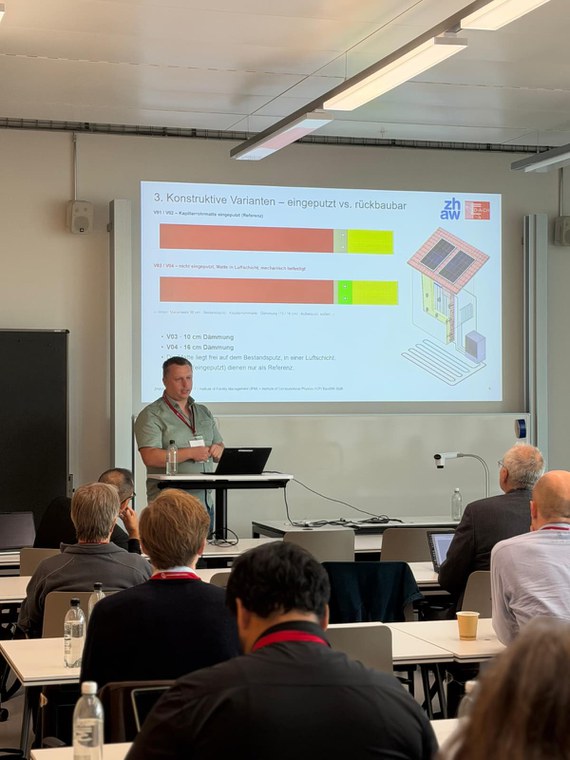
Dirk Weiß presents the design variants of the AktivDHKS
In the AktivDHKS project, capillary tube mats are installed on the exterior of existing walls and operated at very low flow temperatures of around 20 °C. The mats compensate for the wall’s heat loss, while the existing radiators remain in place. The presentation showcased a fully removable variant in which the mat is not embedded in plaster but is secured only mechanically. Measurements taken at the research test facility at TU Dresden correlate very well with the simulations in DELPHIN: The temperatures in the wall deviate by less than 0.5 K on average.
Dynamic Heating Load Instead of a Flat Rate
Methods for Determining Load Profiles at the Building Level – Approaches by WTA Working Group 12-1
Katja Tribulowski, Dirk Weiß, Justus Medgenburg, Sophie Ahnert, Volkmar Frotscher – Presentation: Katja Tribulowski
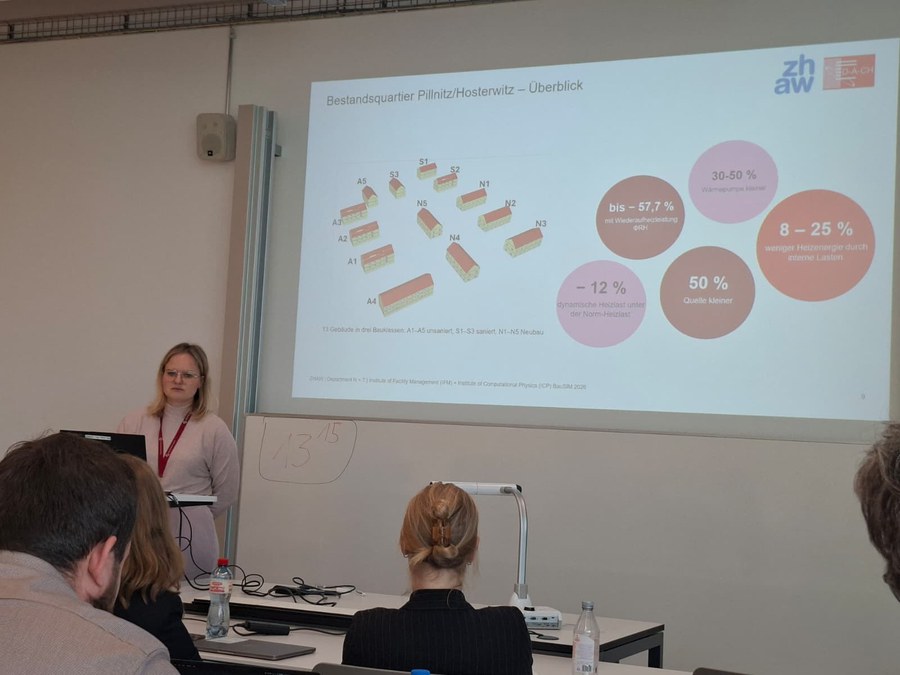
Katja Tribulowski presents the results for the Dresden-Pillnitz neighborhood
Heat pumps and other renewable heat generators are usually designed based on the standard heating load. However, the standard considers only a static extreme case and leads to oversized systems. The WTA Working Group 12-1 is therefore developing a standardized method for dynamic heating load calculation that accounts for hourly climate conditions, internal loads, and ventilation. Using the Dresden-Pillnitz neighborhood as an example, the dynamic heating load is approximately 12% below the standard heating load. If the standard’s reheating capacity is factored in, the system is oversized by up to 57.7%.
The Neighborhood as a Holistic System
FMI-Based Co-Simulation of Coupled Multi-Source Heating Networks – Methodology and Application to a Conversion Neighborhood
Stephan Hirth – Presentation: Dirk Weiß
A real-world conversion district is supplied by three heat sources: geothermal collectors, geothermal probes, and a wastewater heat exchanger. To evaluate this system, the model couples 39 submodels for buildings, the ground, hydraulics, and wastewater heat using the open-source tool MasterSim. A five-year simulation shows how the sources share the load. The heat pump achieves an annual coefficient of performance of approximately 4.4, and the probe field cools down only very slowly.
Discussion and Outlook
A Relaxing Evening by the Limmat
The conference offered ample opportunity for professional exchange, particularly regarding dynamic heating load calculation and our simulation tools DELPHIN, VICUS, and MasterSim. At the end of her presentation, Katja Tribulowski called for participation in WTA Working Group 12, “Climate Protection, Energy, and Simulation,” and several participants from Germany and Switzerland have already expressed interest.
We thank the ZHAW and IBPSA-DACH for the excellent organization and look forward to the next BauSIM.