
Constructive design

Winter Semester 2026/27
Eichenhof Niesky – Student Housing and Learning
Module No.: AD 510
Faculty: Prof. Ansgar Schulz, Prof. Benedikt Schulz, Enrico Glotz, Nina Gromoll, Lorenzo Scheibner, Paul Schmelzer
Niesky is a small town in Upper Lusatia whose history is closely tied to the industrial timber construction industry. In 1887, the company Christoph & Unmack relocated its production to Niesky and grew over the following decades to become one of Europe’s largest timber construction firms. Initially, the company manufactured transportable barracks. These consisted of prefabricated wooden panels that could be quickly assembled and disassembled. This evolved into an extensive line of prefabricated wooden buildings, ranging from single-family homes to schools and hospitals. From 1926 to 1929, Konrad Wachsmann served as the plant’s chief architect. He did not primarily design individual buildings, but rather the system of dimensional standards, components, and connections from which the houses were derived.
Education has also played a major role in Niesky since its founding by the Moravian Church in 1742. In addition to several renowned schools and boarding schools, as well as a teacher-training college, there was a mission school here that trained its graduates for service around the world.
The design assignment builds on these two traditions. On the Eichenhof site, an inner-city brownfield, a space is to be created for the students of the Niesky Timber Construction Campus that combines living and learning. The spatial program is divided into two parts. How these parts relate to one another is part of the design assignment. The first part comprises student housing with various living arrangements. The second part will feature learning and workshop areas where knowledge about wood as a building material is also taught through hands-on experience. In addition to a large learning and work hall, this includes workshops and a materials library. The two protected oak groves in the center of the property give the site its name and are part of the design. The structure will be built of wood. The construction method is to be developed based on the concept—whether solid wood, wood-frame, skeleton, or hybrid construction. The complex should be adaptable without having to be demolished; the student units should later be able to be combined into larger apartments without significantly altering the structural framework.
The guiding principle of the assignment is Building Type E, where the “E” stands for “simple” and “experimental.” This approach stems from an initiative by the state bars of architecture and asks what standards a building actually needs. The mandatory requirements for structural stability, fire safety, health, and environmental protection remain unaffected. By contrast, features, comfort, and technical equipment—to the extent they go beyond what is necessary—are up for reconsideration. Each requirement must therefore be evaluated for its necessity. These are to be replaced by simple, robust, and resource-efficient solutions that derive their quality from construction, space, and materials. Where standards are not applied, this must be justified in the design.
Introduction and Site Visit: October 8, 2026
Registration: via Selma
Summer Semester 2026
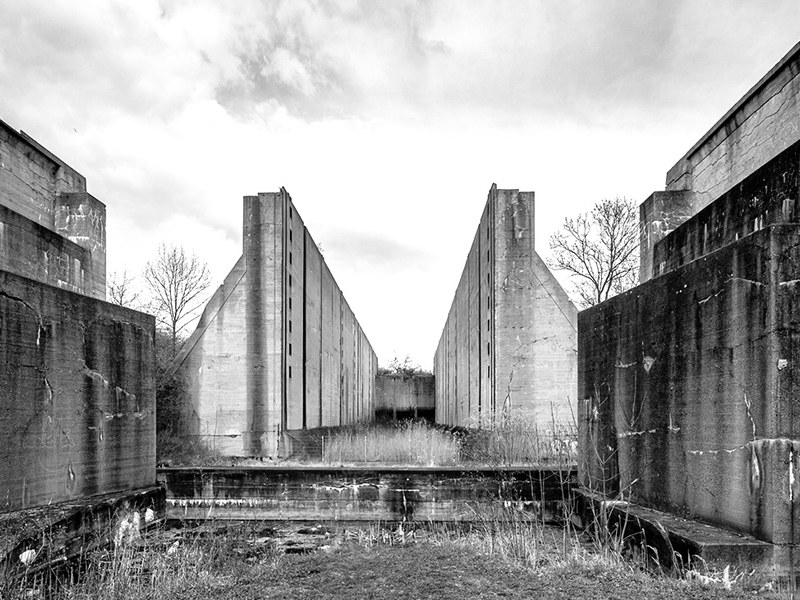
Wüsteneutzsch Lock Staircase
Bike Station and Outdoor Camp
Module No.: AD 510 Instructors: Prof. Ansgar Schulz, Prof. Benedikt Schulz, Sofia Ceylan, Enrico Glotz, Nina Gromoll, Paul Schmelzer
The most significant civil engineering structure of both the Saale-Elster Canal and the entire southern wing of the Mittelland Canal was the planned lock staircase near Wüsteneutzsch. It consisted of two locks arranged one behind the other, which together were intended to overcome a height difference of approximately 22 meters.
The existing ruin is a relic of a time when rivers served as central transportation arteries. Historical shipping, particularly by the so-called “1,000-metric-ton boatmen,” was characterized by the efficient and comparatively resource-conserving transport of large volumes of goods. Movement took place in harmony with the landscape and its natural conditions. Speed played a secondary role; what mattered most was reliable and energy-efficient transportation. With the shift of freight traffic to the road, this balance has fundamentally changed. Today, the truck stands for maximum flexibility and speed, but also for significantly higher energy consumption and an increasing strain on the environment and infrastructure. The original logic of slow, landscape-oriented movement has largely been lost.
The bicycle connects in a surprising way to this original form of travel. It represents a new, conscious form of mobility that is once again more closely oriented toward the landscape and requires minimal energy. Unlike historical shipping, however, the bicycle serves not primarily as a means of transport, but rather for the individual experience of space, distance, and surroundings.
The goal of the assignment is to engage with a historic infrastructure object and transform it into a contemporary context of use. The existing lock staircase is to be preserved as an identity-defining structure, revitalized, and spatially redeveloped.
At the heart of the design is the integration of a covered outdoor swimming pool within the ruins. This establishes a direct connection to the element of water and allows visitors to experience the site’s original function through the senses. The existing towers and walls are to be repurposed as climbing structures and integrated into the overall concept.
In addition, a functional building is to be developed that includes dining facilities, a reception area, service areas, and a conference room. Furthermore, a diverse range of lodging options is to be provided for individual travelers, families, and groups such as school classes. The complex will be connected to bicycle tourism and integrated as a stop into a broader network of sustainable mobility.
The outdoor space should be designed to link the various uses and enhance the spatial impact of the historic site.
The goal is to develop a place that transcends its functional purpose and serves as a space for experience. The former transportation infrastructure will be transformed into a hub for mindful travel.
Registration: via Selma