
Bemessungsmodell für gegen Impakt verstärkte Platten
Inhaltsverzeichnis
Projektdaten
| Titel | Title Promotionsprojekt A5/III: Bemessungsmodell für Entwurf, Konstruktion und Berechnung von gegen Impakt verstärkten Platten als Teilprojekt des GRK 2250 | Doctoral projekt A5/III: Engineering model for calculation, design and construction of RC slabs strengthened against impact loading as part of the RTG 2250 Förderer | Funding Deutsche Forschungsgemeinschaft (DFG) / GRK 2250 Zeitraum | Period 05/2023 – 04/2026 (3. Kohorte | 3rd cohort) Projektleiterin | Project manager apl. Prof. Dr.-Ing. Birgit Beckmann Bearbeiter | Contributor |
Bericht aus dem Jahrbuch 2024/25
Modellentwicklung für verstärkte Betonplatten
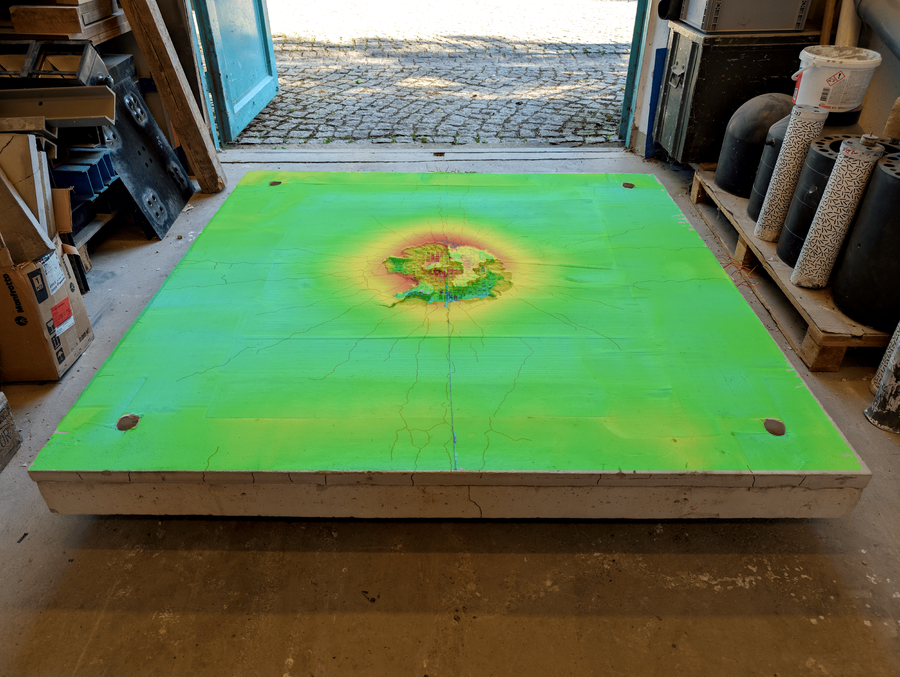
3D-Scan der Rückseite einer verstärkten Stahlbetonplatte nach einer Impaktbelastung
Bestehende Stahlbetonkonstruktionen bieten meist nur begrenzten Schutz gegen stoßartige Belastungen. Das Graduiertenkolleg (GRK) 2250 „Mineral-bonded composites for enhanced structural impact safety“ arbeitet daher intensiv an der Entwicklung von Lösungen, um das Verhalten von Bauteilen unter Impaktbelastungen zu optimieren. Im Promotionsprojekt A5 liegt der Fokus auf dünnen, rückseitig aufgebrachten Verstärkungsschichten aus mineralisch-gebundenen Kompositen, deren Wirkungsweise bereits in der ersten Kohorte des GRK untersucht wurde. Die zweite Kohorte konzentrierte sich auf eine genauere experimentelle Quantifizierung der Widerstandssteigerung, wobei auch der Einfluss der Querkraftbewehrung vertieft betrachtet wurde.
Die dritte und abschließende Kohorte widmet sich der Entwicklung eines Ingenieurmodells für die Berechnung einer rückseitigen Verstärkungsschicht und einer vorderseitigen Dämpfungsschicht für Stahlbetonplatten unter Impaktbelastung. Dafür wurden Plattenversuche durchgeführt, bei denen neuartige, in einem anderen Promotionsprojekt entwickelte Dehnungssensoren an den Carbongelegen der Verstärkungsschicht appliziert waren. Durch die alternierende Anordnung der unterschiedlich langen Sensoren konnten die lokalen Dehnungen, die durch die vertikale Bewegung des Stanzkegels entstehen, näherungsweise gemessen werden. Die globalen und lokalen Verformungen der Platte stimmten gut mit den gemessenen Deformationen überein, sobald die Dehnungen in der Textilebene sowohl rechnerisch als auch messtechnisch übereinstimmten. Die Bewehrungskonfigurationen der getesteten Platten sollen einen direkten Transfer auf verstärkte Platten mit unterschiedlicher Längsbewehrungskonfiguration ermöglichen.
Mit dem Ingenieurmodell soll auch die analytische Berücksichtigung einer oberseitig applizierten Schicht aus Infraleichtbeton mit einer Deckschicht aus SHCC (engl. strain hardening cementious composite), welche im Promotionsprojekt A6/II experimentell untersucht worden war, möglich sein. Als Opferschicht zwischen Impaktor und Stahlbetonplatte wandelt diese einen großen Anteil der Impaktenergie um und sorgt für eine verringerte Schädigung der Grundplatte.
Bericht aus dem Jahrbuch 2023
Verstärkung auf beiden Seiten
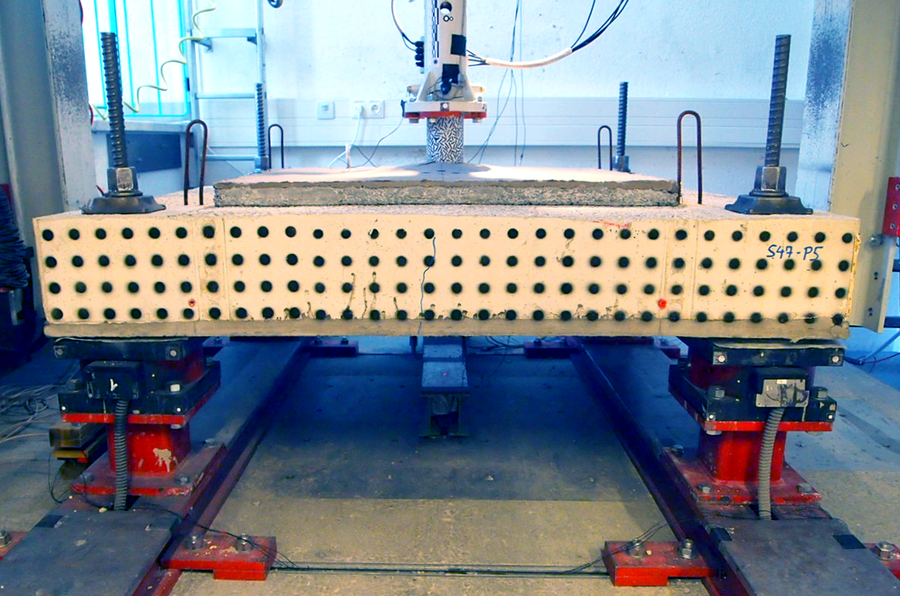
Impaktversuch auf Platte mit Dämpfungssystem an der Oberseite und rückseitiger Verstärkungsschicht
In der Regel weisen bestehende Konstruktionen aus Stahlbeton lediglich einen begrenzten Widerstand gegenüber stoßartigen Belastungen auf. Das Graduiertenkolleg (GRK) 2250 „Mineral-bonded composites for enhanced structural impact safety” widmet sich daher intensiv der Erforschung und Optimierung des Bauteilverhaltens unter Impaktbelastungen.
In den ersten beiden Kohorten des Promotionsprojekts A5 stand die Erforschung von dünnen, rückseitig aufgetragenen Verstärkungsschichten aus mineralischen Kompositen auf Stahlbetonplatten sowohl mit als auch ohne Querkraftbewehrung im Vordergrund. In der aktuellen dritten Kohorte wird dies durch die Betrachtung einer vorderseitig applizierten mineralisch gebundenen Dämpfungsschicht ergänzt. Münden soll diese Forschung in einem Ingenieurmodell, welches das Verhalten derart verstärkter Stahlbetonplatten beschreibt.
Zum Ende der zweiten Kohorte wurde eine finale Testserie zur Zusammenführung der Forschungen mehrerer Promotionsprojekte des GRK in der Fallturmanlage des Instituts durchgeführt. Hierzu wurden sowohl Probekörper mit unterseitig appliziertem Carbonbeton (Thema in A5/I und II) oder einer oberseitig aufgebrachten Dämpfungsschicht (Thema von Projekt A6/II) als auch Platten mit einer Kombination aus beidem geprüft. Dabei zeigte sich, dass das im Projekt A6/II entwickelte mehrschichtige Dämpfungssystem effektiv die in den Probekörper eingebrachte Impaktbelastung minderte und oberseitige Abplatzungen vollständig verhinderte. Das Lösen von rückseitigen Bruchstücken konnte ebenfalls reduziert werden. In dieser Hinsicht zeigten die rückseitigen Verstärkungsschichten ihre Leistungsfähigkeit, da diese durch ihre Membranwirkung das Herauslösen von Bruchstücken vollständig verhindern konnten. Eine Kombination beider positiver Effekte führte zu einer wesentlichen Reduktion der Plattenschädigung im getesteten Geschwindigkeitsbereich und einem erfolgreichen Abschluss der Arbeiten der zweiten Kohorte.
In der dritten Kohorte wird das System der beidseitig verstärkten Platten anhand eines Dreimassenschwingers betrachtet. Dabei beschreiben die einzelnen Federn das globale Biegeverhalten, das lokale Stanzverhalten sowie die (gedämpfte) Einwirkung des Impaktors. Das Verhalten des vereinfachten dynamischen Modells soll anhand von Versuchen verifiziert und verbessert werden.